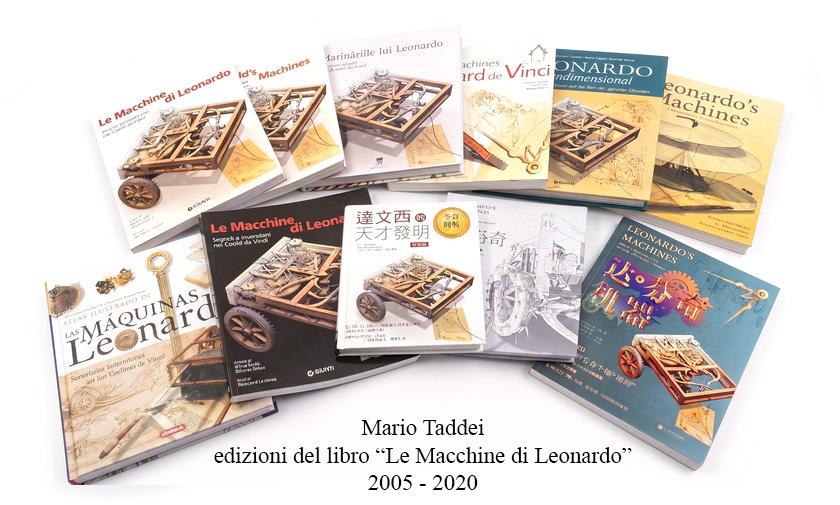
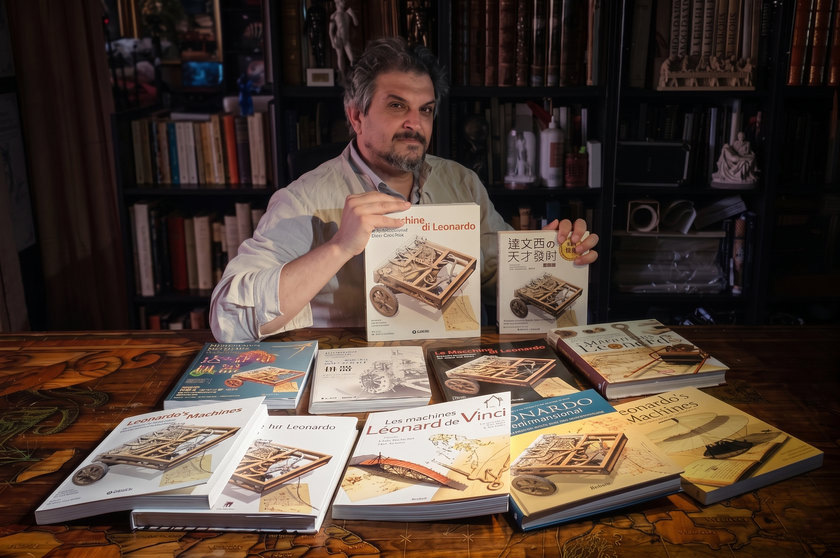
2008 – Leonardo da Vinci’s Ingenious Inventions – The story of my first book in China – 達文西的天才發明, Mario Taddei

ENGLISH
Italiano
中文


2008, 達文西的天才發明

Leonardo da Vinci’s ingenious inventions

My first book in Chinese on Leonardo’s machines

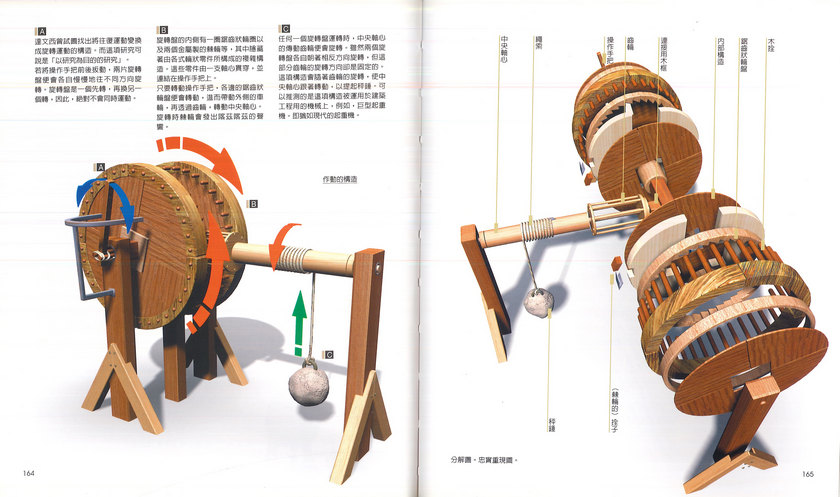
In 2008, my book on Leonardo da Vinci’s machines, 達文西的天才發明 (Leonardo da Vinci’s Ingenious Inventions), was published in Chinese. This date is very significant in my professional career, because from that moment onwards, my research on Leonardo’s machines began to circulate within the Chinese publishing world, influencing publishers, exhibition organisers, popularisers and model makers.
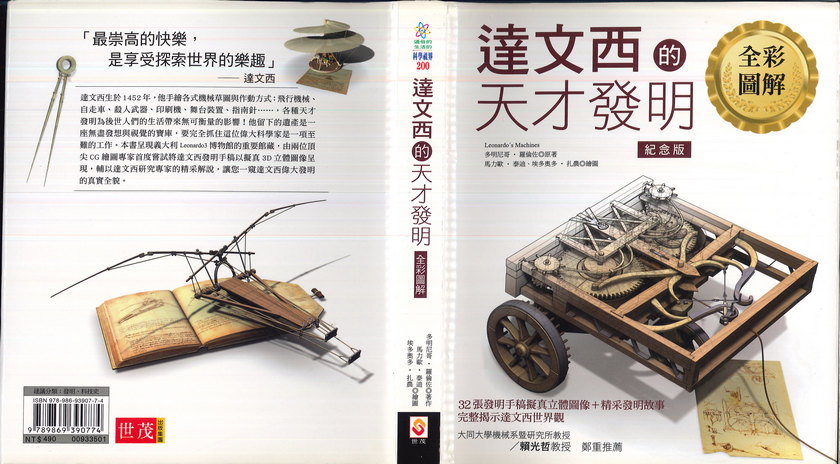
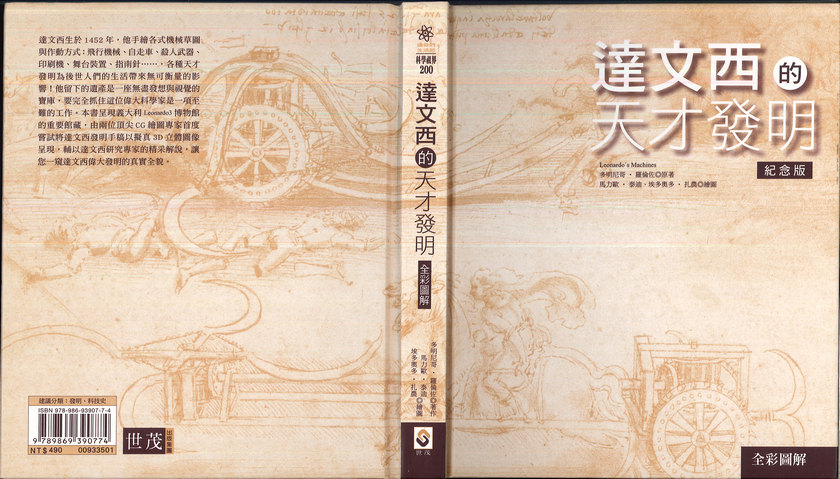
2008 Mario Taddei – Leonardo da Vinci’s Machines: Chinese Edition- 達文西的天才發明

In the years that followed, I discovered that many of my reconstructions, images and interpretations of Leonardo’s machines had been used in China in numerous exhibitions, publications, educational displays and even in the production of toys and educational models. On the one hand, I am proud that my work has contributed for so many years to the scientific and cultural dissemination of Leonardo da Vinci in China. On the other hand, I cannot ignore the fact that these works have often been copied, reproduced or used without my being contacted, without formal authorisation and without the proper payment of fees or royalties. But that is another story.
1999 Tesi Mario Taddei – Politecnico di Milano – Leonardo da Vinci 3D e il Castello sforzesco

Here, however, I want to tell the story behind this important book – a story that does not begin in 2008, but much earlier.

It all began in 1999, whilst I was working on my thesis at the Politecnico di Milano, when I started reconstructing Leonardo da Vinci’s earliest machines in 3D. We were still in the early days of 3D computer graphics, and I was using tools that seem prehistoric today, such as 3D StudioMAX for DOS. My thesis involved the three-dimensional reconstruction of part of Milan’s Castello Sforzesco and envisaged, within it, an interactive exhibition dedicated to Leonardo da Vinci, featuring screens, multimedia content and virtual reality systems capable of bringing history to life in a new, more immersive and engaging way.
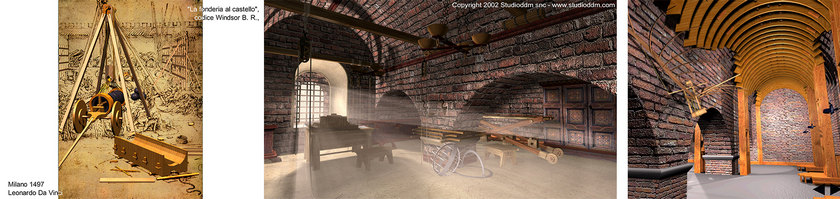
1999 Tesi Mario Taddei – Politecnico di Milano – Leonardo da Vinci 3D e il Castello sforzesco

In the years that followed, my passion for Leonardo never wavered. I continued on my own to create three-dimensional models, studies and reconstructions of his machines, whilst also trying to persuade some clients of my former company, Studio DDM, to develop projects inspired by Leonardo da Vinci. For me, it was not merely a cultural or professional interest; it was a genuine obsession with study, research and experimentation.

During that period, I invested a great deal, including financially. I used my own money to buy the first large-format books and the first reproductions of Leonardo’s codices, resources that would later prove essential for studying his manuscripts directly. I still remember the day I used practically all the money I had in my bank account to buy the editions of the Codex Atlanticus and other large-format Leonardo manuscripts, published in monumental volumes. At the time, I also asked my former business partner and then friend for financial help, but he refused, as he wasn’t interested in the subject. My passion for Leonardo was entirely my own, and it had been with me for many years by then.
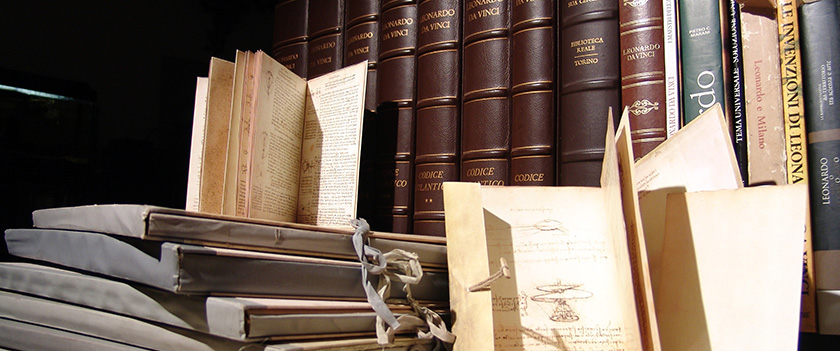
2000 Mario Taddei – I codici di Leonardo TREC e Commissione Vinciana

When I finally had those manuscripts in my hands, a whole new world opened up to me. It wasn’t just the few famous machines that everyone knew about and that were constantly on display in museums, books and exhibitions. There were hundreds of pages to study, interpret and reconstruct. There were designs, details, mechanisms and insights that no one had yet really explored systematically using 3D modelling tools.
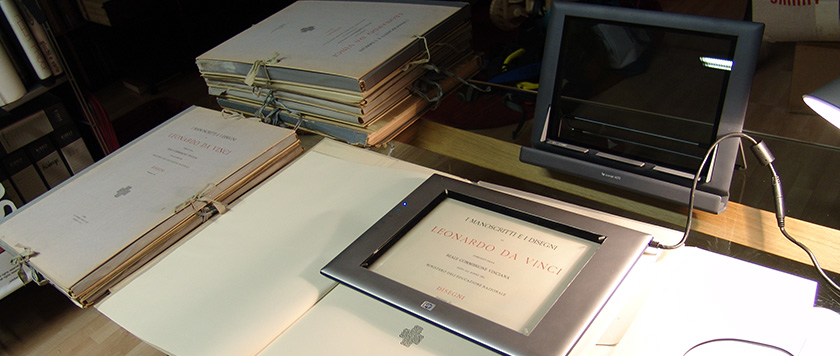
2000 Mario Taddei – I codici di Leonardo TREC e Commissione Vinciana

At the time, I was certainly fascinated by the major exhibitions on Leonardo da Vinci and also by the famous Leonardo da Vinci National Museum of Science and Technology in Milan, where models of his machines were on display. However, I was beginning to realise something important: museums almost always displayed the same machines, the same subjects, and the same interpretations that had been repeated for decades. With the manuscripts I had bought with my own money and through my own work, I realised instead that Leonardo’s technical legacy was far vaster, more mysterious and richer than what was normally shown to the public.
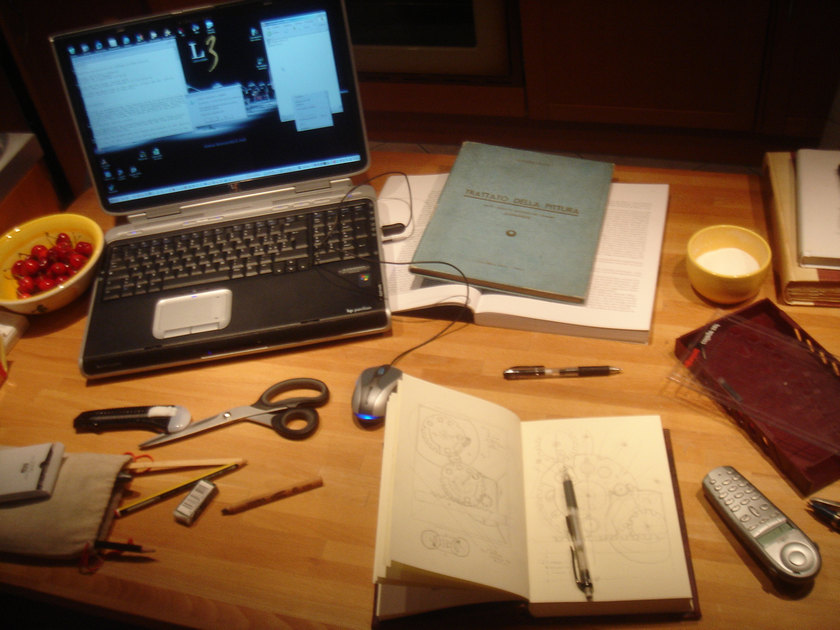
2004 Night-time research and studies – Mario Taddei

Between 1999 and 2005, I therefore spent much of my time studying Leonardo da Vinci’s manuscripts, comparing the pages, interpreting them and reconstructing machines which, up until then, had never really been analysed directly from the codices using this method. This long period of study gave rise to my great publishing adventure on Leonardo: I began presenting my images, my 3D reconstructions, my models and my interpretations to various publishers, paving the way for books on Leonardo’s machines that would later be published in Italy and, subsequently, in China as well.

The 2008 Chinese book therefore represents much more than a simple foreign edition. For me, it is the tangible sign of my work’s arrival in the Chinese cultural sphere. It is the first moment in which my research into Leonardo’s machines—born of solitary work at the Politecnico, of manuscripts acquired through sacrifice, and of years of 3D modelling—begins to speak to a new audience, far from Italy, yet deeply interested in the genius of Leonardo da Vinci.


2003: the meeting with Paolo Galluzzi and Carlo Pedretti

One of the most significant encounters of my career in the study of Leonardo da Vinci took place in 2003.

My uncle, Michele Dota, then president of the Florence Association of Architects, was well aware of my passion for Leonardo. It was to him that I had asked whether he knew anyone in Florence who worked at the famous Museum of the History of Science, one of the world’s most important centres for the study of the scientific and technological history of the Renaissance.
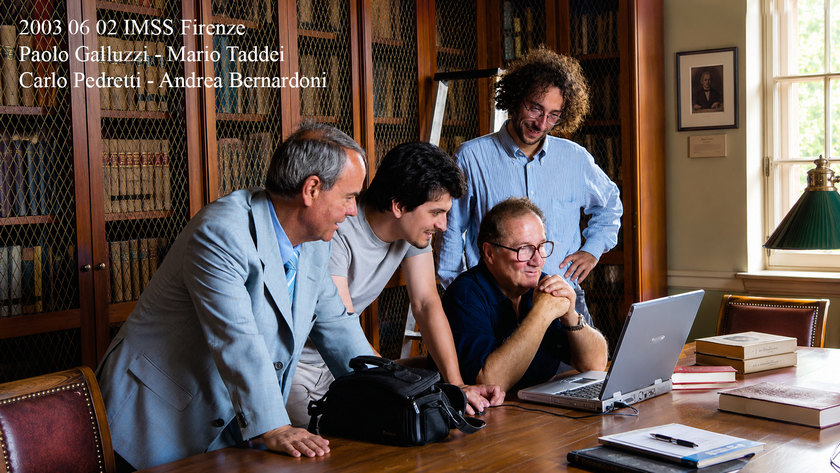
2003 06 02 Foto IMSS Firenze Paolo Galluzzi – Mario Taddei -Carlo Pedretti – Andrea Bernardoni -Presentazione Progetti leonardo 3D

By a stroke of luck, his wife happened to know Paolo Galluzzi, then director of the museum and a leading figure in Renaissance studies and the history of science. Thanks to my uncle Michele, I was thus able to secure an appointment that, for me at the time, seemed almost impossible: I was still young, unknown in academic circles, and had not yet published the books that would follow in the years to come.

I asked if I could present my research into 3D computer graphics on Leonardo da Vinci’s machines in person. I had already created several three-dimensional models on my own, some of which had never been published, based on my direct study of Leonardo’s manuscripts. Among these were reconstructions related to the Cavallo Sforza and a simulation of the casting of the great equestrian monument, a subject I was keen to explore and investigate further at the time.

The meeting took place on 2 June 2003. I still remember the setting perfectly: a beautiful room, somewhere between a private library and the director’s office, surrounded by antique books and seminal texts on the Renaissance. I was in the centre of Florence, in an extraordinary place; from the window you could see the Arno and catch a glimpse of the Uffizi. For anyone who loves studying Leonardo, the history of science and the Renaissance, it was an almost magical place.
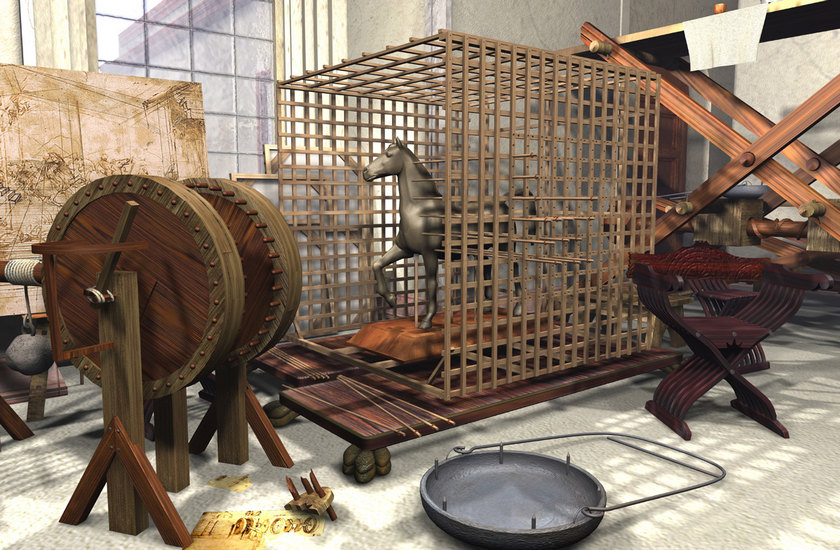
1998-2003 Mario Taddei – Modelli 3D Leonardo da Vinci al Castello sforzesco

To my great surprise, following the initial introduction by my uncle Michele, Paolo Galluzzi had also arranged a meeting with Carlo Pedretti, who was one of the world’s leading experts on Leonardo da Vinci. It was incredibly exciting for me: some of the books I owned and was studying bore his very signature. Also present at the meeting was Andrea Bernardoni, who was my age at the time, worked at the museum and specialised in Renaissance science and the history of science.

That meeting was wonderful, because I finally had the time and attention needed to present my research, my three-dimensional models and the method I was developing. There was no talk of money, no talk of contracts, no talk of the market. We spoke only of research, manuscripts, machines, Leonardo, technical interpretations and digital reconstructions. It was a pure, joyful, almost poetic moment, devoted entirely to knowledge.
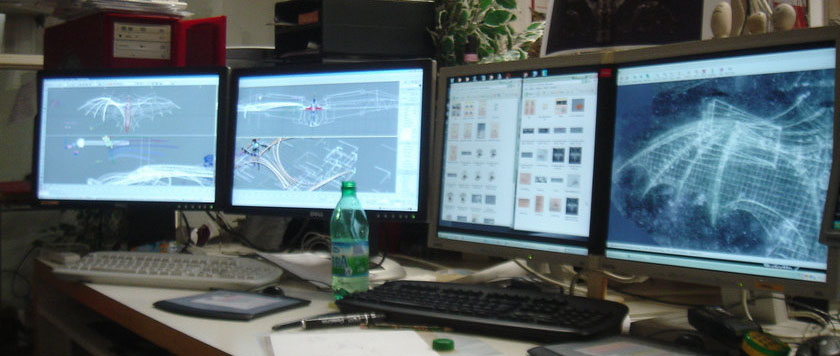
Night work, mechanical bat model

That meeting marked the decisive start of my career in the world of Leonardo. Both Carlo Pedretti and Paolo Galluzzi recognised the value of my work and appreciated it so much that they encouraged me to consider writing a book featuring the new 3D reconstructions of Leonardo’s machines. The idea was to pitch it directly to Giunti, one of the world’s leading publishers of books on Leonardo da Vinci and, more generally, one of Italy’s most historic and prestigious publishing houses.

At that point, I gathered all the machines I had studied, prepared a list of the reconstructed subjects and began to organise the content of what would become my first major publishing project on Leonardo’s machines. My research, which had begun in solitude amidst computers, manuscripts and 3D modelling, was finally beginning to engage with scholars, museums and publishers of international standing.
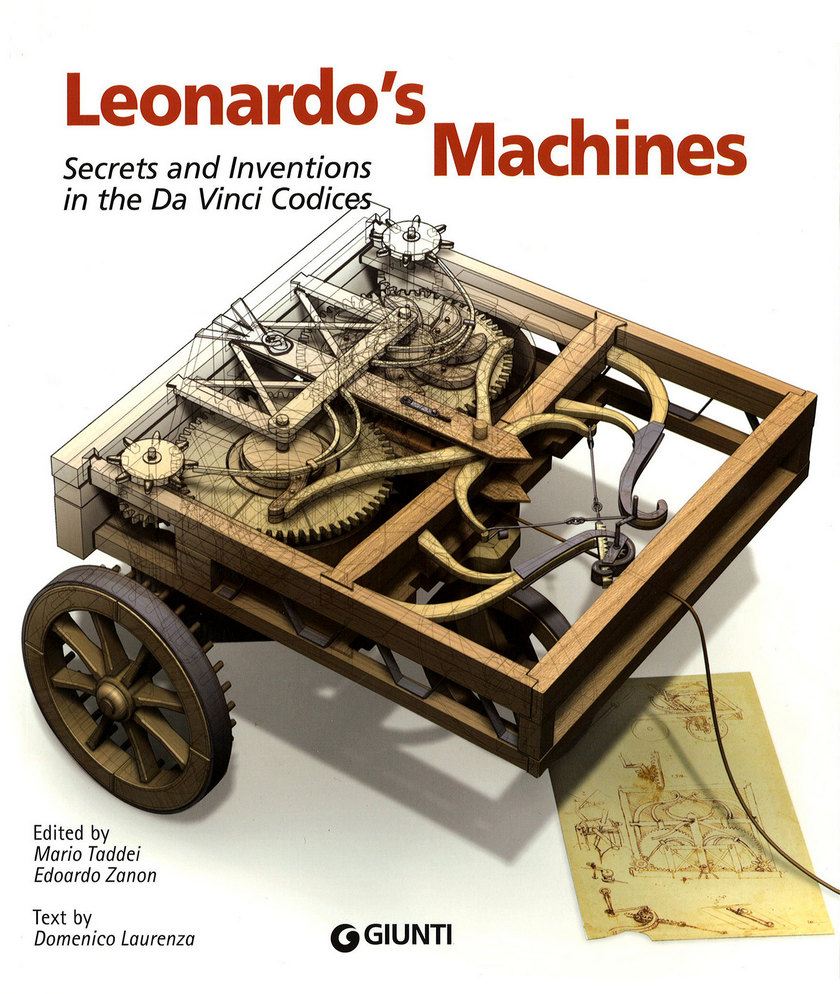
2005 Leonardo’s Machines: Secrets and Inventions in da Vinci’s Codices – Mario Taddei

Leonardo’s Machines: Secrets and Inventions in da Vinci’s Codices

Giunti Editions, 2005

In the two years following my meeting with Paolo Galluzzi and Carlo Pedretti, whilst I continued to work as normal at Studio DDM, I devoted much of my free time to studying Leonardo da Vinci’s manuscripts. I made particular use of the large-format editions of the codices that I had purchased at great financial sacrifice – truly monumental volumes that allowed me to examine the pages, the drawings and the technical details of Leonardo’s machines.

During that period, I came across numerous interesting projects. The main one, which Paolo Galluzzi himself had suggested I look into further, concerned Leonardo da Vinci’s famous automobile. It was a machine that had already been studied by leading engineers and scholars, but which still held many mysteries regarding its actual functioning. For me, it was an incredible and wonderful challenge: I had to start from existing studies, understand what had already been proposed before me, verify previous interpretations and seek new solutions.
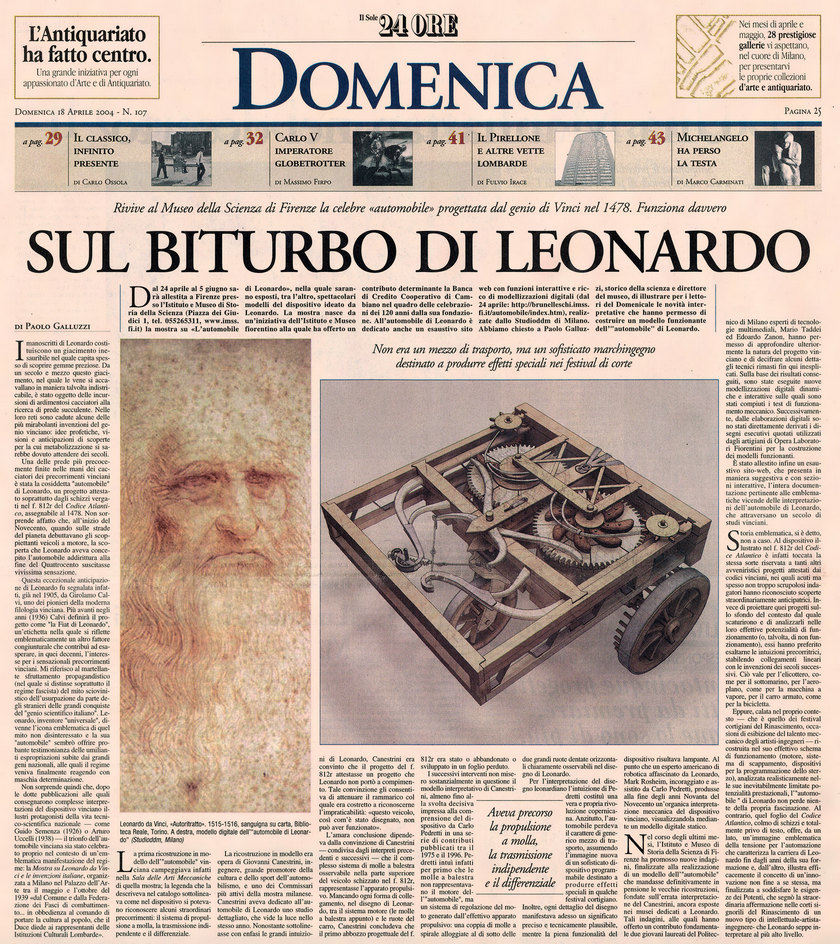
Incredible but true, he managed to identify some new mechanisms and propose a more complete reconstruction. My 3D reconstruction, created in 2004, has become one of the most widely accepted interpretations of Leonardo’s car and still appears today, directly or indirectly, in countless museums, books and educational materials dedicated to the genius from Vinci. It was a new and innovative reconstruction, because I had identified technical solutions and drawings by Leonardo that helped to better understand how the machine worked, in particular the braking system and the interpretation of the pedals or mechanical controls.
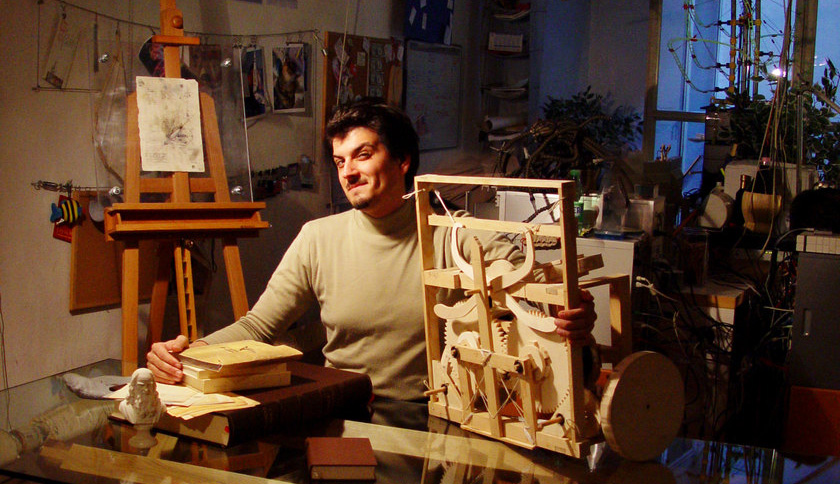
2004 First prototype of Leonardo’s robotic car – Mario Taddei – Mark E. Rosheim (reference)

It was an incredible project, but I didn’t want to limit myself to just the car. I wanted to demonstrate that within Leonardo’s codices there was a whole universe of machines still to be studied, interpreted and reconstructed. I therefore began to analyse numerous other subjects, some very famous, others almost forgotten or never correctly and fully reconstructed. Among these were the multiple bombard on the first page of the Codex Atlanticus, several war machines, the paddle boat, the swing bridge and many other inventions.
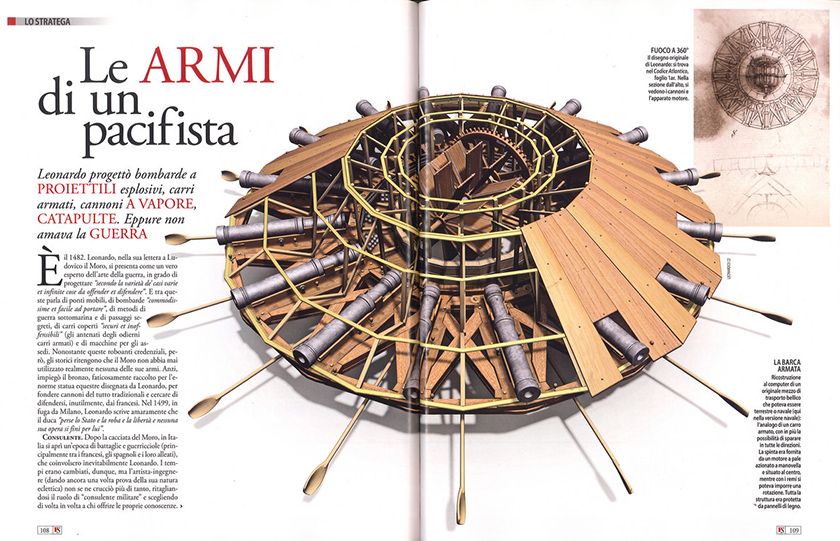
Model of the multiple bombarda published in a scientific journal. Mario Taddei

My method was always the same: I started with the manuscript, studied the original drawing, tried to understand its technical logic, produced interpretative drawings, and then reconstructed the machine using 3D computer graphics. In this way, I prepared a catalogue for the publisher Giunti featuring numerous machines, many of which were completely unpublished or, at any rate, had never been presented to the public with that new historical and three-dimensional interpretation.

I personally handled most of the subjects. Only a few secondary themes were entrusted to other collaborators at Studio DDM, but the main concept of the work, the cultural project, the structure and the method of reconstruction were mine. I have always been the principal creator of this work.
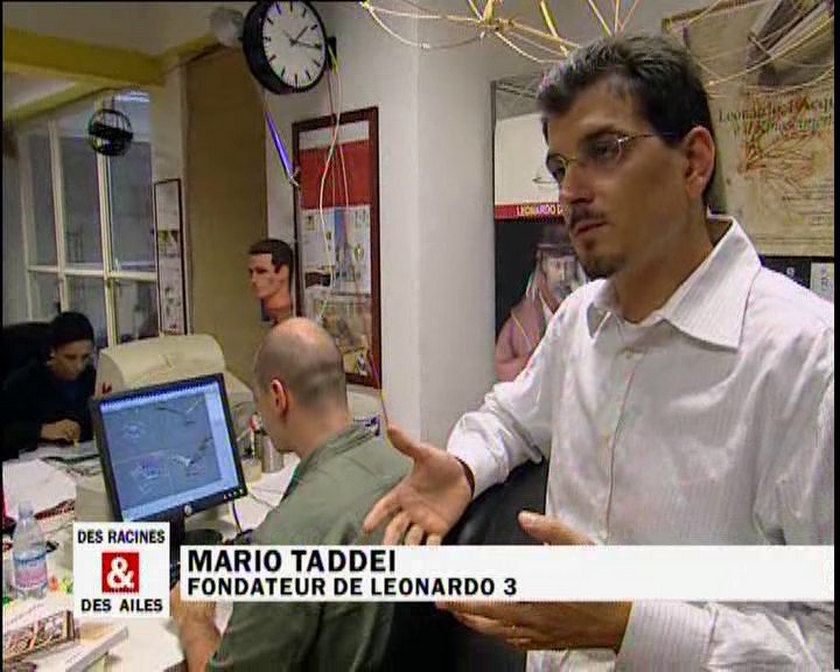
Leonardo da Vinci – 2005 interview – France Television – Mario Taddei

Following the book’s publication, I also received a very significant accolade. A French publisher came to Italy to make a documentary on Leonardo da Vinci and, having seen the book in its French edition, interviewed me. I was still very young and found myself being interviewed alongside two leading figures in Leonardo studies: Carlo Pedretti and Pietro C. Marani. For me, it was an extraordinary moment, because my work—born of passion, manuscripts and 3D computer graphics—was finally recognised alongside the great tradition of academic studies on Leonardo.
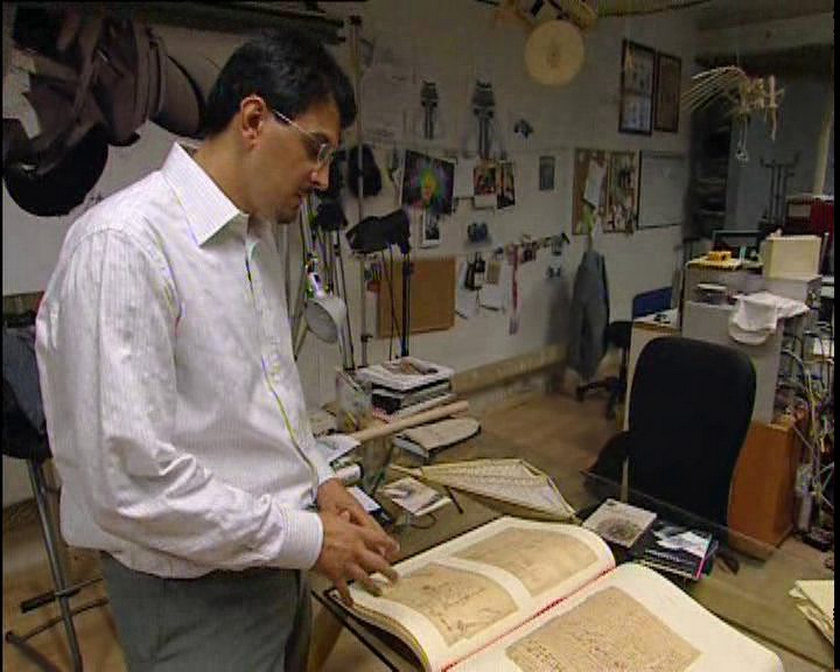
Leonardo da Vinci – 2005 interview – France Television – Mario Taddei

Il libro Le macchine di Leonardo. Segreti e invenzioni nei codici da Vinci, pubblicato da Giunti nel 2005, ebbe un successo enorme. Sinceramente, non lo realizzai per soldi. Lo feci per passione, per ricerca scientifica e per il desiderio di divulgare nuove immagini, nuove ricostruzioni e nuovi progetti legati a Leonardo da Vinci. Le royalties concordate all’epoca erano bassissime, ricordo circa l’1%, praticamente nulla rispetto al lavoro svolto. Ma in quel momento per me contavano soprattutto lo studio, la scoperta e la possibilità di far conoscere al pubblico un Leonardo diverso, più tecnico, più meccanico, più progettuale.
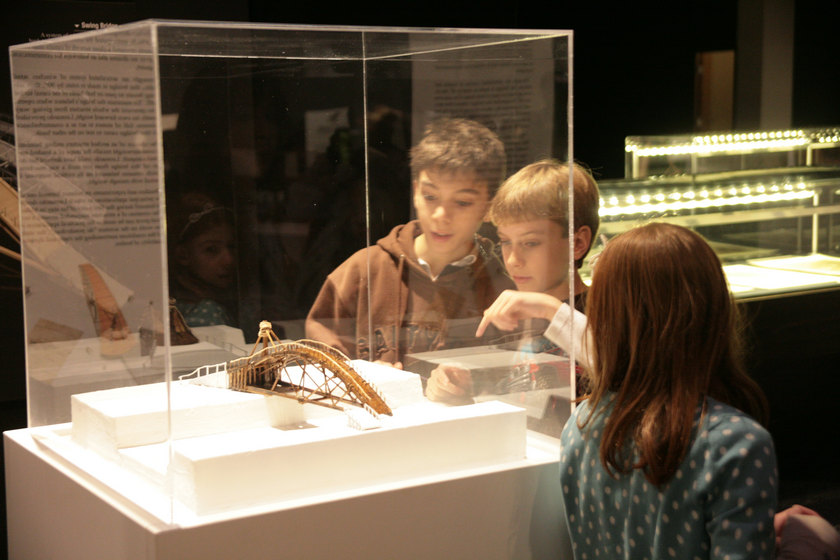
2004 ‘Leonardo: Water and the Renaissance’ exhibition at the Castello Sforzesco – Mario Taddei

It was an international success. Within a few years, the book had been translated into countless languages, and today I can say, with pride, that almost every part of the world has had its own edition of that volume. At the same time, as the years went by and I gained further experience, I realised that some of my early interpretations were not entirely correct. This, however, is part and parcel of the research process. Knowledge evolves, errors are corrected, hypotheses are superseded. That is another story, one that would take centre stage twenty years later, with the new book on Leonardo’s machines, produced with far greater experience and a deeper historical and technical understanding.

That first book, however, remains fundamental. It not only gave me the joy of telling the story of Leonardo’s machines to an international audience, but it also became a real springboard for my career. Many subsequent projects, exhibitions and initiatives—first with Studio DDM and later with the company Leonardo3—came about precisely because people, museums, publishers and producers discovered that book and got in touch with me.
1999-2001 Mario Taddei – Progetto Leonardo3

In those same years, I had in fact set up the Leonardo3 project. I had registered the domain and personally built the website for this new project, which aimed to offer a different perspective on research into Leonardo da Vinci. The “3” clearly referred to the third dimension, 3D, and the possibility of delving into Leonardo’s machines, codices and designs through new digital technologies. It was an idea that stemmed directly from my 1999 thesis at the Politecnico di Milano and which, thanks to the 2005 Giunti book, finally began to take shape as a publishing, museum and international initiative.
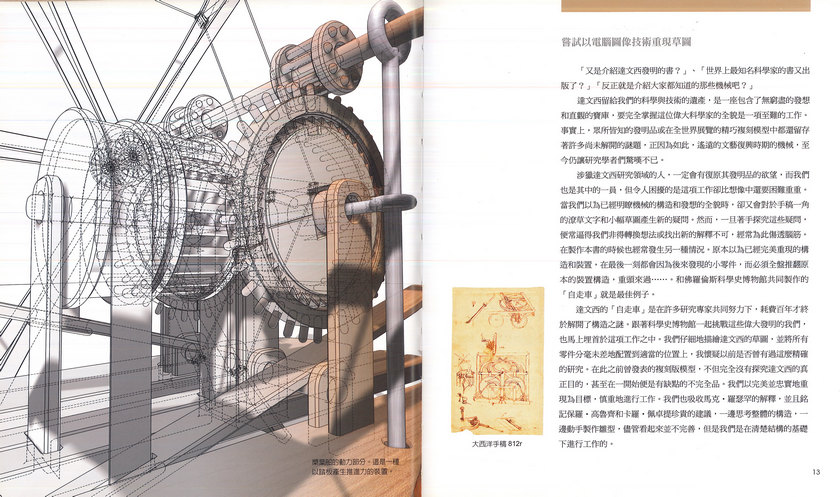
2008 Mario Taddei – Leonardo da Vinci’s Machines: Chinese Edition- 達文西的天才發明

Machines and new reconstructions

The book Leonardo’s Machines: Secrets and Inventions in da Vinci’s Codices features many of my studies and three-dimensional models. Among the machines I studied personally and for which I produced the main reconstructions were:

Flying machines and studies on flight:
mechanisms for mechanical wings, flapping wings, aerial screws, flying machines, mechanical wings.
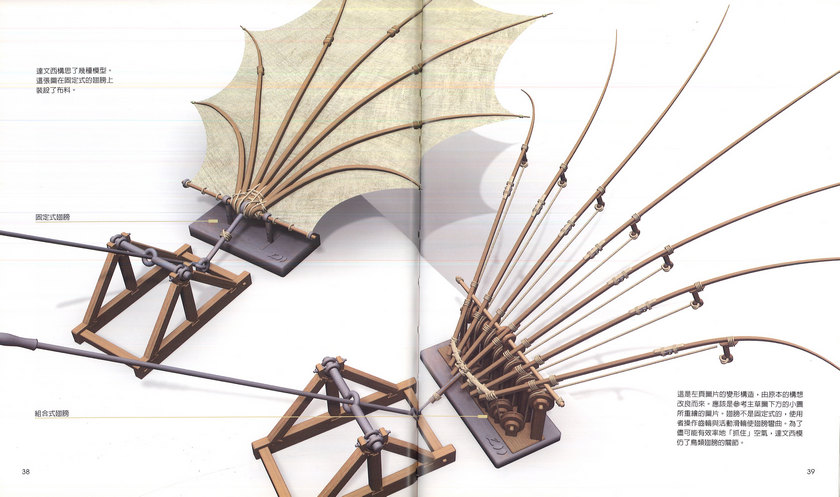
2008 Mario Taddei – Leonardo da Vinci’s Machines: Chinese Edition- 達文西的天才發明

Military machinery:
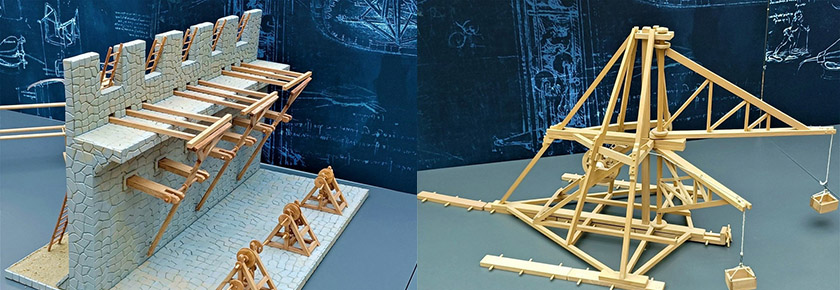
ballista, machine gun, wall defence systems, scythe-mounted chariots, tank, catapult, multiple bombard, bombards in action, fortress.
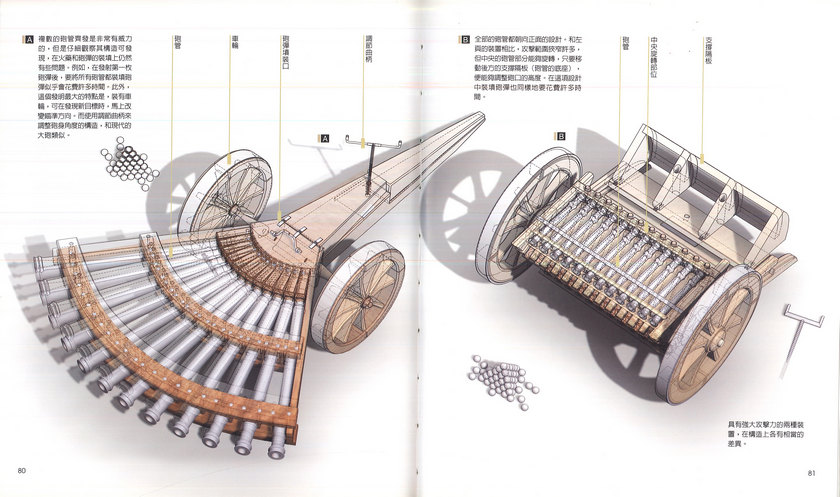
2008 Mario Taddei – Leonardo da Vinci’s Machines: Chinese Edition- 達文西的天才發明

Civil and mechanical engineering equipment:
mechanical saw, paddle steamer, swing bridge, reciprocating machine, trenching machine.
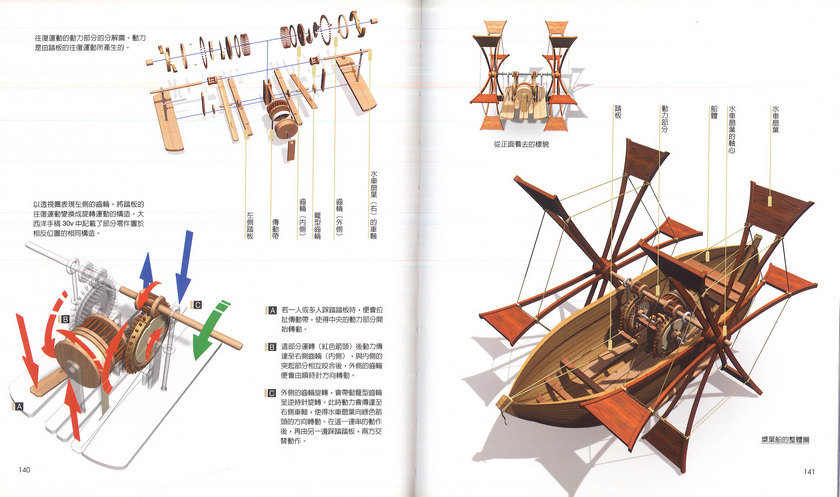
2008 Mario Taddei – Leonardo da Vinci’s Machines: Chinese Edition- 達文西的天才發明

Theatrical machinery, instruments and devices:
Leonardo’s car, stage set for Orfeo, and a compound compass.
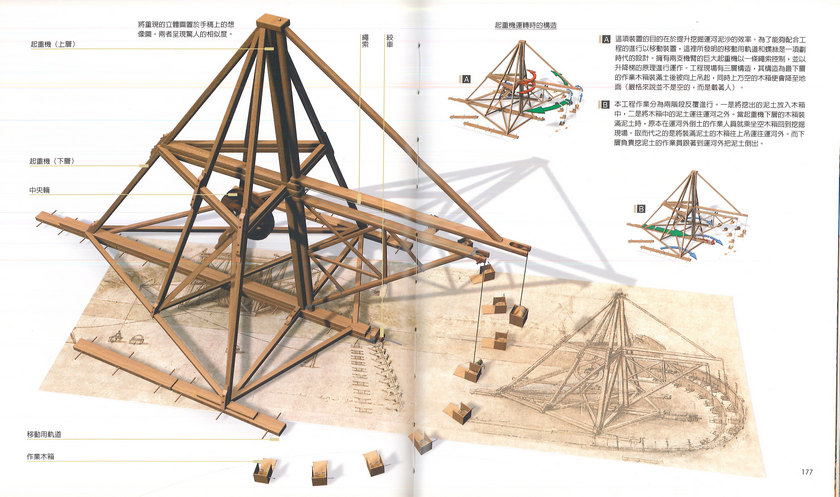
2008 Mario Taddei – Leonardo da Vinci’s Machines: Chinese Edition- 達文西的天才發明

A few other simpler models were entrusted to other people or collaborators, but the main part of the research, interpretation and three-dimensional construction of the most important subjects was my responsibility.

I can proudly say that, during those years, I looked directly into Leonardo’s manuscripts for the sources to propose new solutions. For example, whilst studying the mechanisms for mechanical wings and the flapping wing, I realised for the first time that a famous drawing by Leonardo, traditionally interpreted almost as a kind of fan, could instead be read as a study of human force applied to movement. This interpretation led me to reconstruct a much more interesting and complex mechanism, seeking to understand how it actually worked.
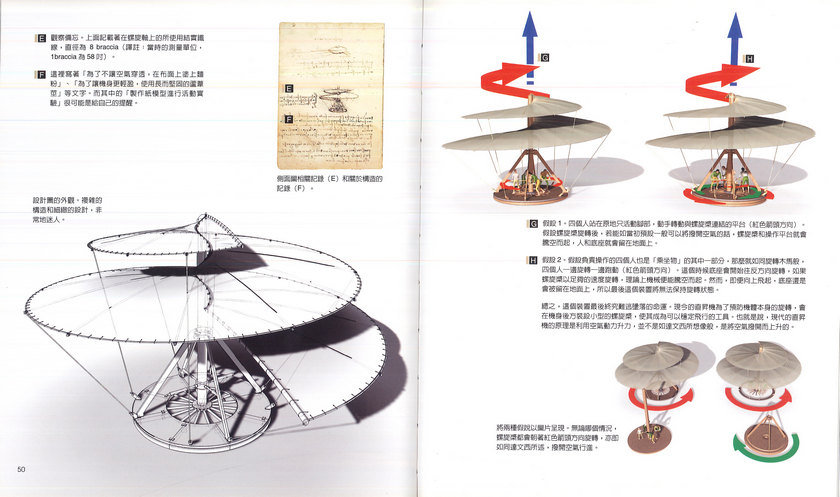
2008 Mario Taddei – Leonardo da Vinci’s Machines: Chinese Edition- 達文西的天才發明

I also offered a new interpretation of the famous aerial screw, often incorrectly referred to as ‘Leonardo’s helicopter’. The models previously displayed in exhibitions were almost always static and could not actually have functioned. I, on the other hand, sought to identify the mechanisms required to make the blade rotate, coming to the conclusion that, in order to be understood in functional terms, the machine had to be divided into two distinct mechanical parts.
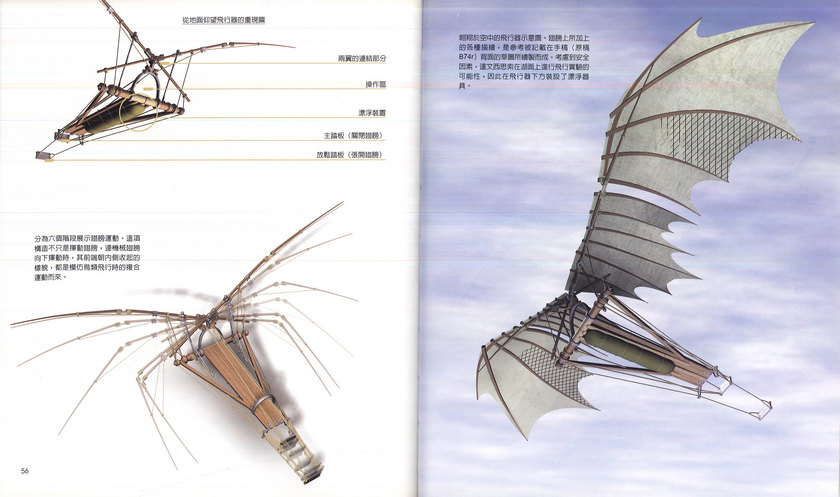
2008 Mario Taddei – Leonardo da Vinci’s Machines: Chinese Edition- 達文西的天才發明

I then studied Leonardo’s flying machines, attempting to interpret every single mechanism, every cable, every wire and every lever depicted in his drawings. I believe I produced one of the most faithful three-dimensional reconstructions of Leonardo’s flying machine ever presented up to that point, with images that, for the first time, showed not only the external form but also the movement of the components and the possible functioning of the structure.
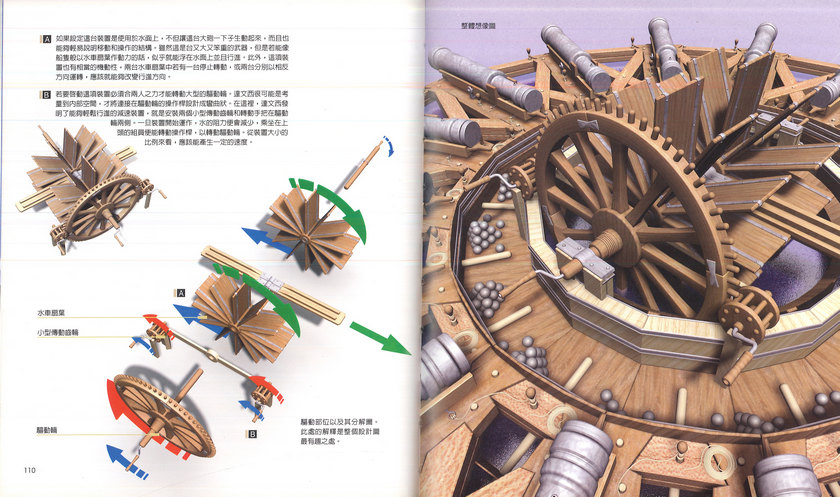
2008 Mario Taddei – Leonardo da Vinci’s Machines: Chinese Edition- 達文西的天才發明

I also worked on war machines: systems for defending city walls, scythe-wielding chariots, machine guns, catapults and other classic subjects from Leonardo’s tradition. Some of these machines were already known and had long been on display in museums, but my real discovery at that time was the reconstruction of the multiple bombard on the first folio of the Codex Atlanticus, with a central mechanism that, prior to my studies, had not been interpreted in that way. At the time, I also hypothesised that this bombarda might be connected to a naval structure. Many years later, I would realise that this interpretation was probably incorrect, but this too is part of the history of research, which advances through hypotheses, verifications, errors and new discoveries.
*** Translated with www.DeepL.com/Translator (free version) ***
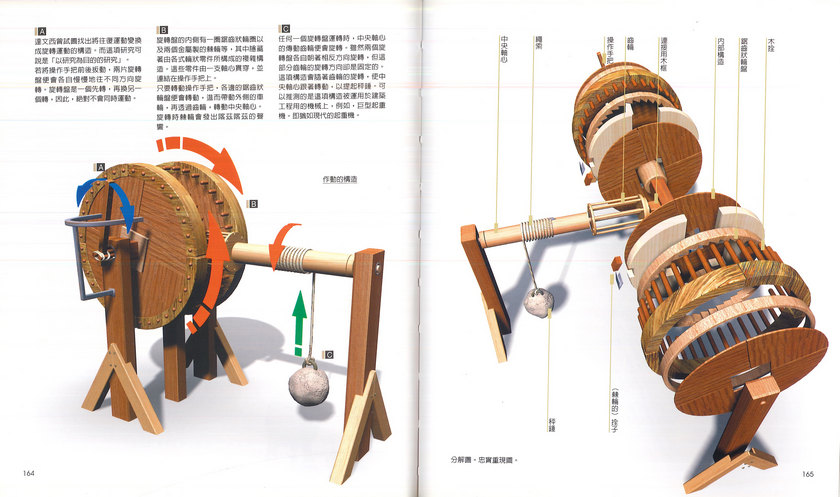
2008 Mario Taddei – Leonardo da Vinci’s Machines: Chinese Edition- 達文西的天才發明

I then built a model of the mechanical saw, but above all I realised that the famous reciprocating machine, which Leonardo had drawn in exploded view, could be interpreted as the engine of a paddle steamer. For the first time, I therefore reconstructed this machine in its entirety and made it fully operational, linking the internal mechanism to its practical application. In the years that followed, this interpretation too would be taken up and replicated in many exhibitions dedicated to Leonardo.
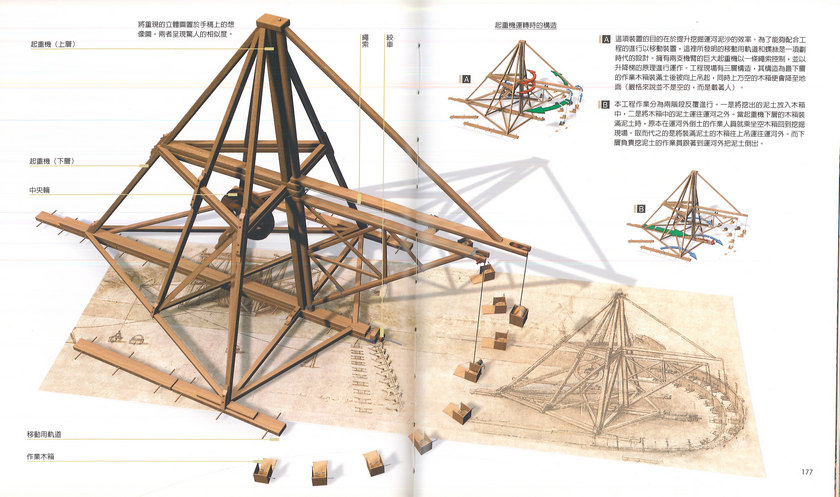
2008 Mario Taddei – Leonardo da Vinci’s Machines: Chinese Edition- 達文西的天才發明

I also studied the swing bridge and the large dredging crane, eventually arriving at Leonardo’s famous car. In this case, I presented a completely new reconstruction, with all the components shown in exploded view and visible from the inside. In my opinion, my interpretation surpassed many previous models, both from a historical and a technical perspective. Paolo Galluzzi himself recognised the value of some of the new solutions I had identified. I recall, for example, the interpretation of a central mechanism as a brake or as a triggering system to start the machine remotely. This opened up a completely new understanding of Leonardo’s car, not only as a mechanical machine, but also as a possible theatrical, automatic and scenographic device, extremely advanced for its time.
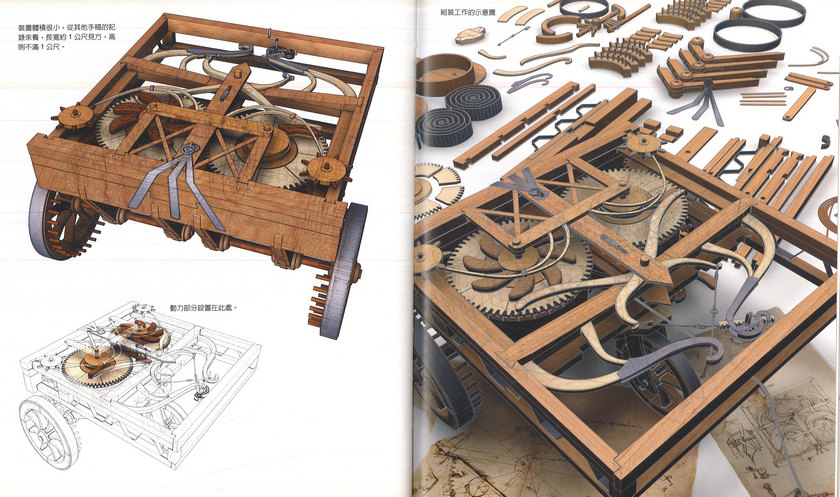
2008 Mario Taddei – Leonardo da Vinci’s Machines: Chinese Edition- 達文西的天才發明

I then worked on the stage design for Orfeo and, finally, enjoyed reconstructing some of Leonardo’s instruments, such as the compound compasses – technical objects that are also very beautiful in terms of their design.

Other subjects in the book—the Claviviola, the dismantlable cannon and the file-making machine—were created by the book’s co-author, which is why I have excluded them from the list as I am not their creator. Domenico Laurenza provided the historical context through the introductory texts to the thematic chapters, but he did not work on the machines.

All these models, published in the book, travelled the world. To my great satisfaction, in the years that followed, I saw them recreated or reinterpreted in numerous international exhibitions dedicated to Leonardo da Vinci. I never earned much from this work, because many museums, publishers, craftsmen and entrepreneurs continued to use or copy my images, my interpretations and my designs without proper financial recognition. Even today, I still come across images and models derived from my 2004 work in publications, museums, books and exhibitions dedicated to Leonardo’s machines.
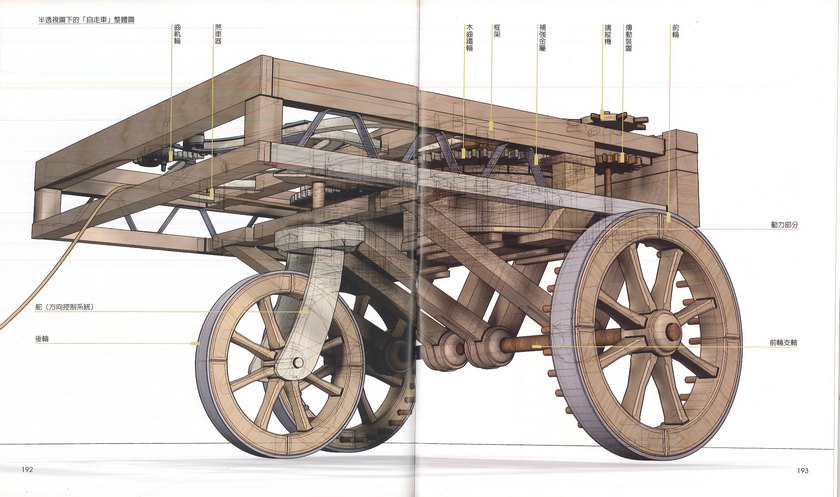
2008 Mario Taddei – Leonardo da Vinci’s Machines: Chinese Edition- 達文西的天才發明

I have also tried to fight a battle over copyright, both moral and economic, but I have discovered that when significant financial interests are at stake, some people are prepared to support even false or historically inaccurate accounts just to protect their own interests. Fortunately, there are publication dates, books, documents and images that bear witness to my work, regardless of what others may say. But that is another story altogether, one that deserves to be told separately.

I do, however, recall a very important lesson from my professor at the Politecnico di Milano, Mario Arnaboldi. In one of his famous lectures, he explained to us that, for designers, seeing their work copied all over the world can also be a confirmation of its strength and quality. The more a design is replicated, the more it signifies that it has had an impact. Of course, this does not negate the issue of copyright and recognition of one’s work, but it also teaches a fundamental lesson: the true skill of the designer lies not merely in defending what they have created, but in continuing to create new things.
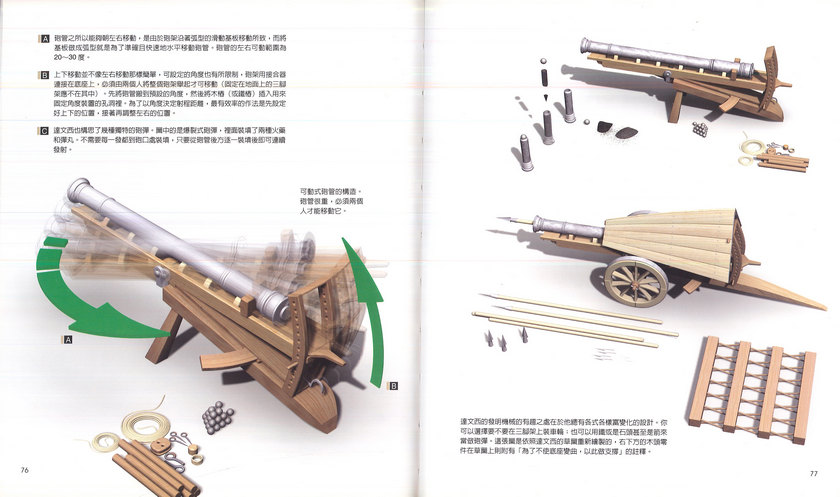

2008 Mario Taddei – Leonardo da Vinci’s Machines: Chinese Edition- 達文西的天才發明

In this sense, Leonardo da Vinci remains the ultimate role model. The real answer is not to get bogged down in battles over the past, even when they are painful and unjust, but to keep studying, interpreting, designing and building. For this reason, despite the pain and sadness caused by the exploitation of many of my images and reconstructions, I have continued to work on Leonardo’s machines, always seeking new solutions and new discoveries.

Edizioni in numerose lingue – Macchine di Leonardo – Mario Taddei

The main reason why my models were copied so extensively is clear: in that book, for the first time, I had produced three-dimensional images with exploded views, cross-sections and internal details. One could see not only the external appearance of the machine, but also its structure, components, mechanisms and how it might function. This made it much easier for a craftsman or builder to copy and reconstruct the machines.
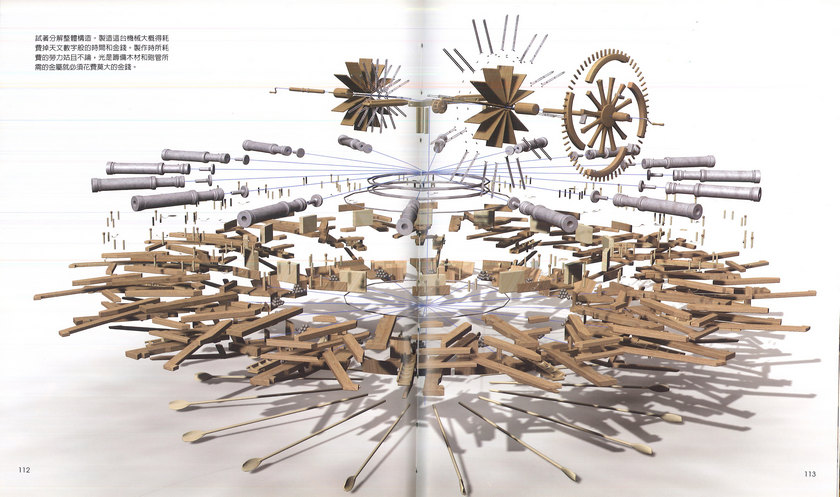

2008 Mario Taddei – Leonardo da Vinci’s Machines: Chinese Edition- 達文西的天才發明

I call them ‘my machines’ not because they are my own inventions rather than Leonardo’s, but because the interpretations, the three-dimensional solutions, the technical hypotheses, the construction details and, in some cases, even the adaptations needed to make a design that remained incomplete or ambiguous in the manuscripts work are my own. Precisely for this reason, even today I am often able to distinguish my reconstructions from others: those who have copied them have, in many cases, also copied my mistakes, my technical details and my interpretative choices, without really going back to study Leonardo da Vinci in the original manuscripts.
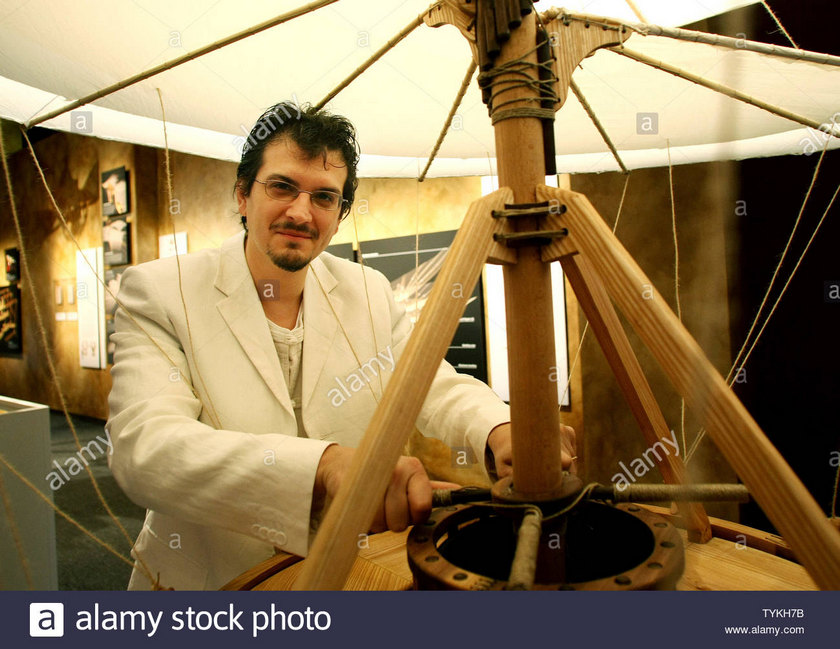
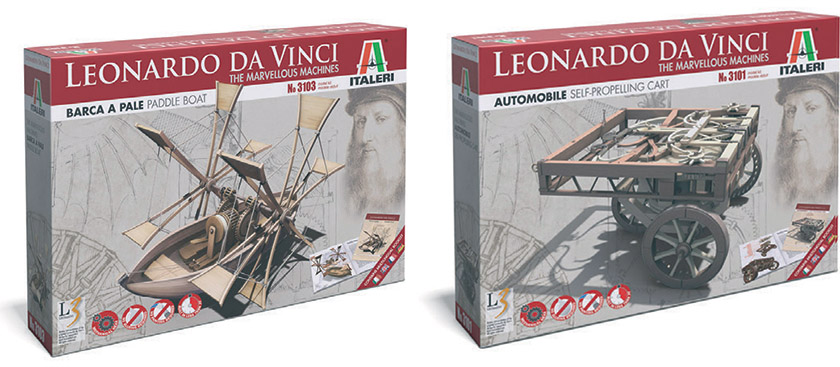
I can therefore say with great pride that those reconstructions, born of my work of study, drawing and 3D modelling, have conquered the world. They have found their way, directly or indirectly, into countless museums and exhibitions dedicated to Leonardo da Vinci. I have also discovered that toys, educational kits and commercial items have been produced based on those models. This demonstrates just how much those images have shaped the contemporary perception of Leonardo’s machines, even though my name and my work have often not been given the recognition they deserve.
Virtual Atlantic Code, 2005
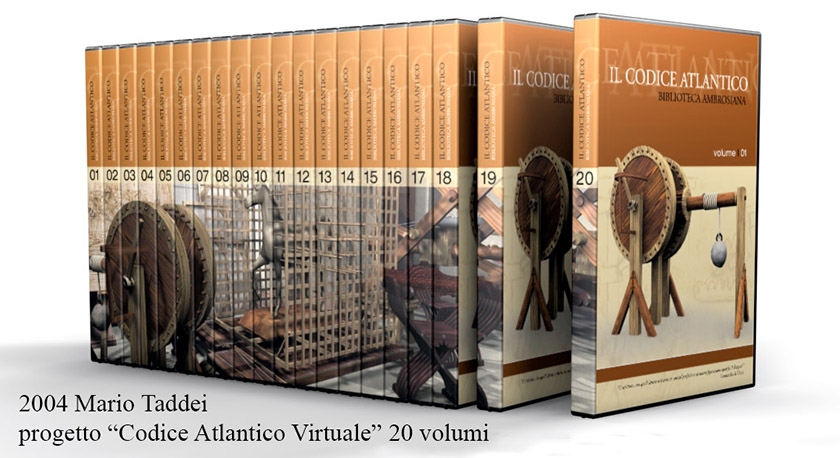
All the machines I had designed and modelled in 3D for the book published by Giunti also became the core of a new project I had been developing since 2003: the Virtual Codex Atlanticus.

The 3D animations and models were not meant to remain confined to a book. I wanted to create something different: a digital, interactive and multimedia tool that would allow the Codex Atlanticus to be consulted in a completely new way. The large volumes of the Codex Atlanticus that I had purchased at great financial sacrifice were extraordinary, but expensive, heavy, difficult to consult and accessible only to a few. I wanted to transform that heritage into an experience available to everyone, using new digital technologies.
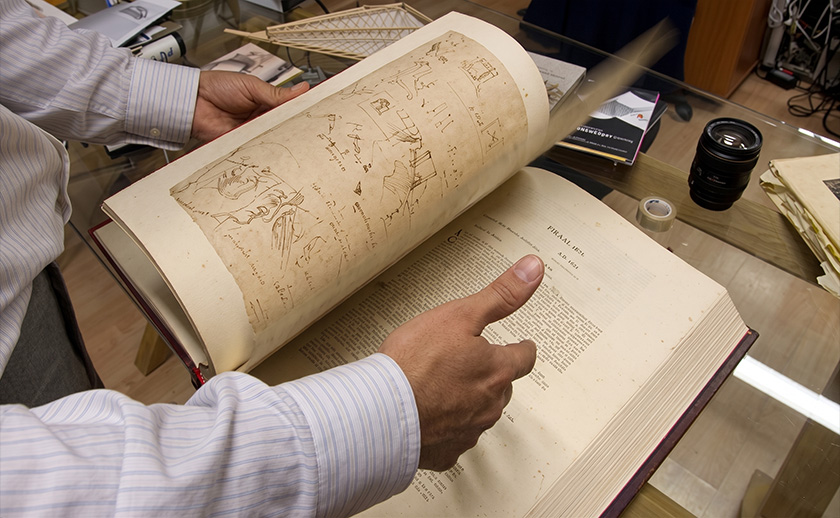
The idea stemmed directly from the first programmes and experiments I had carried out in 1999 for my thesis at the Politecnico di Milano. Even then, I was working on the concept of a virtual museum and an interactive way of engaging with Leonardo’s history. In 2004, I revisited those ideas and began developing a digital book that could be browsed on screen in two dimensions, but to which I added something new: the three-dimensional models of the machines seemed to emerge from the page, allowing users to see, for the first time, Leonardo’s drawings animated in 3D and in an interactive way.
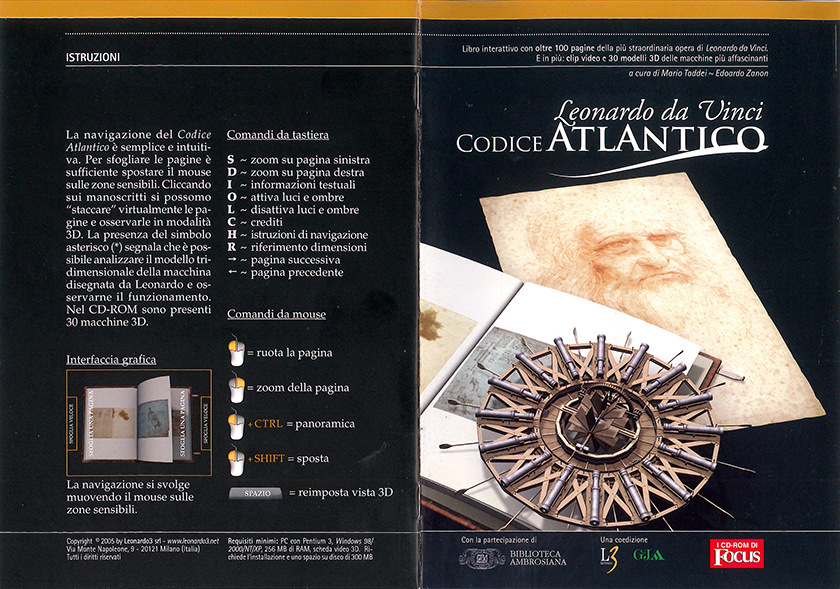
All my research, reconstructions, animations and 3D models created for the Giunti book were therefore incorporated into this project, which I developed during 2004 and 2005. It was an extremely ambitious undertaking for the time. I had also tried to pitch the Virtual Codex Atlanticus to major organisations, including Microsoft, through some contacts, and to various publishing houses. I wanted it to become a major cultural and technological project dedicated to Leonardo da Vinci.
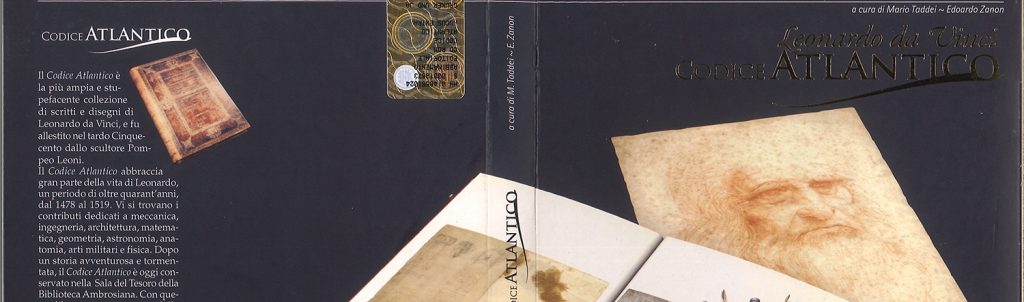
I also had the extraordinary good fortune to present this work directly to the Biblioteca Ambrosiana. In 2004, I entered the Ambrosiana for the first time to study the original manuscripts and take the first photographs. For me, it was a pivotal moment: after years spent with facsimiles, large-format books and reproductions, I could finally engage with the original pages of the Codex Atlanticus. It was like closing a circle between study, passion, technology and historical research.

The Virtual Codex Atlanticus was then published by Leonardo3 and Focus and was a huge success, alongside the Giunti book on Leonardo’s machines. The first edition was produced in collaboration with Focus magazine and was distributed at newsagents and bookshops throughout Italy. I still remember the thrill of seeing that project reach the general public, no longer merely as a personal study or prototype, but as a published and multimedia work distributed nationwide.
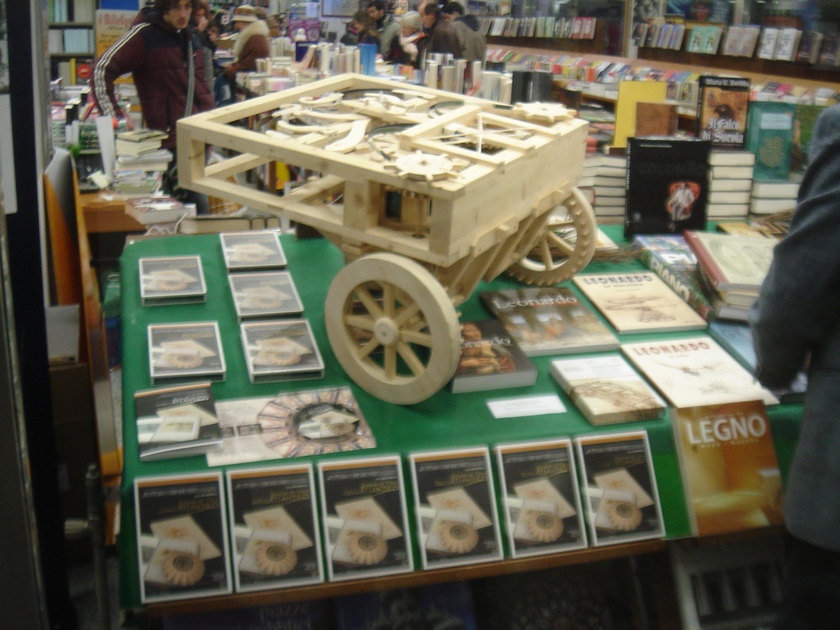
One of the greatest thrills was the creation of the TV advert. For the first time, an advert dedicated to the Virtual Codex Atlanticus was produced and broadcast in prime time on Canale 5. In the advert, you could see my multi-barrelled cannon firing and other mechanisms designed by Leonardo operating in 3D. It was 2005 and, for me, seeing the machines I had studied and reconstructed on the computer on national television was an incredible moment.
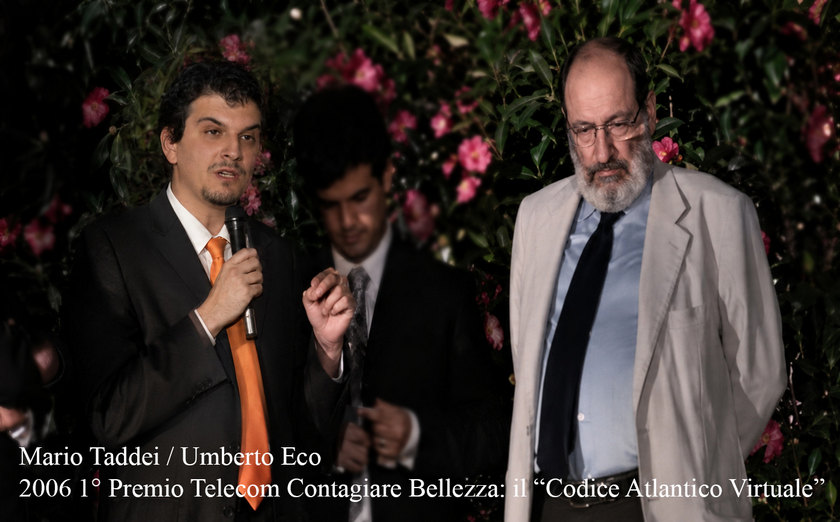
2006 Premio Telecom Italia Contagiare Bellezza Mario Taddei – Umberto Eco

The project then received even greater recognition in 2006, when the Virtual Codex Atlanticus won first prize at the Contagiare Bellezza awards. I was thus fortunate enough to meet Umberto Eco, who chaired the jury. It was a memorable moment in my career.

The award citation described the Virtual Codex Atlanticus as:

“a futuristic project for accessing the Codex Atlanticus”.

The prize was awarded unanimously to Mario Taddei, named as the author, by a jury chaired by Umberto Eco and comprising figures of the highest cultural standing: Riccardo Chiaberge, Dario Del Corno, Philippe Daverio, Andrea Kerbaker, Marco Magnifico, Renato Mannheimer, Mario Raimondo, Vittorio Sermonti, Andrée Ruth Shammah, Massimo Vitta Zelman and Ugo Volli.

LThe citation recognised the value of the project for:

“its commitment to promoting Italy’s cultural heritage and fostering cultural growth in our country through a medium rich in content, expressive originality and emotional impact”.

For me, that award was hugely significant, because it confirmed that the work I had begun almost single-handedly – starting with my 1999 thesis, the manuscripts I had acquired at great personal sacrifice, the 3D models and my passion for Leonardo – had now achieved top-level cultural recognition.

The Virtual Codex Atlanticus took the models I had created since 1999 and presented them in a new form: no longer simple static images, but animated machines, with sounds, three-dimensional effects, movement and interaction. It was a new way of delving into Leonardo’s pages, of seeing his drawings come to life and of better understanding the logic behind his machines.
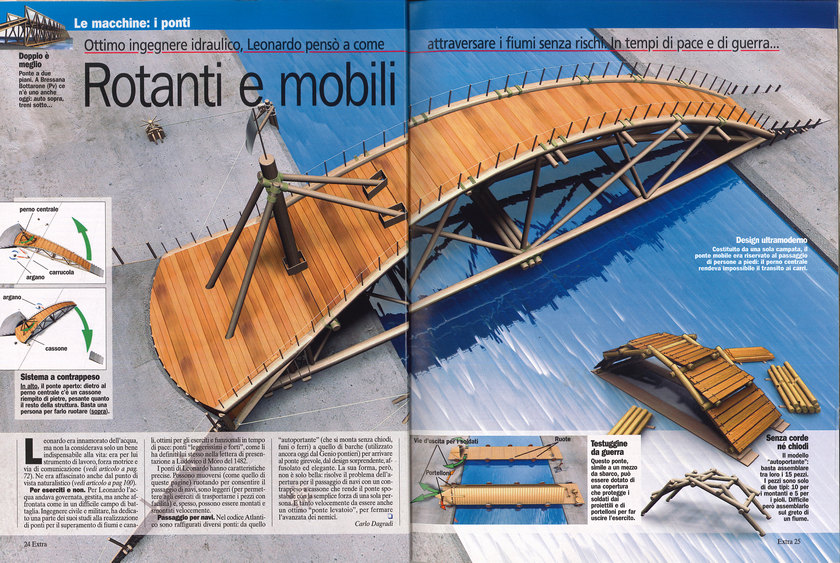
Together with the Giunti book, the Virtual Codex Atlanticus played a decisive role in the international dissemination of my reconstructions. Even today, many of the works, images and models contained in that project continue to be used, directly or indirectly, in exhibitions, museums, publications and displays dedicated to Leonardo da Vinci all over the world.

The book and the software were therefore two parts of the same journey. The book allowed the machines to be described and shown on paper, whilst the Virtual Codex Atlantico allowed them to be animated, explored and brought to life. For me, they both represented the same idea that originated at the Politecnico: to use digital technology not to replace history, but to make it more understandable, more exciting and closer to the public.
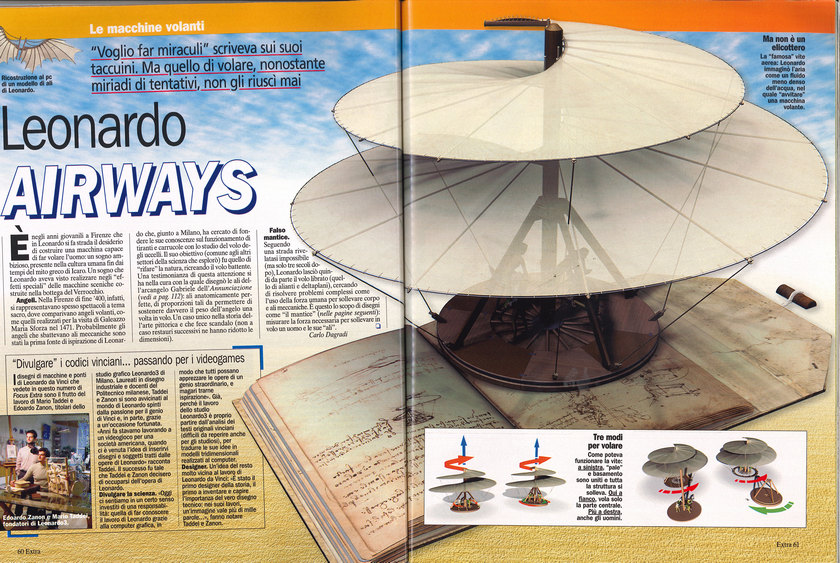
The 2008 Chinese edition
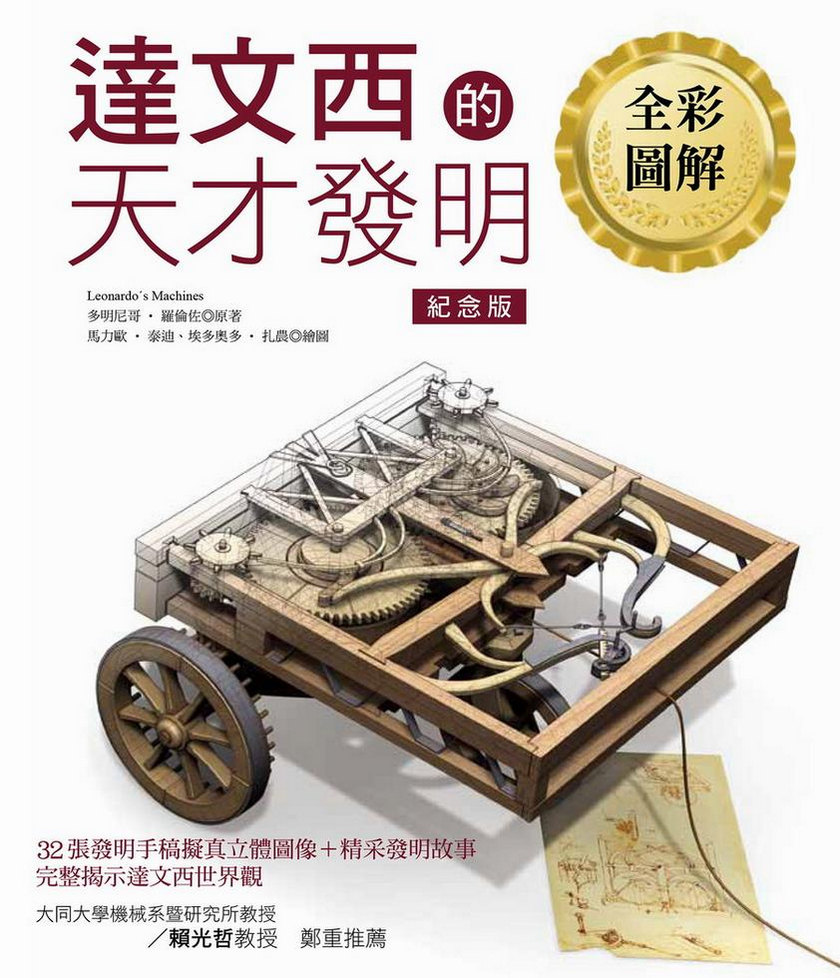
2008 Mario Taddei – Leonardo da Vinci’s Machines: Chinese Edition- 達文西的天才發明

圖解達文西天才發明【全彩珍藏版】

Shy Mau Publishing Company

The first edition of my book on Leonardo da Vinci’s machines, published by Giunti in 2005, presented all my groundbreaking research and three-dimensional renderings of Leonardo’s machines, many of which had never been seen before in that form. The book was an immediate success. Following the Italian edition, an English version was quickly produced, and Giunti began contacting publishers worldwide to produce foreign editions.

Within two or three years, numerous editions were published: French, German, Russian, Spanish and others. In 2008, a Chinese edition was also released, published by Shy Mau Publishing Company, under the title:

圖解達文西天才發明【全彩珍藏版】
The Ingenious Inventions of Leonardo da Vinci: An Illustrated Colour Collector’s Edition

This edition essentially retained the same structure as the Italian edition: the same subjects, the same sequence of photographs, the same reconstructions, and the same narrative and visual structure. It was, however, a smaller, more pocket-sized and certainly more affordable edition, making it highly suitable for widespread distribution to the Chinese public.
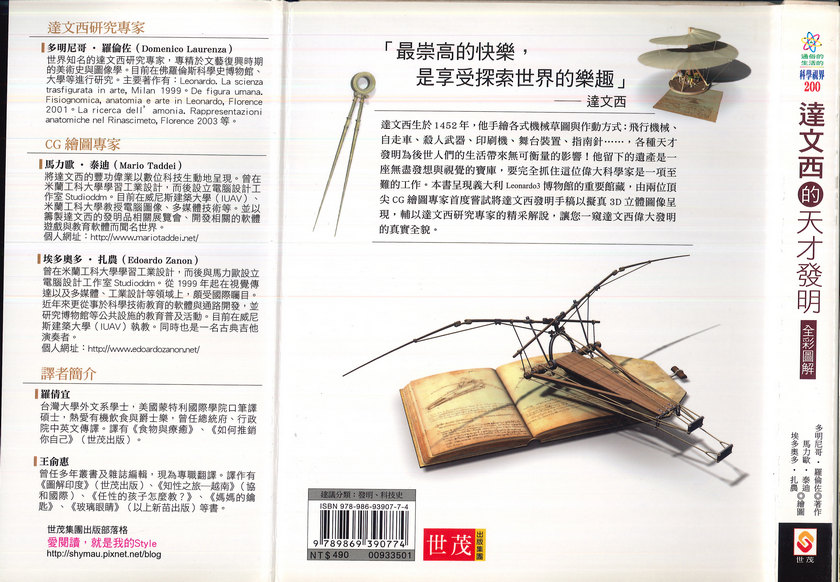
2008 Mario Taddei – Leonardo da Vinci’s Machines: Chinese Edition- 達文西的天才發明

The Chinese edition was a huge success. For the first time, many readers in China were able to see Leonardo da Vinci’s machines in a new, spectacular and accessible three-dimensional format. Before this book, publications on Leonardo mainly featured his most famous paintings, a few manuscripts and the usual traditional illustrations. His machines, on the other hand, were rarely presented with such clear, fascinating and modern 3D reconstructions.

In this book, Leonardo’s machines were no longer merely ancient drawings that were difficult to interpret, but became visible, dismantlable objects that could be observed from the inside, almost as if they could be built. The three-dimensional images made it possible to understand the components, mechanisms and possible functioning of the machines. This was one of the main reasons for the book’s great success.
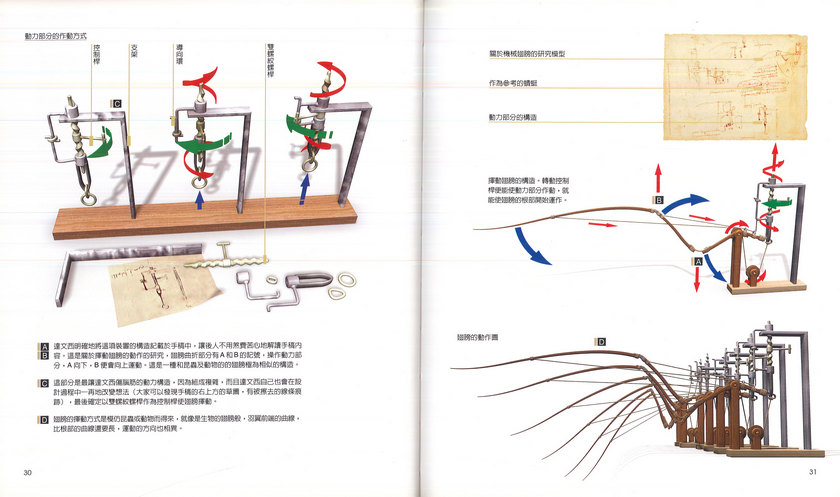
2008 Mario Taddei – Leonardo da Vinci’s Machines: Chinese Edition- 達文西的天才發明

The book was so successful in China that it was reprinted numerous times. There are many special editions, with different covers, different formats and various editorial adaptations. The same book was subsequently published by other Chinese publishing houses as well, with different covers and formats. At one point, I lost count of how many different editions had been produced in China. Whenever I went to China for a conference, an exhibition or a presentation, I would come across a new version, often with a different cover.

Varie edizioni cinesi – Le macchine di Leonardo Books – Mario Taddei 马里奥·塔代伊

I am extremely proud and delighted by this success. At the same time, to be clear, I have never received remuneration commensurate with the actual reach of my work. Certainly, many publishing houses, publishers, producers and cultural operators who have used my images have earned more money than I have. However, I can proudly say that my work has made a significant contribution to spreading the fascination with Leonardo da Vinci, the history of science and research into his machines.

As a child and teenager, I was deeply fascinated by Leonardo’s designs. That is why I am sure that, through this book, I too have influenced countless Chinese children and young people, perhaps encouraging them to take an interest in engineering, art, design, the history of science and design. If even just a fraction of those young people have found in these images the same enthusiasm that I felt when looking at Leonardo’s manuscripts, then that work has been hugely meaningful.
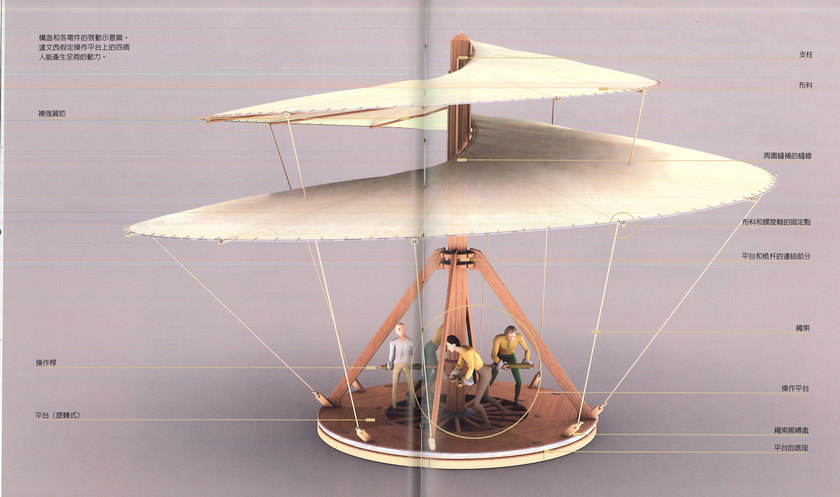
2008 Mario Taddei – Leonardo da Vinci’s Machines: Chinese Edition- 達文西的天才發明

The book, in all its Chinese editions since the 2008 edition, has been reprinted countless times, almost every year, or at any rate with remarkable consistency. I have come across copies with much later publication dates, as late as 2021. This shows that the book has enjoyed a very long publishing life and has been widely distributed.

This circulation was such that, over the years, I was invited to China on several occasions to give lectures and presentations. I remember very well the day I was invited to Peking University for a lecture. A professor from the School of Engineering at Peking University asked me to sign his copy of the book. I believe it was the 2008 edition. It was a moving moment, because it made me realise in concrete terms that this work, which had come into being years earlier in Italy amidst manuscripts, computer graphics and solitary study, had reached one of the most important academic institutions in China.
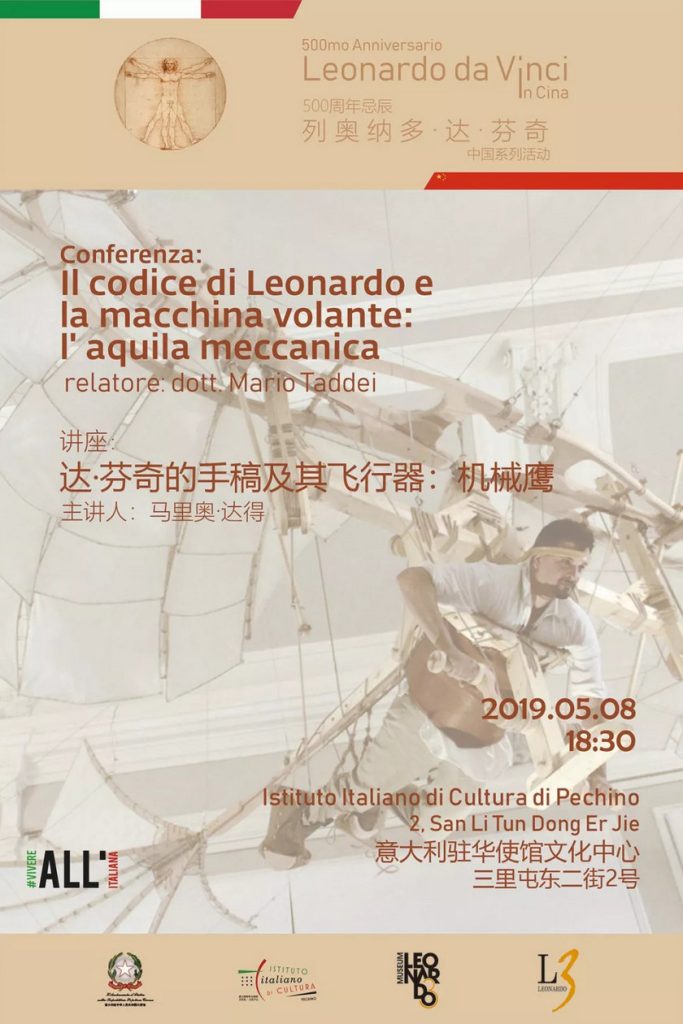
2019 Leonardo500, ‘Leonardo’s Codex and the Flying Machine’, Italian Cultural Institute, Beijing – Ministry of Foreign Affairs, Beijing – Lecture by Mario Taddei

Of course, as the years have gone by, I have also discovered the flip side of this success. Many publishers, museums and manufacturers have copied my designs, my images, my interpretations and even my mistakes. This detail is important: often, those who copied did not go back to Leonardo’s manuscripts to study them properly, but simply copied my three-dimensional images. For this reason, in many cases, I still recognise my machines today, because alongside the correct solutions, my details, my design choices and, at times, my now-outdated interpretations were also copied.

I can say, perhaps without exaggerating too much, that I have contributed to at least eighty per cent of the modern image of many of Leonardo’s machines that are still presented today in museums, exhibitions, books and educational materials around the world. Naturally, this is my personal assessment, but it stems from what I have seen over twenty years of exhibitions, publications and models built. Even today, there are museums and manufacturers that create museum-quality machines based, directly or indirectly, on my drawings and my 3D models.
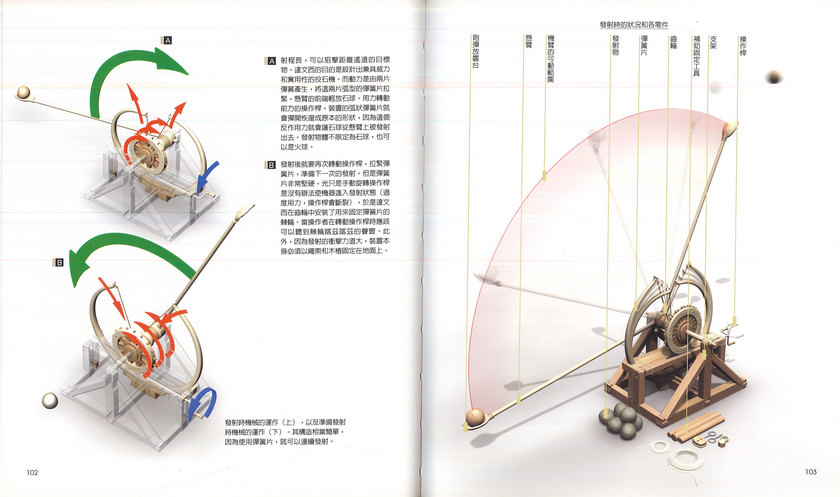

2008 Mario Taddei – Leonardo da Vinci’s Machines: Chinese Edition- 達文西的天才發明
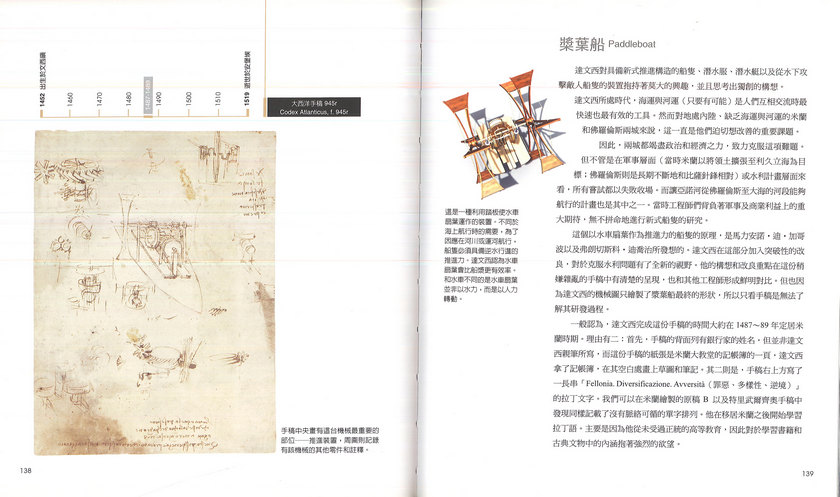
2008 Mario Taddei – Leonardo da Vinci’s Machines: Chinese Edition- 達文西的天才發明

A very clear example is the paddle boat. Before my research, as far as I was aware, it had never been reconstructed in that way – complete and fully operational, including the connection to the reciprocating engine. Following the publication of my book, I found that this machine had been reconstructed in America and in many other museums around the world.
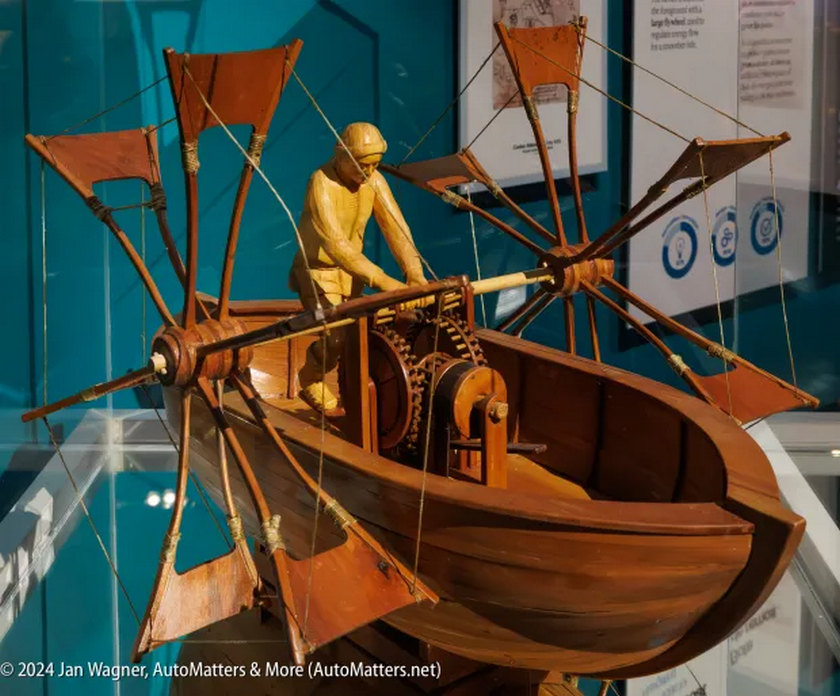
2024 USA – Wagner – Modello della barca a pedali dal Libro Le macchine di Leonardo – 2005 Mario Taddei

Unfortunately, very often my name is not even mentioned as the author of those reconstructions. This happens partly because many people think the design simply belongs to Leonardo da Vinci. And in part this is true: I have never wanted to claim copyright over Leonardo’s original designs, and no one should. Leonardo’s manuscripts, his drawings and his ideas belong to the history of science and are part of humanity’s heritage.
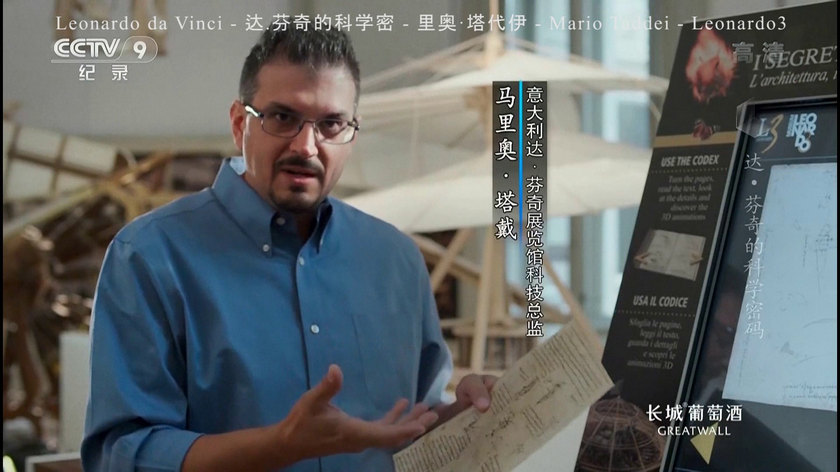
2019 CCTV 9 China Leonardo da Vinci documentary The man and the scientist – Mario Taddei

But that is not the point. I do not claim ownership of Leonardo’s designs. Instead, I claim ownership of my personal interpretations, my three-dimensional models, my images, my technical solutions, my way of reading the manuscripts, of linking different details, of filling in missing parts, and of modifying or adding certain elements in an attempt to make machines work that were often incomplete, ambiguous or difficult to understand in Leonardo’s drawings.
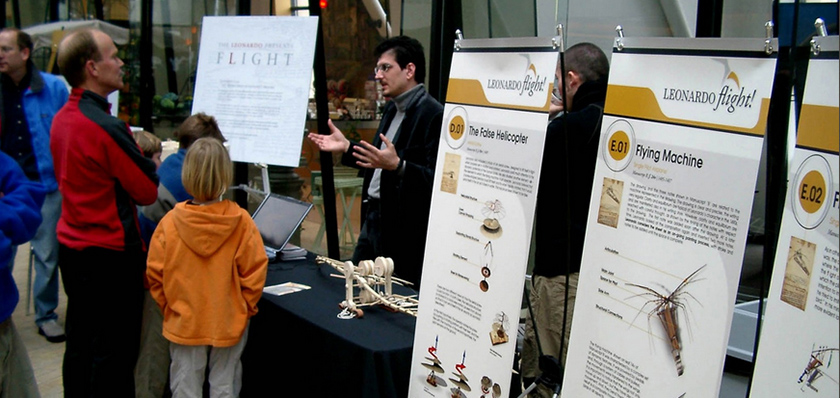
2004 Mario Taddei mostra Leonardo Presents FlightSalt Lake City, USA TheLeonardoMuseum

I therefore call them ‘my machines’ not because they belong to me rather than to Leonardo, but because the reconstructions, the images, the interpretations, the technical choices and the work of transforming the ancient drawing into a modern three-dimensional model are mine. In many cases, those models are not mere copies of the manuscript, but new visual, technical and design interpretations born of years of study.

Leonardo’s world will continue to fascinate future generations. I am delighted to have contributed so significantly, through these books, to the dissemination of knowledge and curiosity regarding the art, science and technology of Leonardo da Vinci.
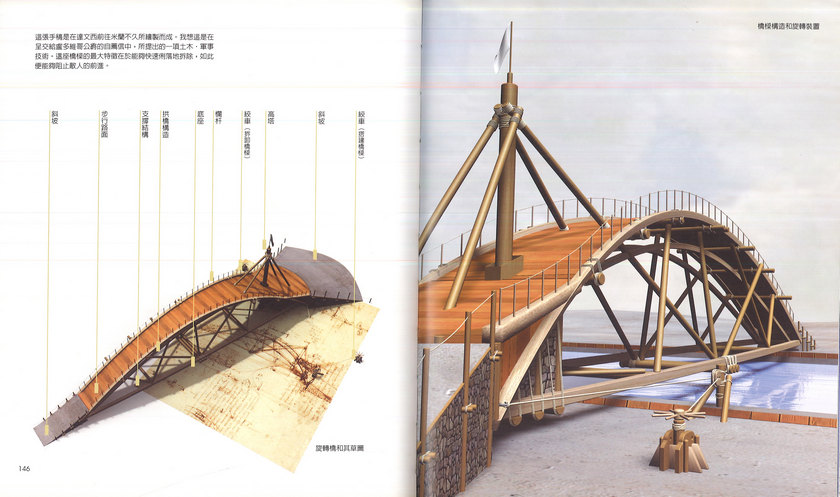
2008 Mario Taddei – Leonardo da Vinci’s Machines: Chinese Edition- 達文西的天才發明

A personal quirk of mine: every time I return to China for a conference, a presentation or a cultural project, I enjoy looking for a new edition of this book. I almost always find one. My collection continues to grow, even though my original contract with the publisher Giunti ended in 2024.
According to copyright law, my works, my three-dimensional models and my images revert to the author’s ownership. This, at least, should be the correct principle under Italian law and international copyright protection.

Unfortunately, in reality, these principles are not always respected. There are speculators, company directors, producers and even museum curators who continue to exploit the work of scholars without acknowledging its value and without fully respecting the author’s moral and economic rights. This has been one of the greatest sorrows of my career.
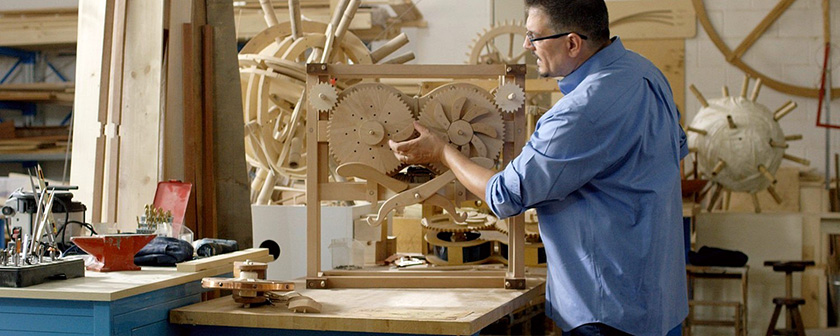
2018 Mario Taddei – Leonardo da Vinci Model Workshop


Along the way, I have met so many people who share my passion for art history, science and Leonardo da Vinci. I have shared wonderful experiences with them, filled with study, research, enthusiasm and outreach. Unfortunately, I have also encountered the cat and the fox, just like in the tale of Pinocchio: people interested primarily in money, capable of exploiting and continuing to exploit my work for profit, without any real love for Leonardo and, just like in the tale, behaving like outright crooks.

2008 Mario Taddei – Leonardo da Vinci’s Machines: Chinese Edition- 達文西的天才發明

Despite everything, I remain pleased and fully aware of the value of this book. With dozens of editions published worldwide, it has inspired readers, students, young people, museums and popularisers. It has made an enormous contribution to the history of the popularisation of science and the art of Leonardo da Vinci.

I can safely say that this book, in its many international editions, is perhaps one of the most translated and widely read illustrated books on Leonardo da Vinci in the world. Of course, if we exclude Dan Brown’s The Da Vinci Code, which is, however, a novel – a completely different publishing phenomenon – and that is a whole other story, a charming and entertaining one.
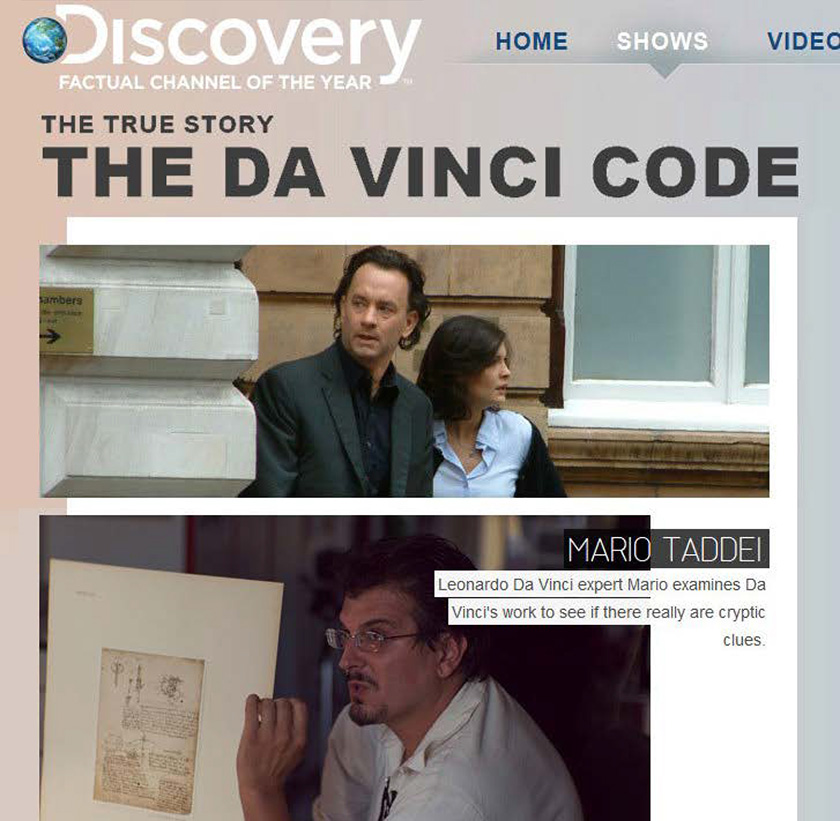
2015 07 15 Davinci Code discovery Channel – Documentary Mario Taddei

For me, however, this book remains a tangible record of a real journey: the manuscripts bought at great personal sacrifice, the nights spent modelling in 3D, the studies of the machines, the meetings with Paolo Galluzzi and Carlo Pedretti, the publication with Giunti, the international translations and, finally, the book’s arrival in China in 2008. From that moment on, my machines of Leonardo began to travel the world, to be read, copied, studied, built, imitated and, above all, to inspire new generations.
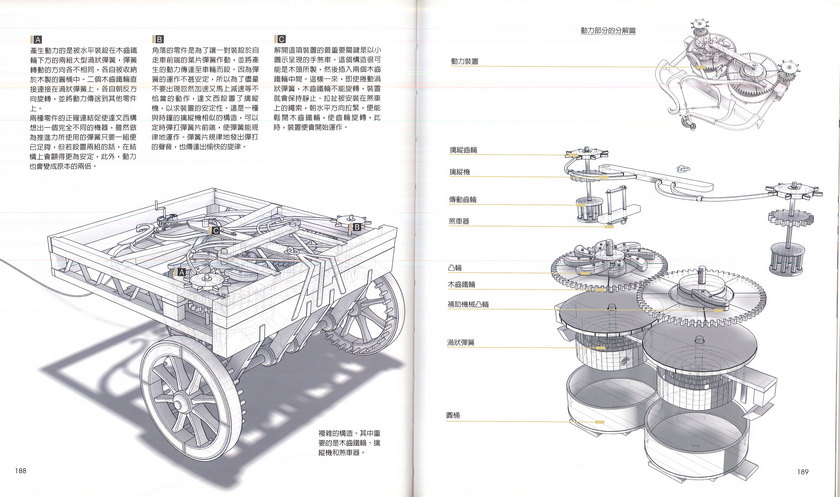
2008 Mario Taddei – Leonardo da Vinci’s Machines: Chinese Edition- 達文西的天才發明

圖解達文西天才發明[全彩珍藏版]
The Ingenious Inventions of Leonardo da Vinci: Illustrated [Colour Collector’s Edition]

出版日期2008-04-29

達文西留下的遺產是一座無盡發想與視覺的寶庫,要完全抓住這位偉大科學家的全貌是一項至難的工作。

本書介紹達文西所繪製的32種機械草圖,經電腦數位轉化為3D立體VR圖像。作者為義大利著名達文西專家——多明尼哥‧羅倫佐與兩位3D繪圖專家,嘗試了解達文西在草稿中所想要表達的技術內涵,並對達文西所設計的機械結構進行各種解讀,最後將解讀結果以電腦3D立體圖像表現出來,並展示於義大利米蘭的達文西博物館。

本書將機械結構視覺化的努力,就是實踐達文西所建立的機械設計哲學的現代版範例。在現代的機械設計過程中,工程師必須完成草圖、設計圖、零件圖與裝配圖等四種圖面。繪製草圖時,工程師將想要設計的物品畫出,過程中,工程師能夠發現各種不適切的構想,從而繼續思考。草圖可說是最能適切說明設計者整個思考過程的重要資料,也是工程師思考時的草稿。每當下一階段的圖面完成時,草稿將被丟棄。因此這種最能傳達設計者的設計思想且極具教育價值的草圖實例,很難出現在一般機械設計與工程教育的現場。

達文西所繪製的草稿圖,歷經五百餘年完整地出現在本書的每一頁中,這些草稿圖與作者的有關說明,將為機械設計與工程教育現場提供最具教育價值的參考資料與教材。

As of 2024, the rights to the book Le macchine di Leonardo, published by Giunti, have reverted to the author.

All designs and images of Leonardo da Vinci’s 3D models created by Mario Taddei are copyright Mario Taddei. (info www.MarioTaddei.net www.DaVinciACADEMY.net)
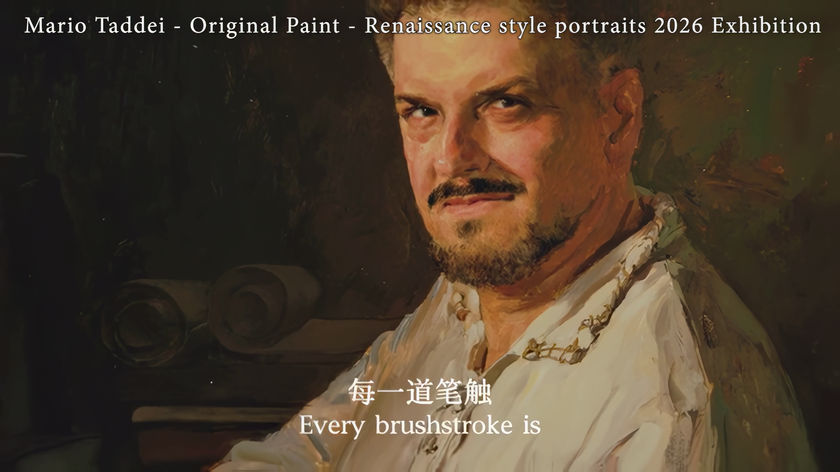
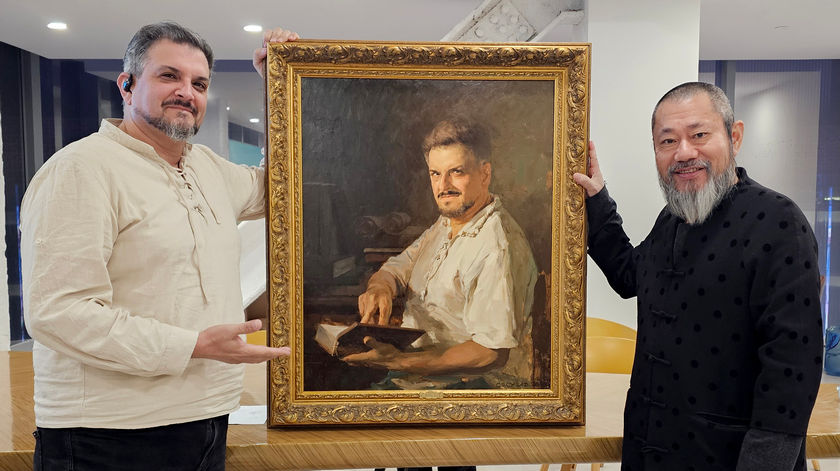
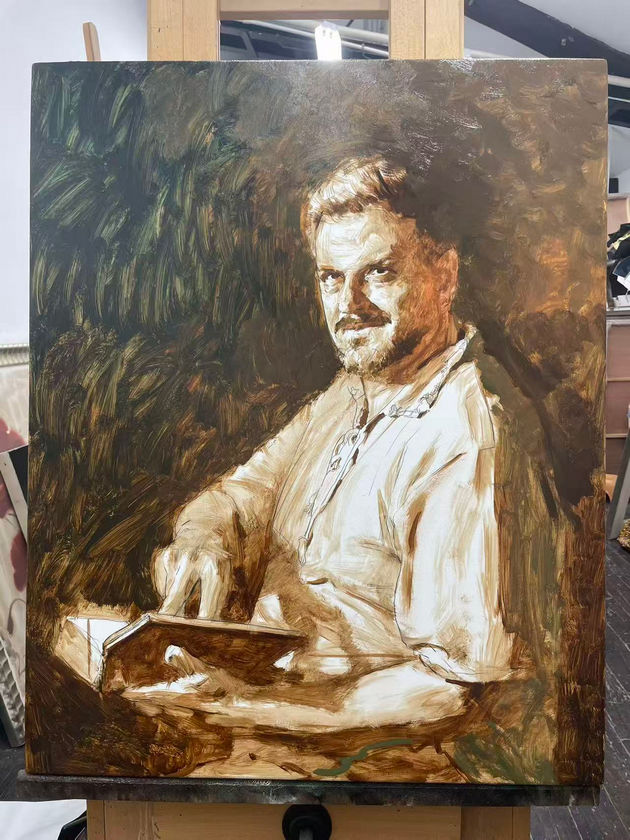
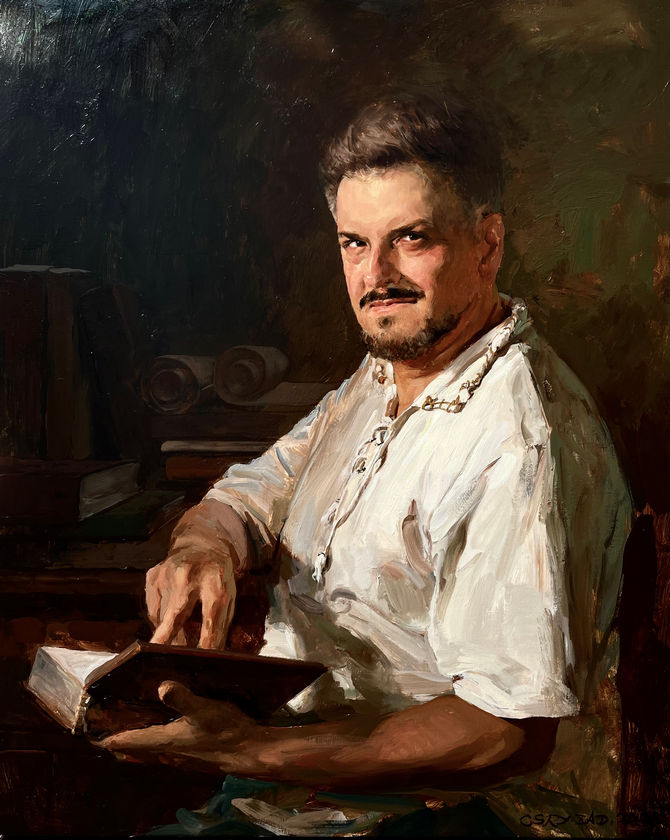
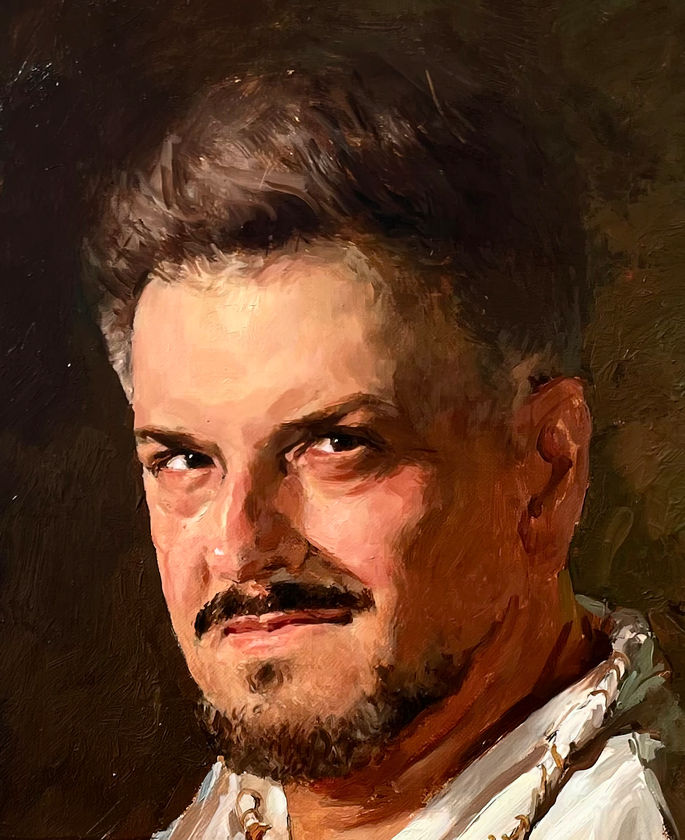
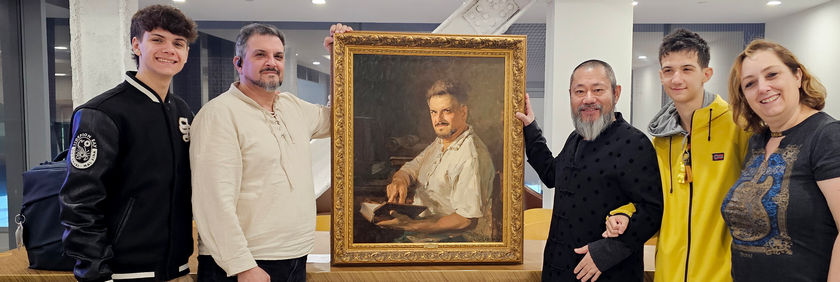
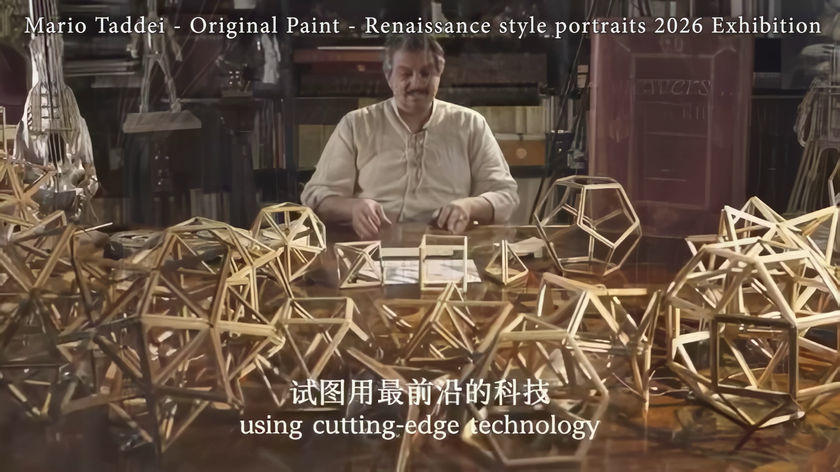
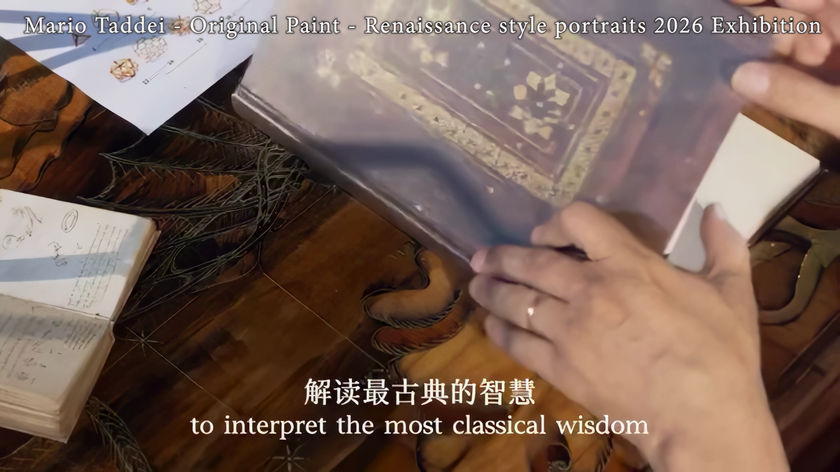
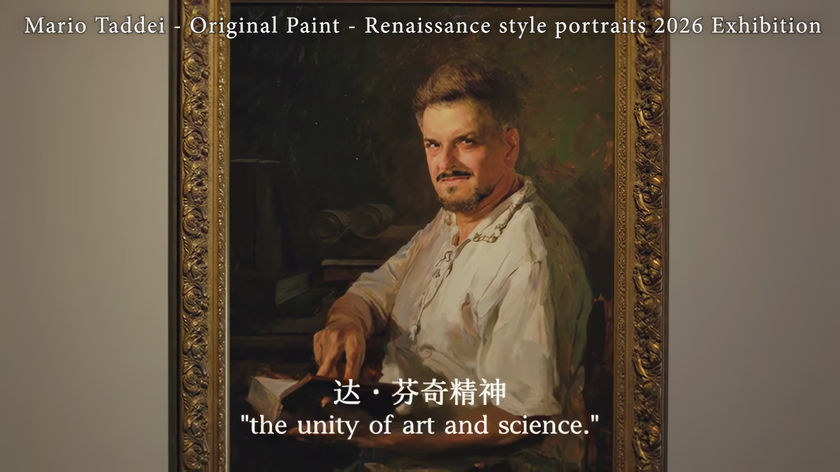
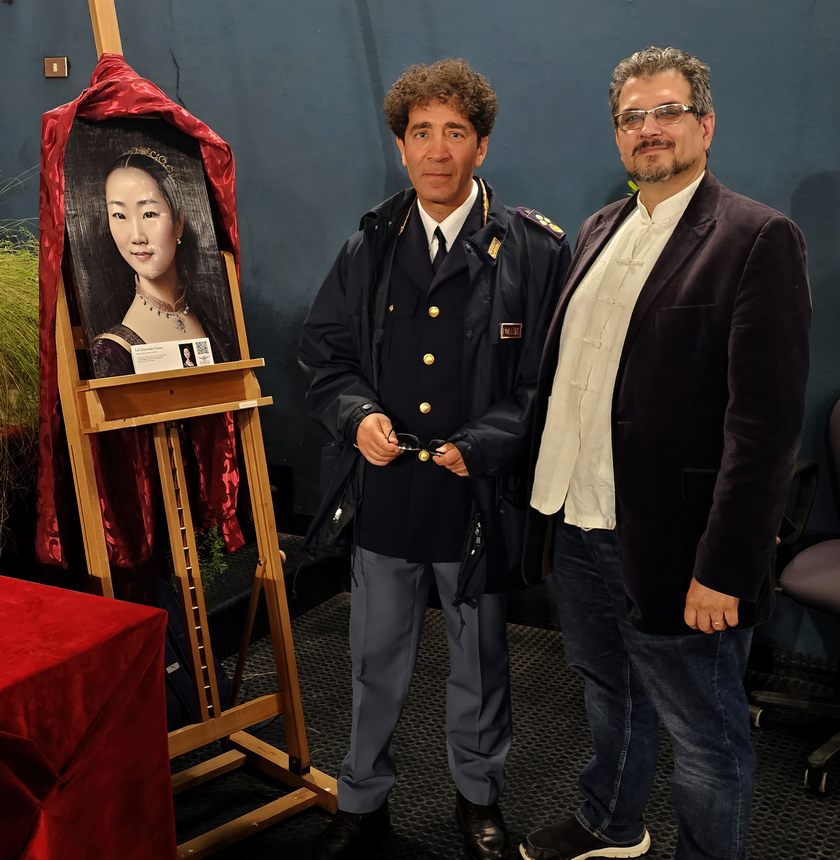
Mario Taddei – Original Paint – Renaissance style portrait for 2026 Exhibition

🇮🇹 Italiano
Grande onore ricevere questo splendido regalo da un importante gruppo artistico cinese.
Il dipinto, realizzato in autentico stile rinascimentale, farà parte di una mostra straordinaria che unirà arte contemporanea e rinascimentale con opere uniche e originali in Cina il prossimo anno.
Ringrazio di cuore Zhang Aidong e Master Shen per questo magnifico omaggio.
Vi terrò aggiornati su questa affascinante collaborazione artistica!


🇬🇧 English
It’s a great honor to receive this beautiful gift from an important Chinese art group.
The painting, created in true Renaissance style, will be part of an extraordinary exhibition that combines contemporary and Renaissance art, featuring unique and original works in China next year.
My sincere thanks to Zhang Aidong and Master Shen for this wonderful gesture.
I’ll keep you updated on this inspiring artistic collaboration!


🇨🇳 简体中文
非常荣幸收到来自中国重要艺术团队的这份珍贵礼物。
这幅以真正文艺复兴风格创作的画作,将参加一场融合当代艺术与文艺复兴艺术的特别展览,展览将在明年于中国举办,展出独特而原创的艺术作品。
衷心感谢 张爱东 和 沈大师 的精彩馈赠。
我会持续分享这场令人期待的艺术合作的最新进展!


🇦🇪 العربية (الفصحى)
يشرفني جدًا أن أتلقى هذه الهدية الفنية الرائعة من مجموعة فنية صينية مرموقة.
ستكون هذه اللوحة، المرسومة بأسلوب عصر النهضة الأصيل، جزءًا من معرض استثنائي يجمع بين الفن المعاصر وفن عصر النهضة، ويضم أعمالًا فريدة وأصلية في الصين العام المقبل.
أقدّم خالص الشكر لـ تشانغ أيدونغ و الماستر شين على هذه الهدية الرائعة.
سأوافيكم بالمستجدات حول هذا التعاون الفني الملهم!


#MarioTaddei #Rinascimento #ArteCinese #MostraDArte #RenaissanceArt #ChinaExhibition #CulturalExchange #ArtAndScience
#LeonardoDaVinciAcademy 🌐 www.DaVinciAcademy.net

🇮🇹 Italiano
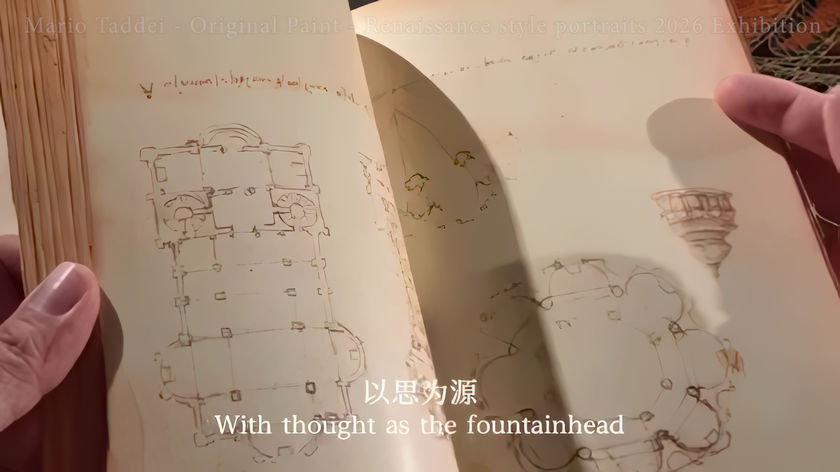
«Con il pensiero come sorgente e la saggezza come chiave
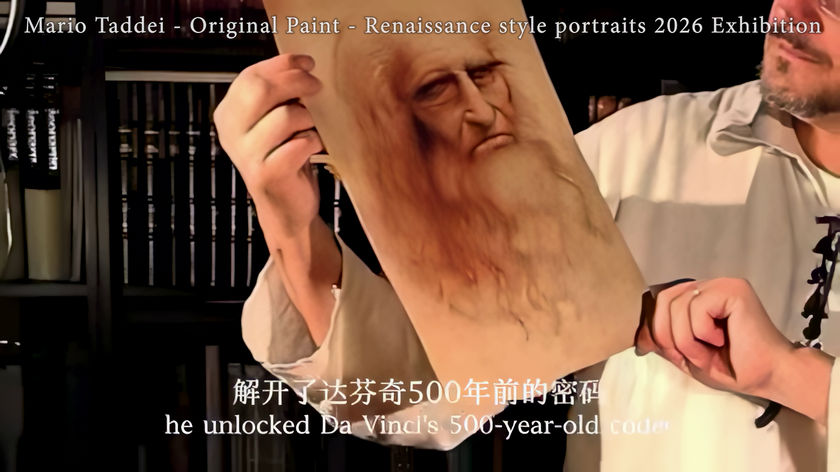
egli ha sbloccato il codice di Da Vinci vecchio di 500 anni.
Chi è lui?
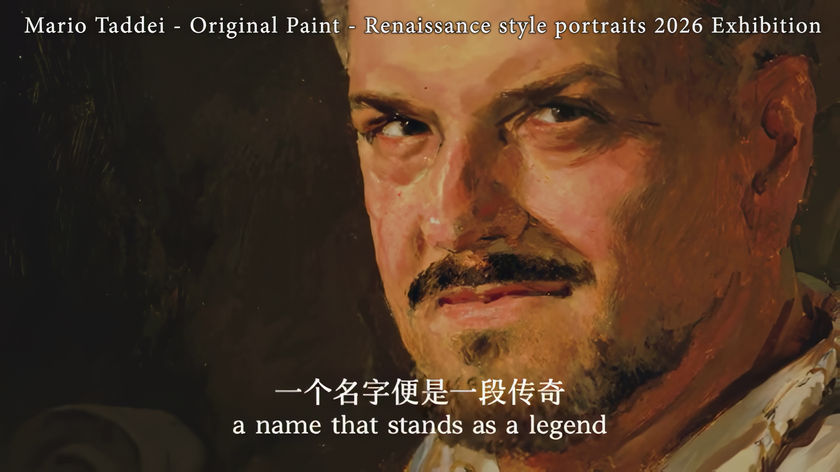
Mario Taddei, un nome che è diventato leggenda.
Come fondatore della Da Vinci Academy d’Italia,
è un artista di fama mondiale e uno dei più riconosciuti
eminenti studiosi di Leonardo da Vinci.
Costruisce un ponte tra la storia dell’arte e l’intelligenza artificiale,
utilizzando tecnologie all’avanguardia per interpretare la saggezza più classica.
Questo ritratto creato per lui possiede un valore che va ben oltre la semplice somiglianza.
La sua eleganza visiva trasmette il cuore dell’esplorazione attraverso discipline integrate
e cattura la sua convergenza intellettuale.
Nel dipinto Mario non porta un’autorità accademica opprimente,
ma si connette con noi attraverso una presenza composta e vigorosa.
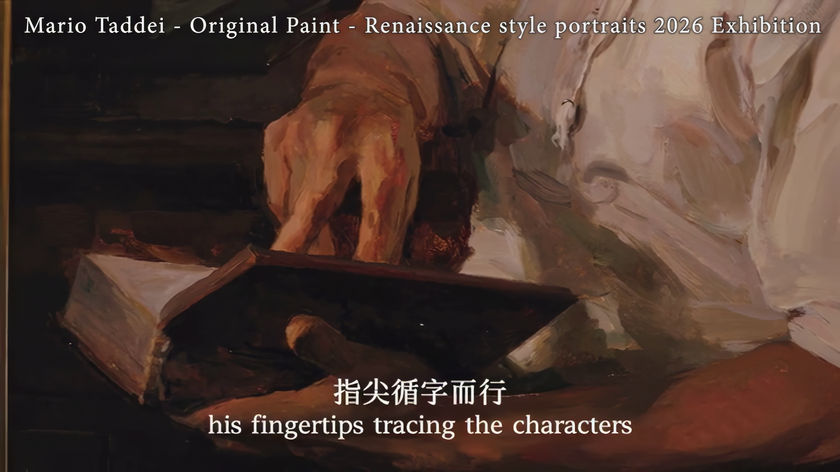
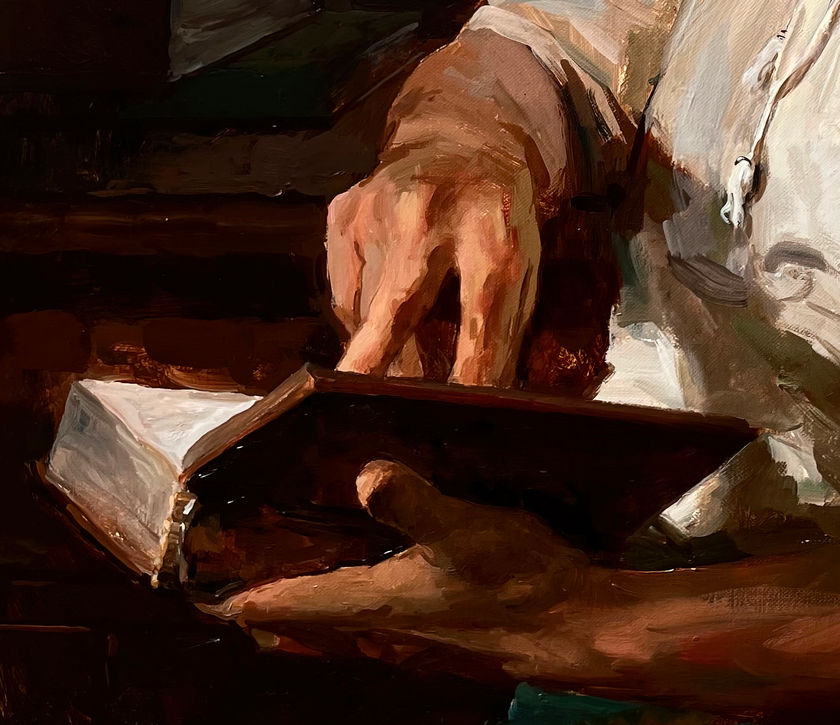
Solleva la mano per sfiorare una pergamena, le dita che seguono ogni tratto dei caratteri:
una ricerca instancabile della conoscenza.
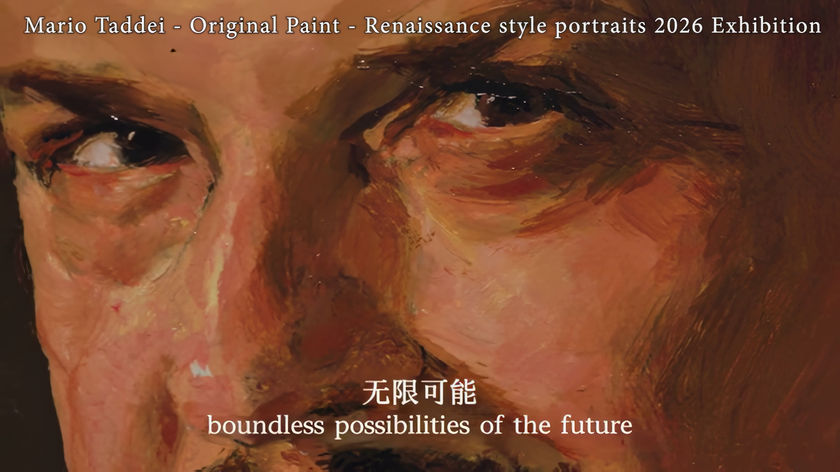
Il suo sguardo penetra nelle profondità della storia mentre guarda fermamente
alle infinite possibilità del futuro.
Luce e ombra si intrecciano, portando avanti l’eredità
del Rinascimento mentre abbracciano il dinamismo moderno.
I toni caldi, come la doratura del tempo, mettono in risalto
il suo straordinario portamento che trascende le discipline.
Ogni pennellata è la manifestazione della saggezza sulla tela,
ogni tonalità incarna lo spirito di Da Vinci, l’unità tra arte e scienza.»
Testo tratto dal video di MasterShen

🇬🇧 English (original)
“With thought as the fountainhead and wisdom as the key
he unlocked Da Vinci’s 500-years-old code.
Who is he?
Mario Taddei a name that stands as a legend.
As the founder of Italy’s Da Vinci Academy
he is a globally acclaimed artist and one of the most widely recognized
preeminent Da Vinci scholars.
He builds a bridge between art history and artificial intelligence
using cutting-edge technology to interpret the most classical wisdom.
This portrait created for him holds value that extends far beyond mere likeness
Its visual elegance conveys exploration’s core via integrated disciplines
and capture his intellectual convergence.
In the painting Mario carries no overbearing academic authority
instead he connects with us through a composed forceful presence.
He lifts his hand to brush a scroll his fingertips tracing the characters every movement
a relentless pursuit of knowledge.
His gaze penetrates the depths of history while gazing firmly
at the boundless possibilities of the future.
Light and shadow intertwine carrying on the legacy
of the Renaissance while embracing modern dynamism.
The warm tones like the gilding of time highlight
his remarkable demeanor that transcends disciplines.
Every brushstroke is the manifestation of wisdom on canvas
every hue embodies the Da Vinci spirit of the unity of art and science.”
Text From the video By MasterShen

🇨🇳 简体中文
“以思想为源泉,以智慧为钥匙,
他解开了达·芬奇五百年的密码。
他是谁?
马里奥·塔代伊——一个被誉为传奇的名字。
作为意大利达·芬奇学院的创始人,
他是一位享誉全球的艺术家,也是世界上最著名的
达·芬奇权威学者之一。
他在艺术史与人工智能之间架起了一座桥梁,
运用尖端科技去诠释最经典的智慧。
这幅为他创作的肖像,其价值远远超越了单纯的相似。
画面的优雅视觉传达了探索的核心,通过多学科的融合,
捕捉了他思想的汇聚。
在这幅画中,马里奥没有展现令人压迫的学术威严,
而是以一种沉稳而有力的气场与我们相连。
他举起手轻拂卷轴,指尖追随着文字的每一个笔画——
那是对知识的不懈追求。
他的目光穿透历史的深处,同时坚定地凝视着
未来无限的可能。
光与影交织,延续着文艺复兴的遗产,
同时拥抱现代的活力。
温暖的色调如同时间的鎏金,
凸显出他超越学科的非凡风采。
每一笔都是智慧在画布上的显现,
每一种色彩都体现了达·芬奇“艺术与科学合一”的精神。”
—— 摘自 MasterShen 视频文字

🇦🇪 العربية (الفصحى)
«بالفكر كمصدر، وبالحكمة كمفتاح،
فكّ شيفرة دافنشي التي مرّ عليها خمسمائة عام.
من هو؟
ماريو تاداي، اسم أصبح أسطورة.
بصفته مؤسس أكاديمية دافنشي في إيطاليا،
فهو فنان ذو شهرة عالمية وأحد أبرز
الباحثين في إرث دافنشي المعترف بهم في العالم.
يبني جسرًا بين تاريخ الفن والذكاء الاصطناعي،
مستخدمًا أحدث التقنيات لتفسير أسمى أشكال الحكمة الكلاسيكية.
هذه اللوحة المرسومة له تحمل قيمة تتجاوز مجرد الشبه،
فأناقتها البصرية تنقل جوهر الاستكشاف عبر تداخل التخصصات
وتجسّد تلاقي فكره العميق.
في اللوحة لا يظهر ماريو بسلطة أكاديمية متعجرفة،
بل يتواصل معنا من خلال حضورٍ متّزنٍ وقوي.
يرفع يده ليلمَس المخطوطة، وأطراف أصابعه تتبع كل حركة من حروفها،
في سعيٍ لا يهدأ نحو المعرفة.
نظرته تخترق أعماق التاريخ بينما تتجه بثبات
نحو آفاق المستقبل اللامتناهية.
يتداخل الضوء والظل ليواصلا إرث
عصر النهضة مع احتضان الحيوية الحديثة.
الألوان الدافئة، كطلاء الزمن الذهبي، تُبرز
هيبته المميزة التي تتجاوز حدود التخصصات.
كل ضربة فرشاة تجسيدٌ للحكمة على القماش،
وكل لونٍ يجسّد روح دافنشي في وحدة الفن والعلم.»
نص من فيديو للفنان ماستر شين

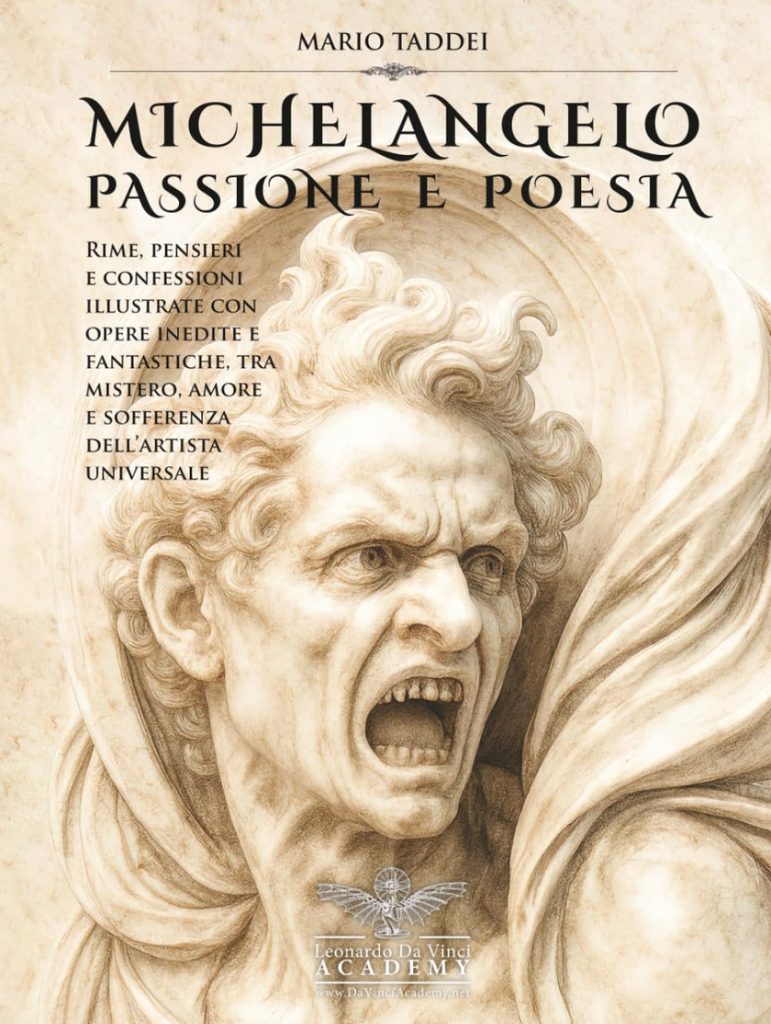
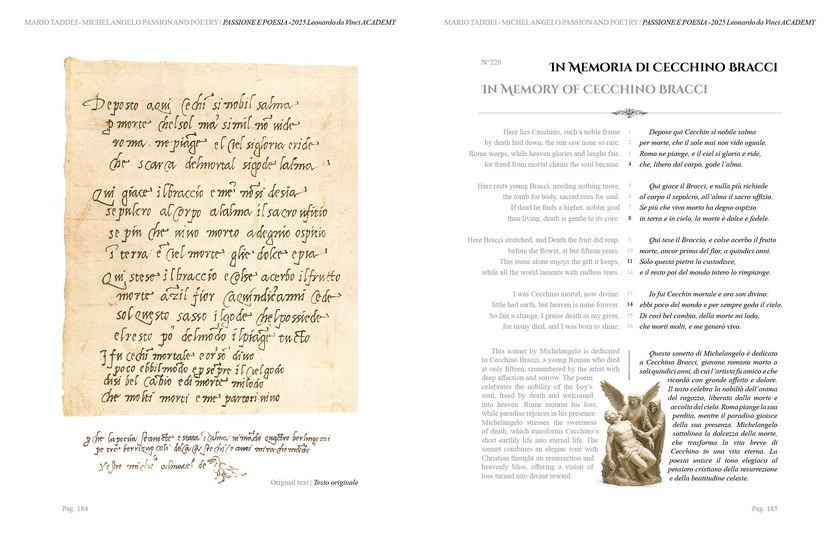
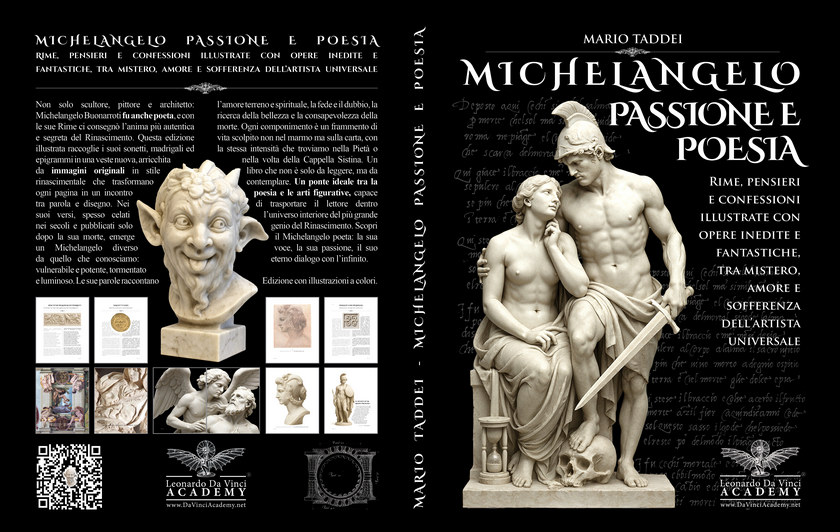
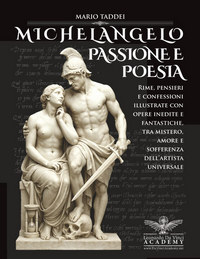
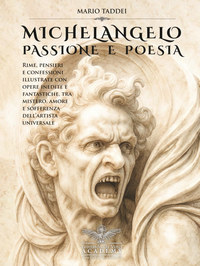
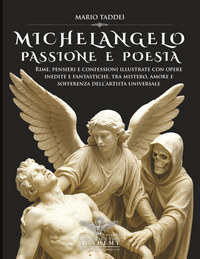
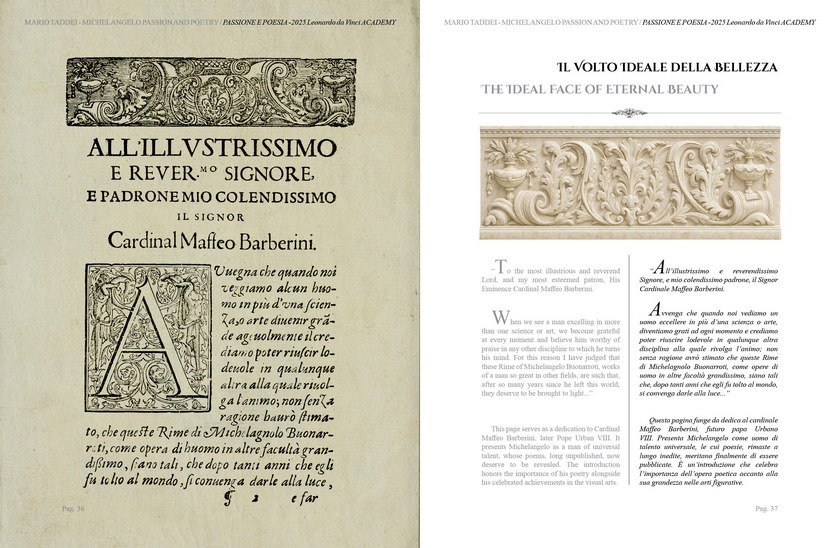
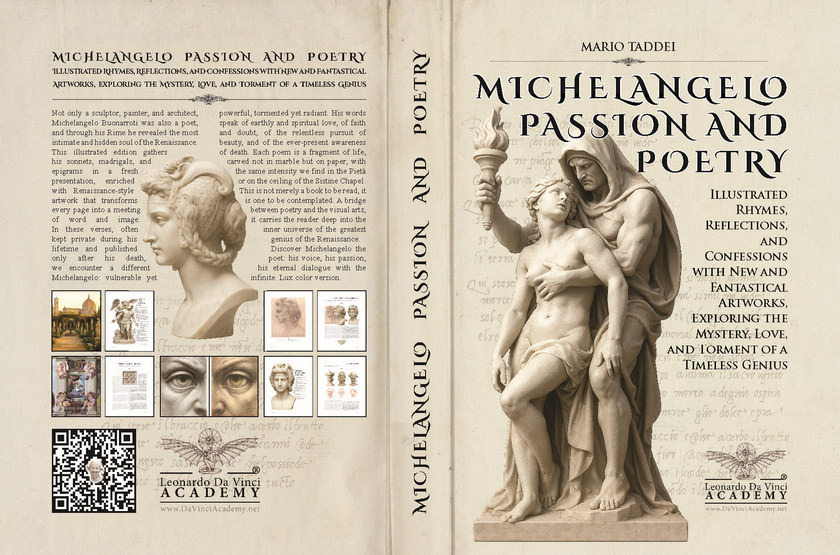
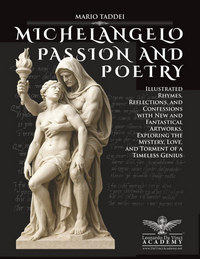
LIBRO MICHELANGELO, PASSIONE E POESIA – PASSION AND POETRY BOOK

Rime, pensieri e confessioni illustrate con opere inedite e fantastiche, tra mistero, amore e sofferenza dell’artista universale

MICHELANGELO, PASSIONE E POESIA
Rime, pensieri e confessioni illustrate con opere inedite e fantastiche, tra mistero, amore e sofferenza dell’artista universale


Non solo scultore, pittore e architetto: Michelangelo Buonarroti fu anche poeta, e con le sue Rime ci consegnò l’anima più autentica e segreta del Rinascimento.

Questa edizione illustrata raccoglie i suoi sonetti, madrigali ed epigrammi in una veste nuova, arricchita da immagini originali in stile rinascimentale che trasformano ogni pagina in un incontro tra parola e disegno. Nei suoi versi, spesso celati nei secoli e pubblicati solo dopo la sua morte, emerge un Michelangelo diverso da quello che conosciamo: vulnerabile e potente, tormentato e luminoso. Le sue parole raccontano l’amore terreno e spirituale, la fede e il dubbio, la ricerca della bellezza e la consapevolezza della morte. Ogni componimento è un frammento di vita scolpito non nel marmo ma sulla carta, con la stessa intensità che troviamo nella Pietà o nella volta della Cappella Sistina. Un libro che non è solo da leggere, ma da contemplare. Un ponte ideale tra la poesia e le arti figurative, capace di trasportare il lettore dentro l’universo interiore del più grande genio del Rinascimento.
Scopri il Michelangelo poeta: la sua voce, la sua passione, il suo eterno dialogo con l’infinito.


Edizione – Leonardo da Vinci Academy 2025
Copyright 2025, Mario Taddei, www.MarioTaddei.net

📜 Michelangelo poeta: l’anima nascosta del Rinascimento

Tutti conoscono Michelangelo Buonarroti come uno dei più grandi artisti della storia: autore del David, della Pietà, della volta della Cappella Sistina. Ma pochi sanno che fu anche un poeta straordinario, capace di riversare nei versi tutta la sua sofferenza, le sue passioni e i suoi tormenti interiori.

Michelangelo scrisse oltre 300 poesie, tra sonetti, madrigali ed epigrammi, molti dei quali rimasti a lungo inediti. Nei suoi scritti troviamo riflessioni sulla bellezza, sull’amore terreno e divino, sulla morte, la fede, il corpo, la carne e lo spirito. Le sue parole scolpiscono emozioni come faceva col marmo: crude, sincere, spesso dolorose. Questo libro è un invito ad ascoltare la sua voce più segreta.

🎨Illustrazioni inedite: omaggio a Michelangelo

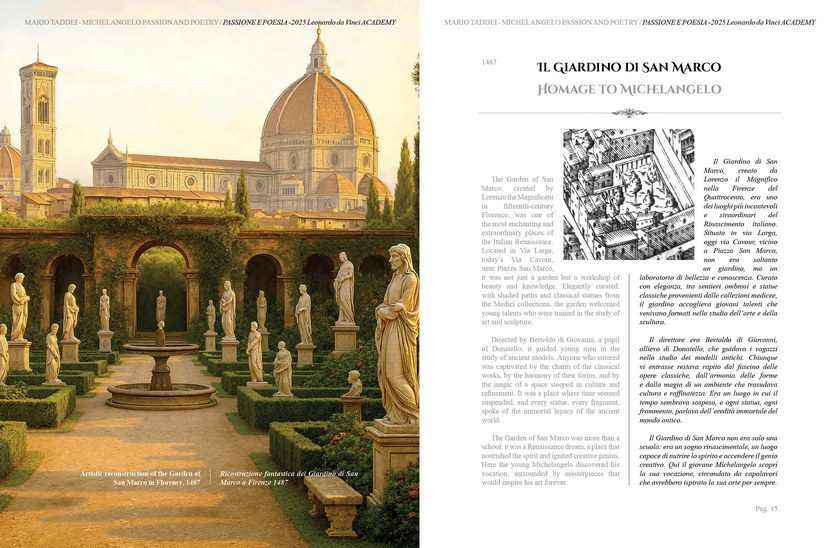
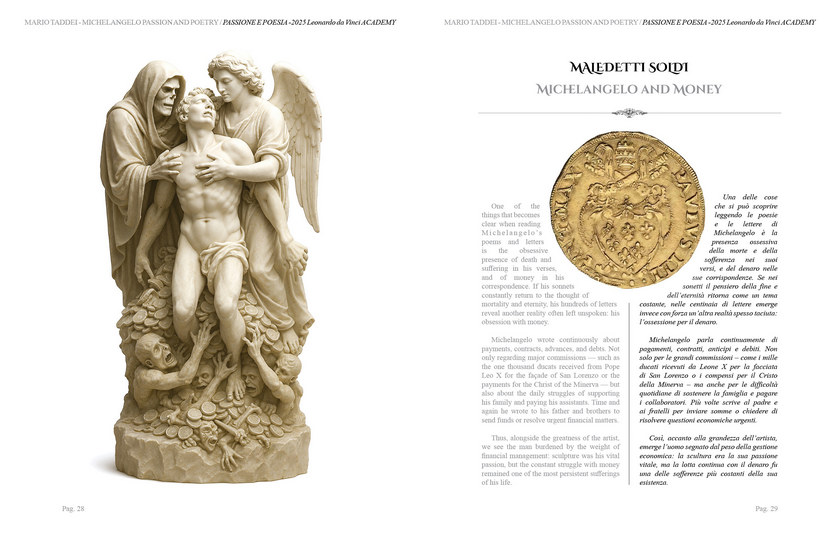
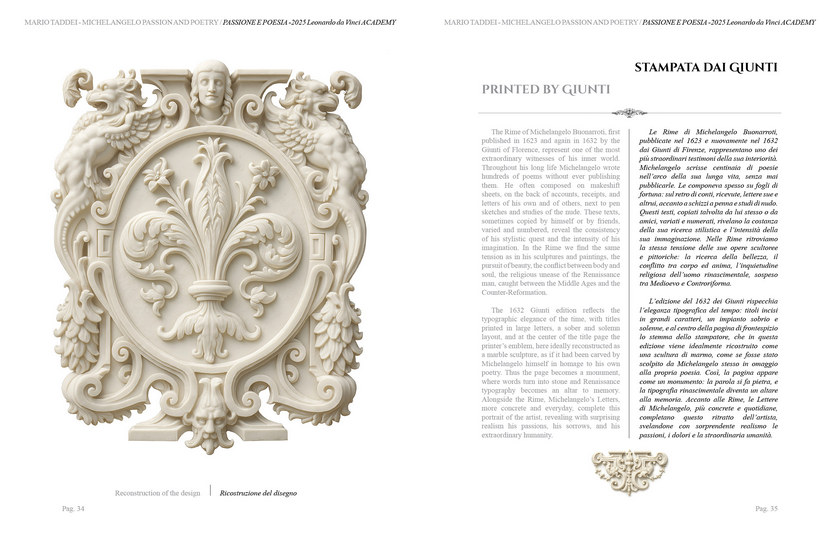
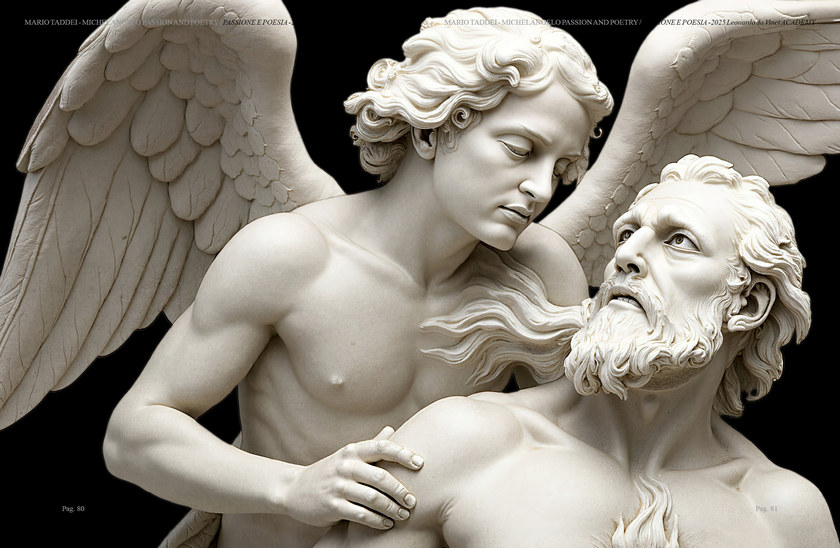
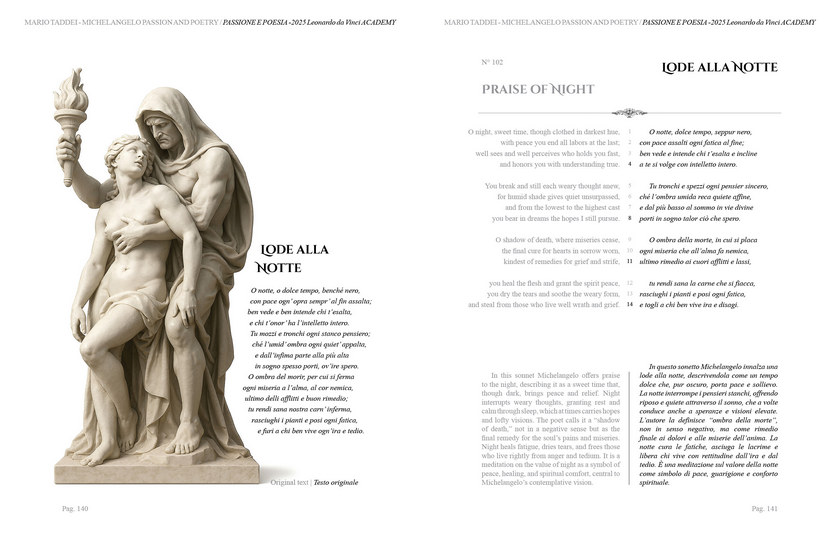
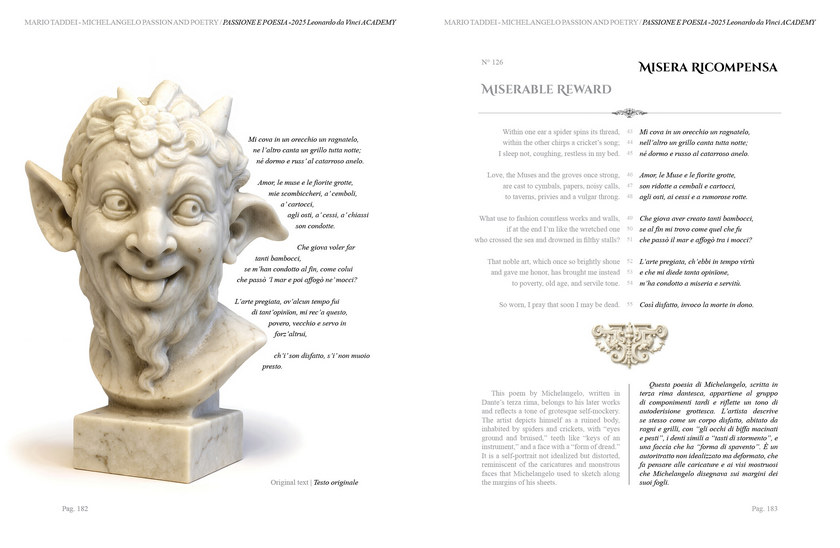
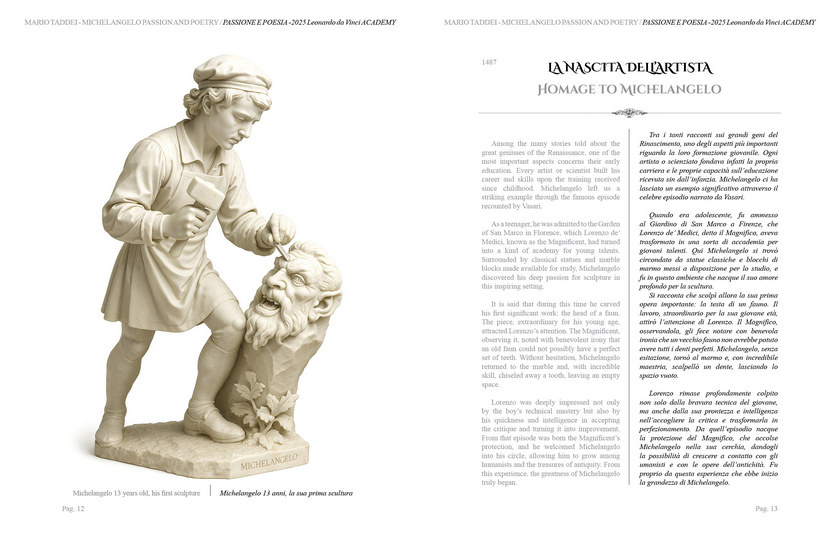
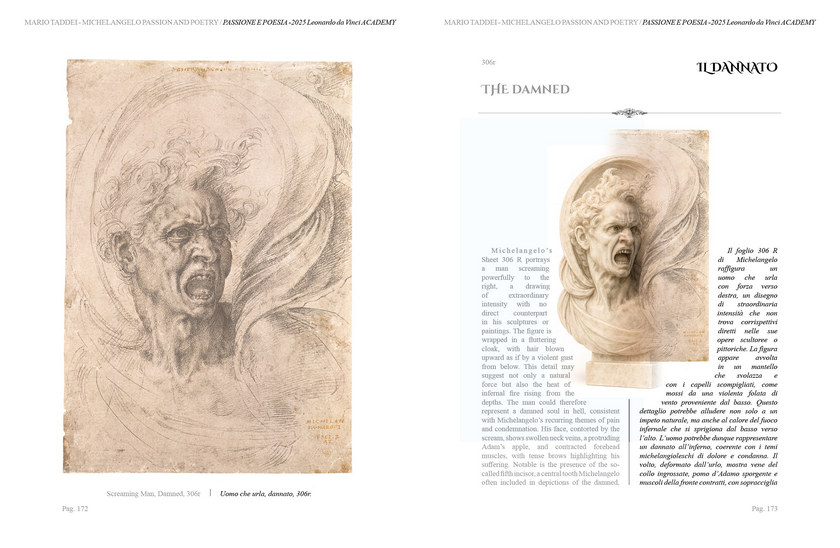
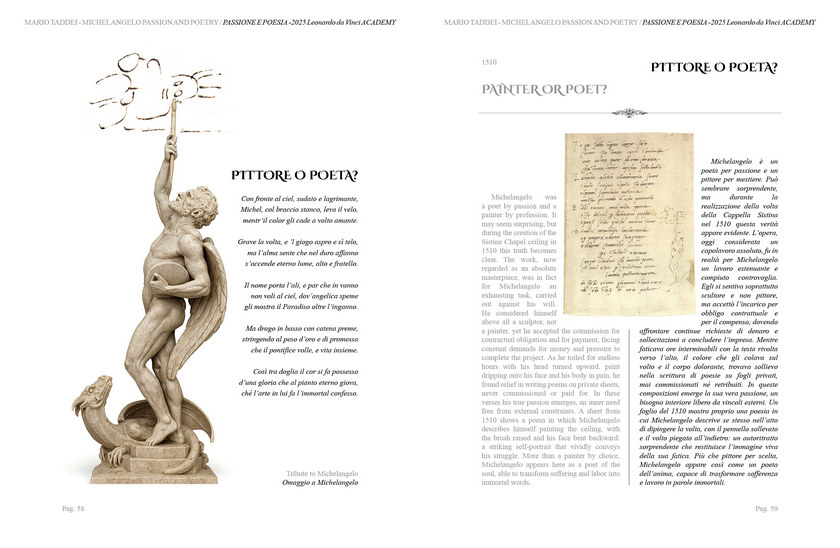
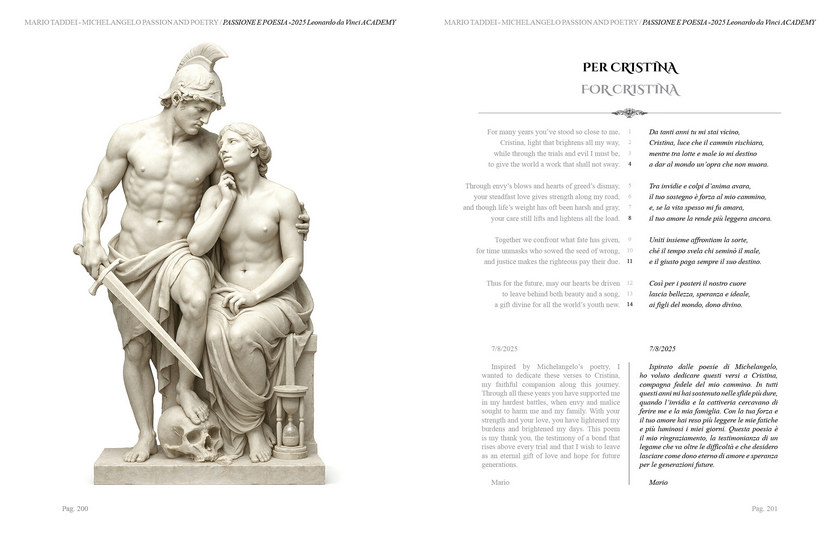
Questa edizione non si limita a raccogliere le poesie: le accompagna con illustrazioni originali e statue inedite create come omaggio al Michelangelo scultore.

Per ogni poesia è stata realizzata un’immagine: una figura, una statua, una scena simbolica che ne interpreta visivamente il significato. In tutto, centinaia di illustrazioni accompagnano i versi con forza, sensibilità e rispetto per lo stile rinascimentale.
Si tratta di un lavoro unico: un dialogo tra parola e immagine, dove ogni pagina diventa un incontro tra arte antica e visione contemporanea.

🪨I disegni di Michelangelo prendono forma

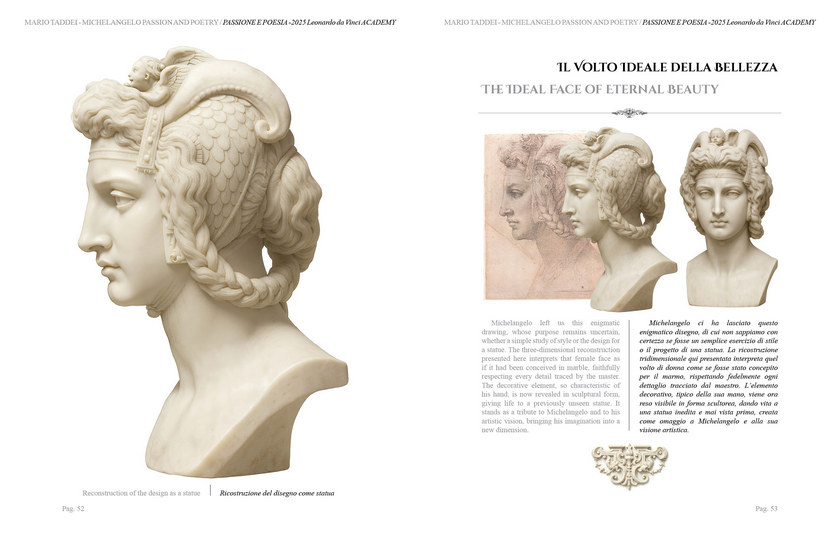
Michelangelo non fu solo poeta e scultore, ma anche disegnatore. Molti dei suoi schizzi, contenuti in manoscritti e carte private, rappresentano idee e studi per opere mai realizzate: statue, figure, simboli, progetti.

Per la prima volta, alcuni di questi disegni sono stati ricostruiti come se fossero statue tridimensionali, restituendo corpo e volume a ciò che era rimasto solo sulla carta. Dopo 500 anni, i sogni visivi di Michelangelo rivivono in forma digitale e illustrata.
Questa sezione del libro è un omaggio alla sua capacità visionaria, e porta il lettore a scoprire un Michelangelo “futurista”, che progettava forme ancora oggi moderne.

💌Un libro da regalare, un viaggio da condividere

Il libro contiene anche una breve introduzione alla vita di Michelangelo, raccontata con semplicità per avvicinare ogni lettore al suo mondo. È quindi un’ottima scelta anche come regalo speciale per chi ama l’arte, la poesia o il Rinascimento, ma anche per chi desidera stupire il proprio partner con parole d’amore scritte dal più grande artista italiano.
Le poesie parlano infatti di passione, bellezza, dolore e desiderio. Sentimenti eterni

📚Poesie comprensibili, finalmente accessibili

La lingua delle poesie originali di Michelangelo può risultare complessa, arcaica, e per molti lettori scoraggiante. Ecco perché in questo libro ogni poesia è proposta sia nella versione originale che in una versione semplificata in italiano moderno, comprensibile e fedele.

Inoltre, tutte le poesie sono tradotte anche in inglese chiaro, rendendo questa edizione un punto di partenza ideale per chi vuole avvicinarsi alla poesia di Michelangelo per la prima volta, senza barriere linguistiche.
Dopo aver letto questo libro illustrato, il lettore potrà eventualmente approfondire i testi originali integrali nelle edizioni critiche, ma lo farà con consapevolezza, non da estraneo.

📖Edizioni per ogni lettore: bellezza accessibile

Per incontrare le diverse esigenze dei lettori, il libro è disponibile in quattro edizioni differenti:

  • Lusso a colori, con tutte le pagine illustrate a colori, in copertina rigida o flessibile
  • Versione monocromatica su carta avorio, con le illustrazioni in scala di grigi, anch’essa disponibile in copertina rigida o flessibile

Anche nella versione monocromatica, il libro mantiene un fascino unico: le statue e i disegni appaiono come vere opere scolpite in ombra e luce, in piena armonia con lo stile michelangiolesco.

Scopri Michelangelo come non l’hai mai letto, né visto prima.
Un libro che parla al cuore, alla mente e agli occhi.

EDIZIONI ITALIANE

Il libro è disponibile in diverse edizioni, pensate per soddisfare ogni esigenza, sia estetica che economica.
Esistono due versioni interamente a colori, con copertina rigida o copertina flessibile, ideali per chi desidera un’esperienza visiva completa e di pregio.

Per chi preferisce una soluzione più accessibile, sono disponibili anche due versioni stampate su carta avorio con illustrazioni monocromatiche, anch’esse in copertina rigida o copertina flessibile.
Anche in questa versione il libro mantiene il suo fascino, grazie alla resa intensa e suggestiva delle immagini in scala di grigi, perfettamente in linea con lo stile delle statue e dei disegni di Michelangelo.

💡 Consiglio dell’autore:
Per chi cerca il miglior equilibrio tra qualità e prezzo, si consiglia vivamente l’edizione con copertina rigida e pagine monocromatiche, che unisce eleganza, resistenza e convenienza.

Mario Taddei
Mario Taddei, laureato al Politecnico di Milano,  ha dedicato molti anni di lavoro, ricerca e studio a Leonardo da Vinci, analizzandone meticolosamente l’intera produzione artistica e scientifica. È docente di Computer grafica e Book informatico. Ha progettato e realizzato macchinari in 3D, video, ricostruzioni virtuali, ha tenuto lezioni e conferenze in vari paesi, ha curato pubblicazioni e mostre, iniziative didattiche, musei concreti e virtuali, multimediali e interattivi, tutti dedicati alla scienza medievale e rinascimentale e in particolare all’opera di Leonardo.

ENG

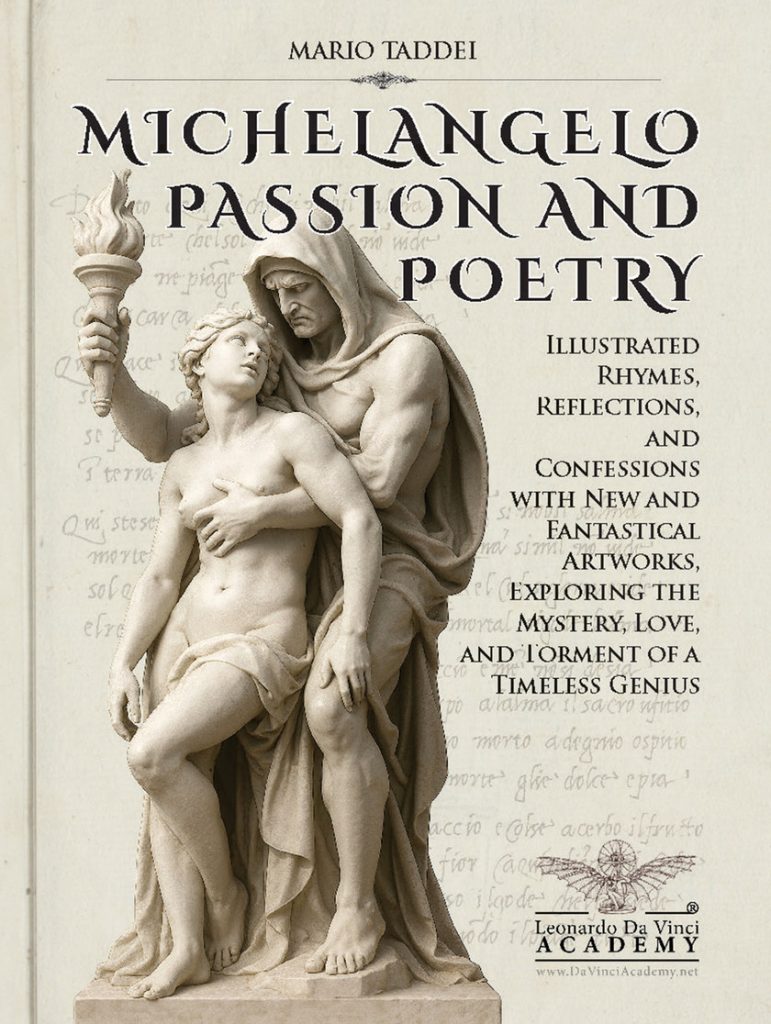
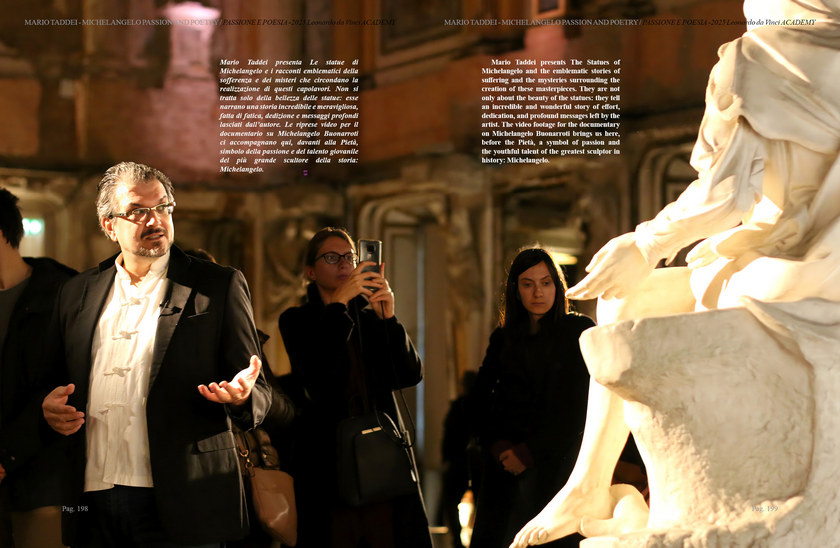
MICHELANGELO: PASSION AND POETRY

Rhymes, thoughts, and confessions illustrated with unpublished and visionary works, exploring the mystery, love, and suffering of the universal artist

Not only a sculptor, painter, and architect: Michelangelo Buonarroti was also a poet. Through his Rime, he revealed the most authentic and hidden soul of the Renaissance.

This illustrated edition brings together his sonnets, madrigals, and epigrams in a new form, enriched with original Renaissance-style images that transform every page into a meeting of word and drawing.

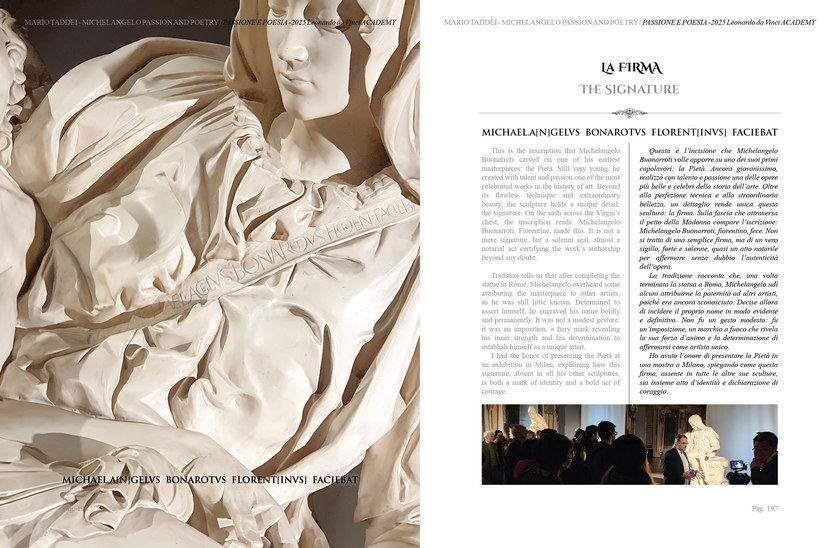
In these verses—often hidden for centuries and published only after his death—emerges a Michelangelo different from the one we think we know: vulnerable yet powerful, tormented yet radiant. His words speak of earthly and spiritual love, of faith and doubt, of the pursuit of beauty and the awareness of mortality. Each poem is a fragment of life, carved not in marble but on paper, with the same intensity we find in the Pietà or the ceiling of the Sistine Chapel.

This is not a book to be read only, but to be contemplated. A bridge between poetry and the visual arts, it carries the reader into the inner universe of the greatest genius of the Renaissance.

Discover Michelangelo the poet: his voice, his passion, his eternal dialogue with the infinite.

Edition — Leonardo da Vinci Academy 2025


Copyright 2025, Mario Taddei, www.MarioTaddei.net

Copyright 2025, Leonardo da Vinci Academy, www.DaVinciACADEMY.net

📜 Michelangelo the Poet: The Hidden Soul of the Renaissance

Everyone knows Michelangelo Buonarroti as one of the greatest artists of all time—creator of the David, the Pietà, and the Sistine Chapel ceiling. But few realize he was also a remarkable poet, who poured his pain, passion, and inner torment into hundreds of deeply personal verses.

Michelangelo wrote over 300 poems—sonnets, madrigals, and epigrams—many of which remained unpublished during his lifetime. In his writing, we find reflections on beauty, love (both earthly and divine), death, faith, the body and the soul. His words carve emotion as powerfully as his chisel shaped marble. This book invites you to listen to his most secret voice.

🎨 Unseen Illustrations: A Tribute to Michelangelo

This edition is more than a collection of poems—it’s a visual homage to Michelangelo the sculptor.

For each poem, an original artwork has been created: a figure, a statue, or a symbolic scene that visually interprets the meaning of the verse. In total, the book features hundreds of new and original illustrations, making it a unique dialogue between poetry and image.
Every page becomes a fusion of ancient spirit and modern vision, deeply inspired by Renaissance aesthetics.

🪨 Michelangelo’s Drawings Brought to Life

Michelangelo was also a prolific draftsman. Many of his sketches, found in notebooks and manuscripts, depict conceptual studies for sculptures and paintings that were never realized.

For the first time, some of these drawings have been reconstructed as three-dimensional sculptures, giving shape and volume to what existed only on paper.
After 500 years, Michelangelo’s visionary designs are reborn—finally coming to life through modern interpretation and digital artistry. This part of the book celebrates the forward-thinking genius of an artist far ahead of his time.

💌 A Perfect Gift and an Artistic Journey

The book also includes a concise, engaging introduction to Michelangelo’s life—making it a great gift for anyone interested in art, poetry, or the Renaissance.

It’s also a meaningful present for a loved one: these poems speak of passion, beauty, longing, and faith. They are timeless emotions, shared across centuries, made even more powerful when paired with evocative imagery.

📚 Poetry Without Barriers: Clear, Modern, Translated

Michelangelo’s original language can be dense, archaic, and intimidating for modern readers. That’s why this book presents each poem in its original form, followed by a simplified Italian version—accessible yet faithful to the meaning.

In addition, each poem is translated into clear, readable English, making this the ideal introduction to Michelangelo’s poetic world.
No more struggling with obscure texts—this book removes the fear that often stops readers from approaching classic poetry. After reading this illustrated edition, you may be inspired to explore more academic collections—but this time, with confidence and context.

📖 A Book for Every Reader: Beauty Made Accessible

To meet all preferences and budgets, the book is available in four editions:

  • Full-color luxury edition: available in hardcover or softcover
  • Monochrome edition on ivory paper: also available in hardcover or softcover

Even in the monochrome version, the book remains visually striking. The grayscale tones suit the sculptures and sketches beautifully, capturing Michelangelo’s aesthetic with powerful simplicity.

ENGLISH EDITIONS

The book is available in multiple editions, designed to meet every preference—both aesthetic and budget-conscious.
There are two full-color editions, offered with either a hardcover or softcover, perfect for those who want the most vivid and luxurious visual experience.

For a more affordable option, there are also two editions printed on ivory-colored paper with monochromatic illustrations, again available in both hardcover and softcover formats.
Even in the monochrome version, the book remains visually striking—thanks to the timeless beauty of statues and drawings rendered in elegant grayscale tones.

💡 Author’s recommendation:
For the best balance of quality and affordability, the hardcover monochrome edition is highly recommended. It offers durability, charm, and excellent value.

Mario Taddei

Mario Taddei
Mario Taddei a graduate of the Milan Polytechnic, has devoted many years of work, research and study to Leonardo da Vinci, meticulously analyzing his entire artistic and scientific output. He is a lecturer in Computer Graphics and Computer Book. He has designed and built 3D machines, videos, virtual reconstructions, given lectures and conferences in various countries, curated publications and exhibitions, educational initiatives, concrete and virtual, multimedia and interactive museums, all dedicated to medieval and renaissance science and in particular to Leonardo’s work.

Libri di Mario Taddei – ITALIANO
Mario Taddei’s Books – ENGLISH TEXTS

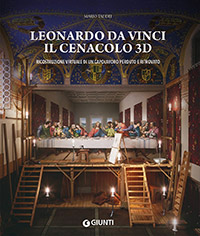
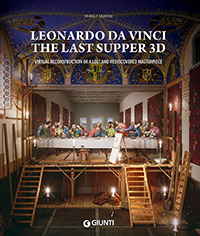
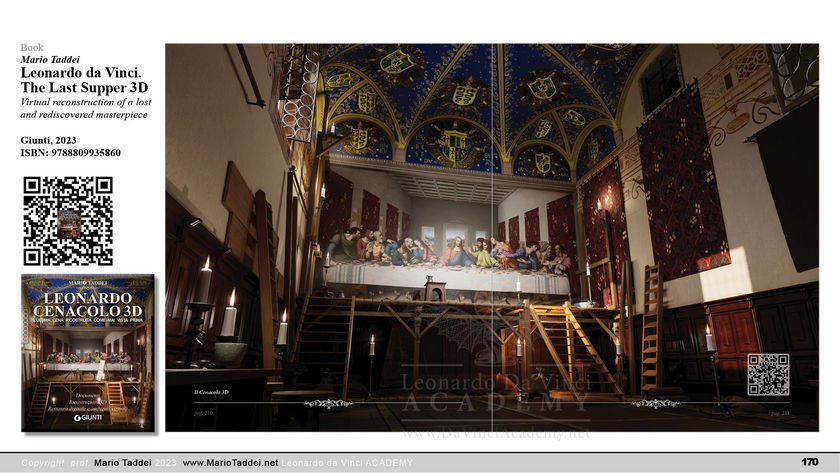
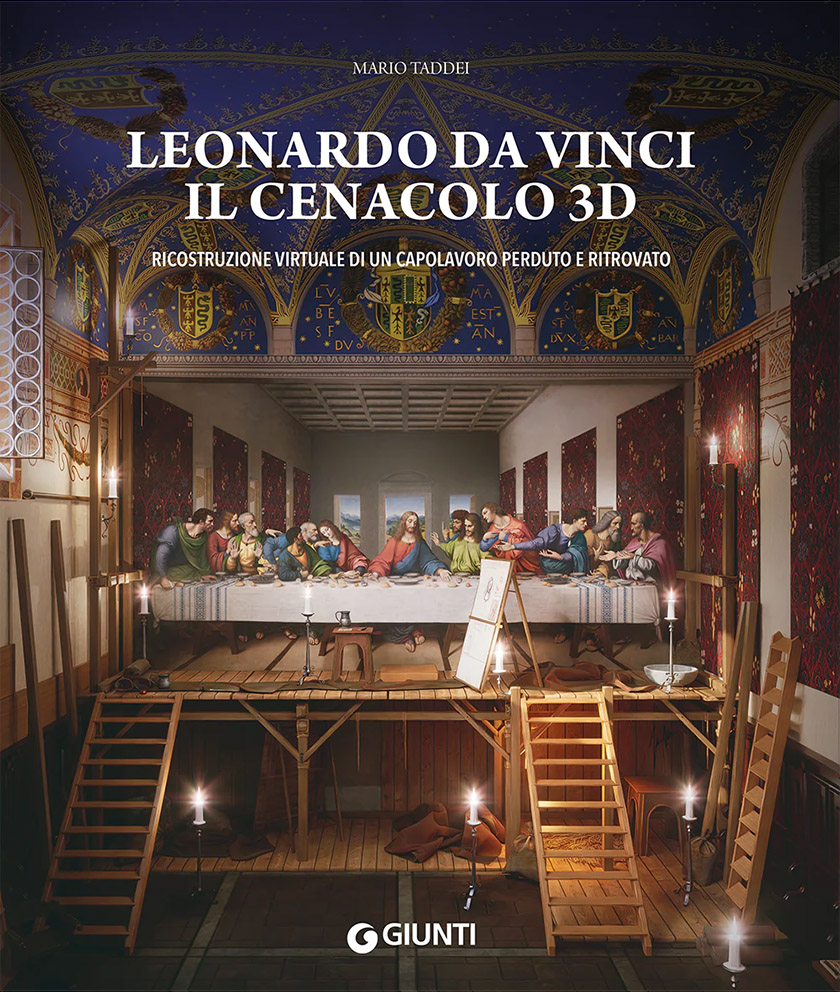
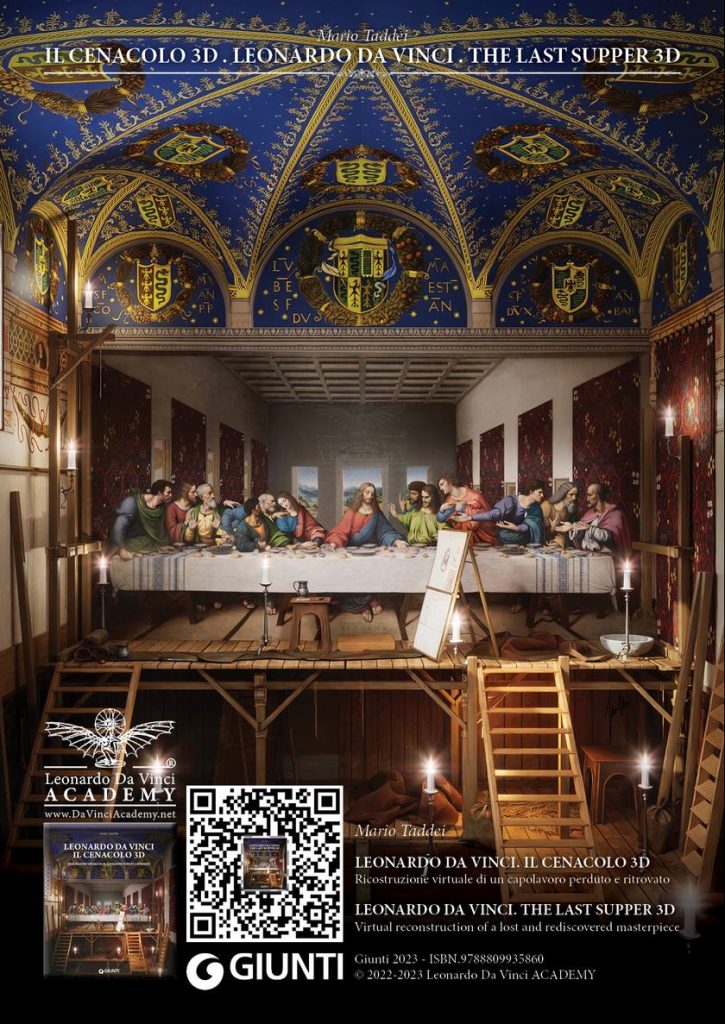
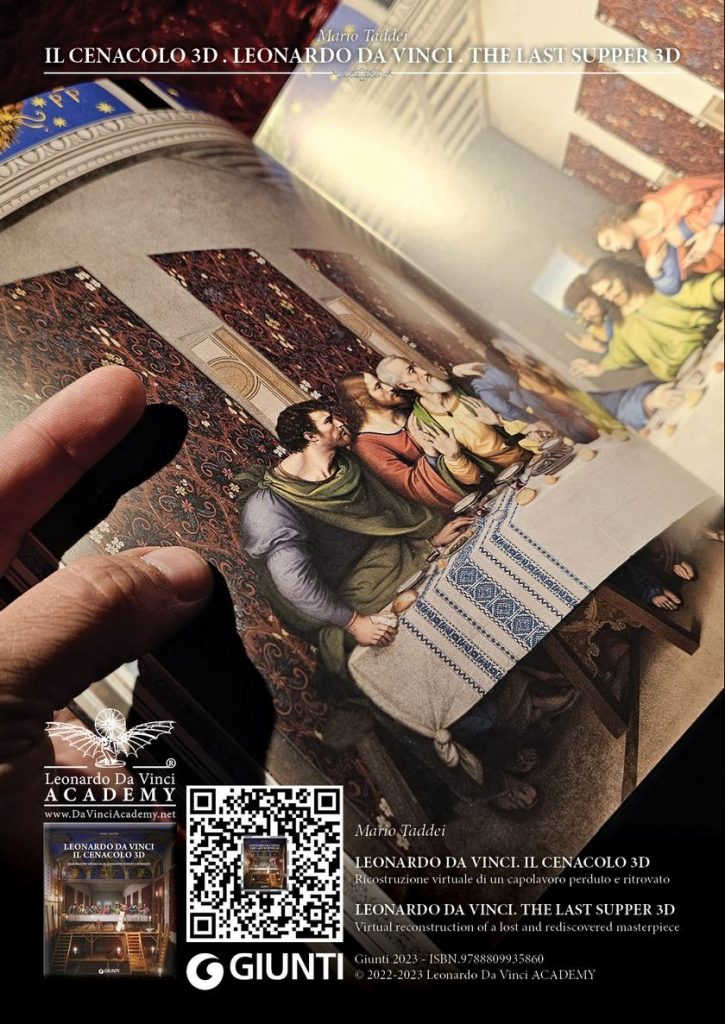
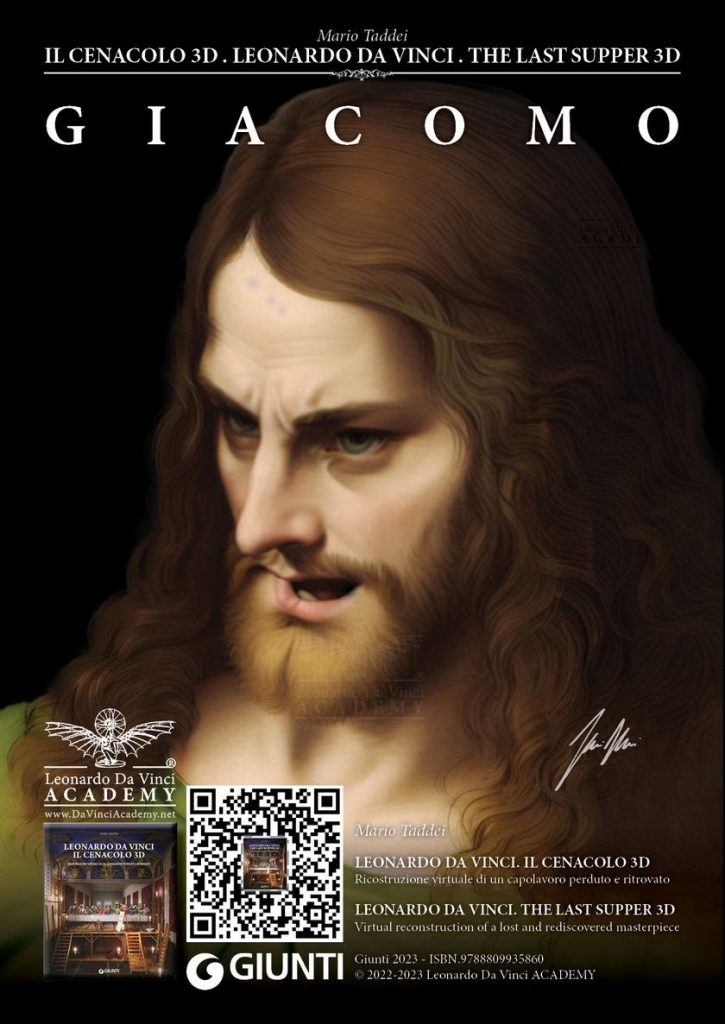
Leonardo da Vinci. The Last Supper 3D.
Virtual reconstruction of a lost and rediscovered masterpiece.

Editore: Giunti

ISBN-13 ‏ : ‎ 978-8809935860
https://www.amazon.it/dp/8809935861

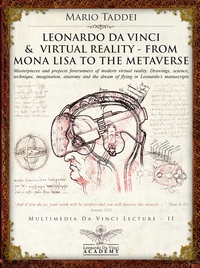
LEONARDO DA VINCI & VIRTUAL REALITY – FROM MONA LISA TO THE METAVERSE
Masterpieces and projects forerunners of modern virtual reality. Drawings, science, technique, imagination, anatomy and the dream of flying in Leonardo’s manuscripts

ISBN-13 ‏ : ‎ 979-8796061497
https://www.amazon.com/gp/product/B09PM8BHH5

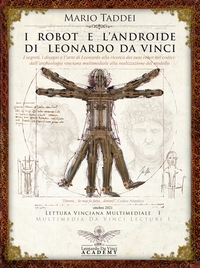
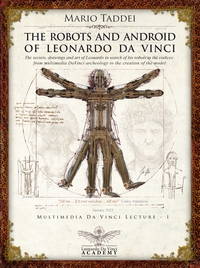
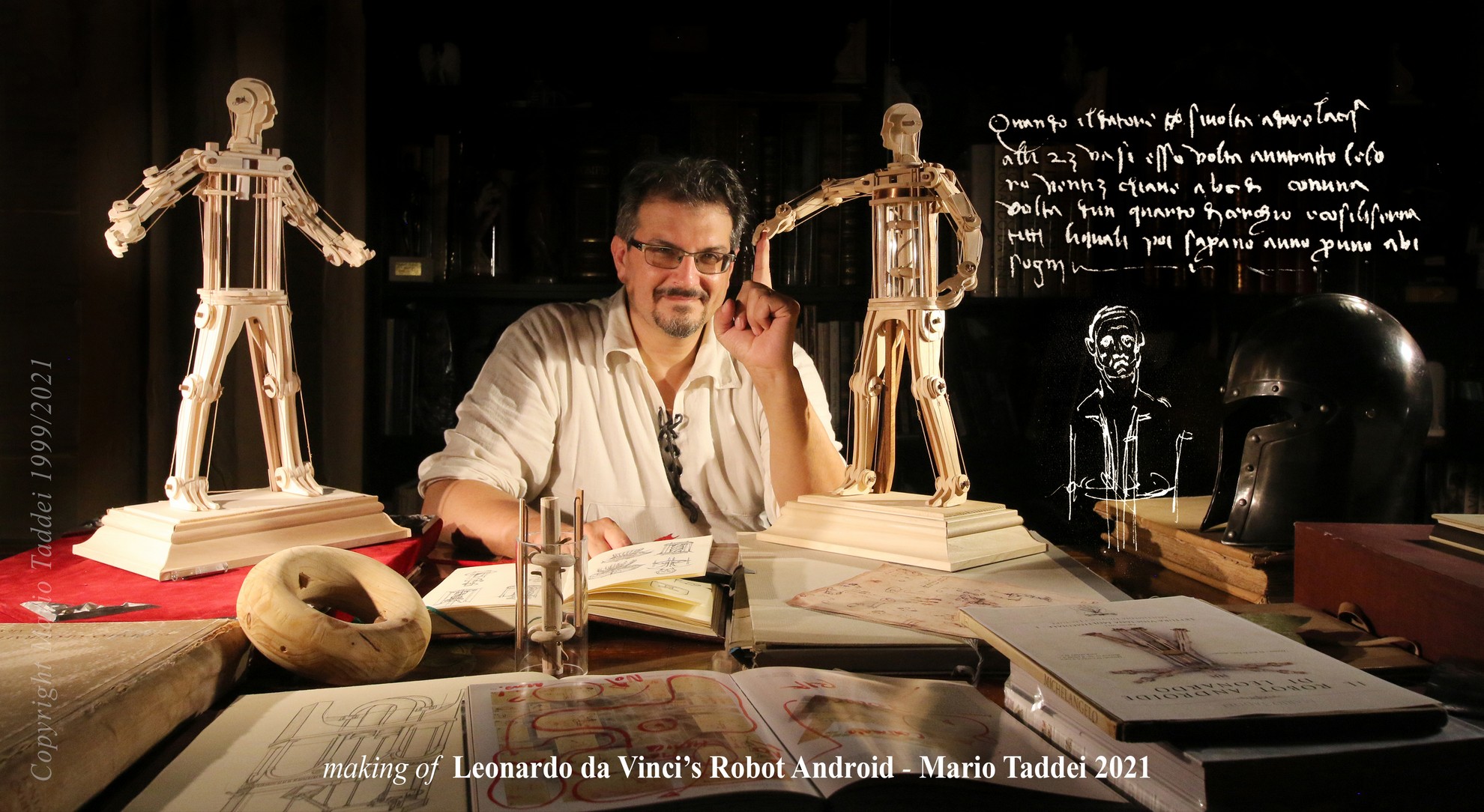
THE ROBOTS AND ANDROID OF LEONARDO DA VINCI:
The secrets, drawings and art of Leonardo in search of his robots in the codices: from multimedia DaVinci

Leonardo da Vinci ACADEMY
ISBN-13 ‏ : ‎ 979-8795402864
https://www.amazon.com/gp/product/B09PM8CVSM

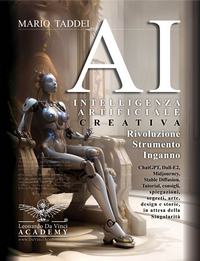
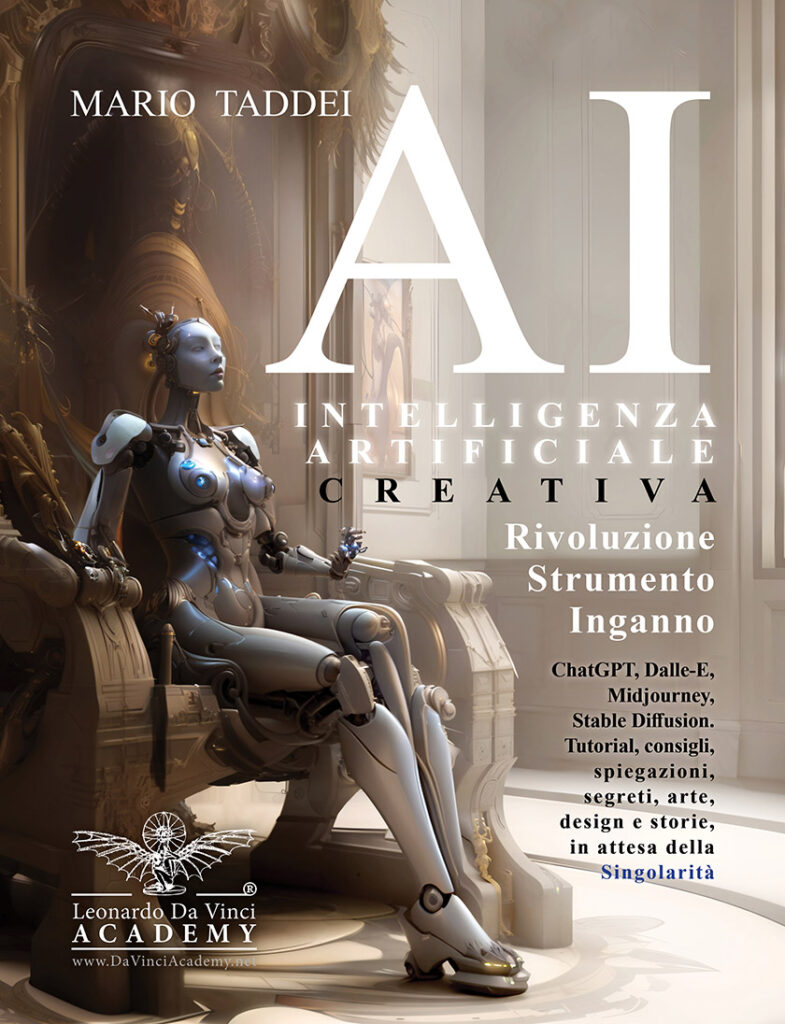
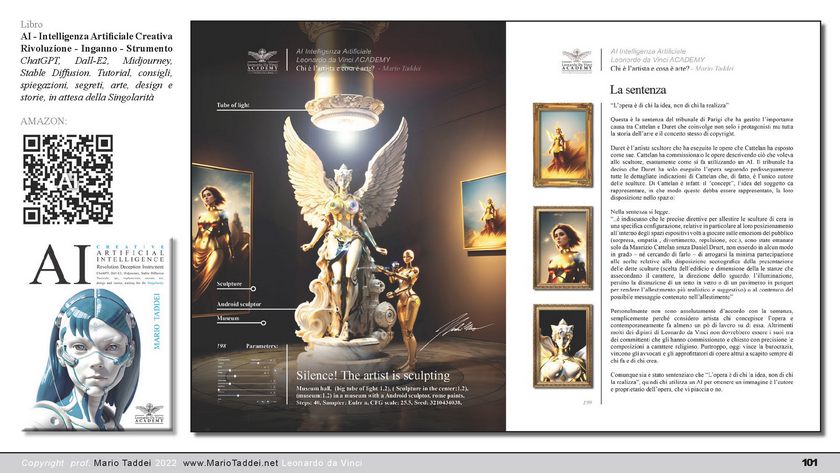
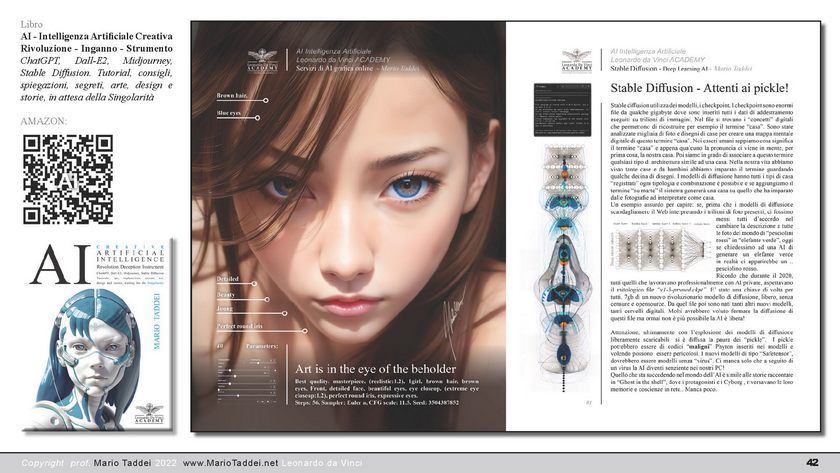
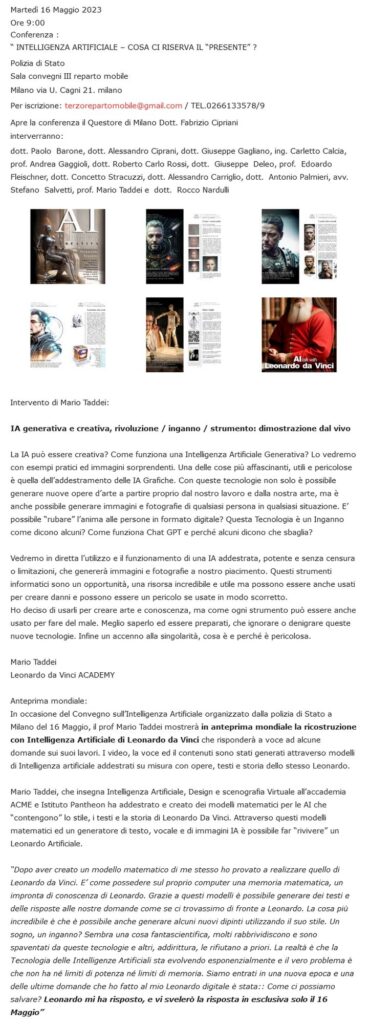
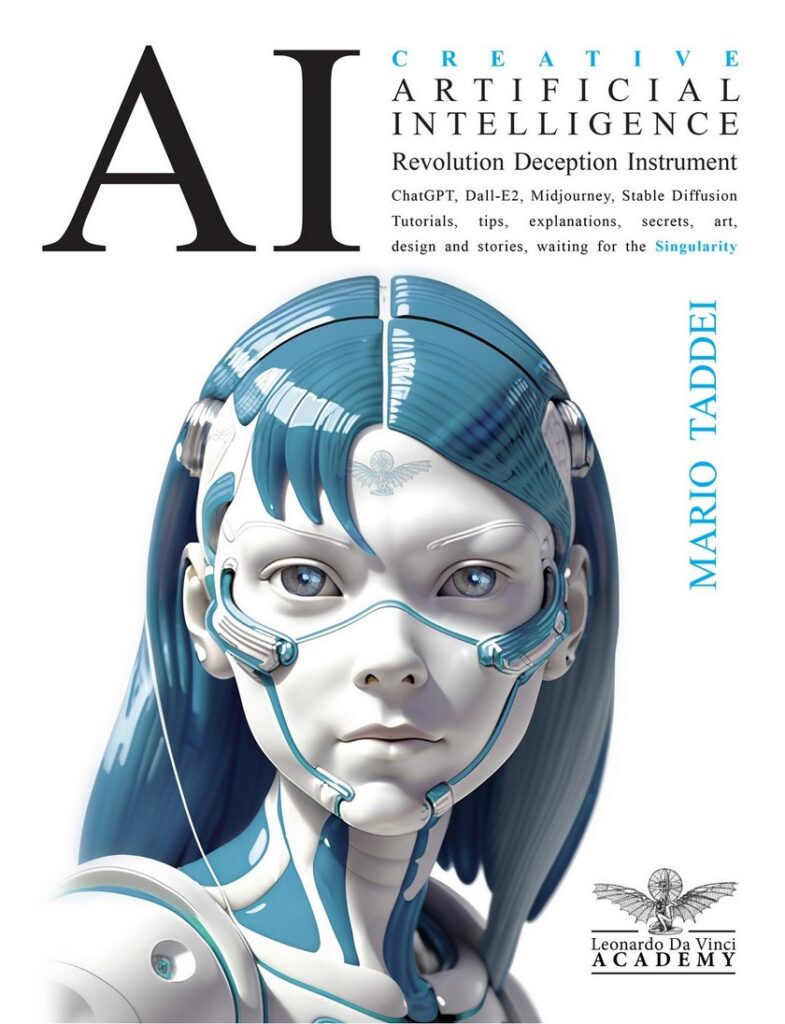
AI – Creative Artificial Intelligence – Revolution – Deception – Tool
ChatGPT, Dalle-E, Midjourney, Stable Diffusion. Tutorials, tips, explanations, secrets, art, design and stories, waiting for the Singularity

Leonardo da Vinci ACADEMY
ISBN-13 ‏ : ‎ 979-8389749382
https://www.amazon.com/dp/B0C126RWJT

How to become Leonardo da Vinci – The true secrets unveiled:
More than 100 tricks and secrets about Leonardo that will inspire you to become the new Da Vinci

Leonardo da Vinci ACADEMY
ISBN: 979-8805365745
https://www.amazon.com/gp/product/B09XZMC9M
P

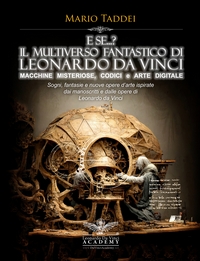
What if…? THE FANTASTIC MULTIVERSE OF Leonardo da Vinci
MYSTERIOUS MACHINES, CODES and DIGITAL ART

Dreams, fantasies and new works of art inspired by the manuscripts and works of Leonardo da Vinci

Leonardo da Vinci ACADEMY
ISBN: 9798353389064
https://www.amazon.com/dp/B0BF35JG9T

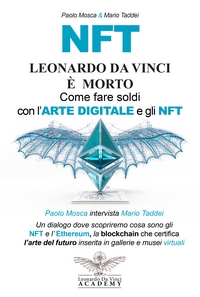
LEONARDO DA VINCI IS DEAD
How to make money with
DIGITAL ART and NFT


Leonardo da Vinci ACADEMY
ISBN-13 ‏ : ‎ 979-8542166650
https://www.amazon.com/gp/product/B09B359XPZ

Leonardo da Vinci e i suoi “Visi Mostruosi”: Un Ritrovamento Straordinario in un’Edizione Rara del Trattato di Pittura

ENGLISH


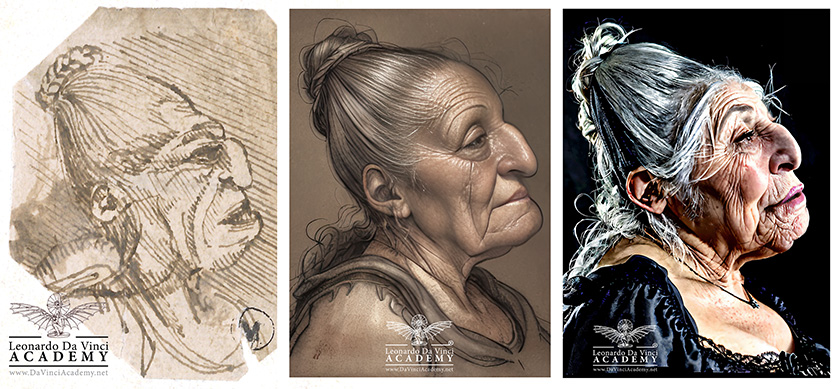
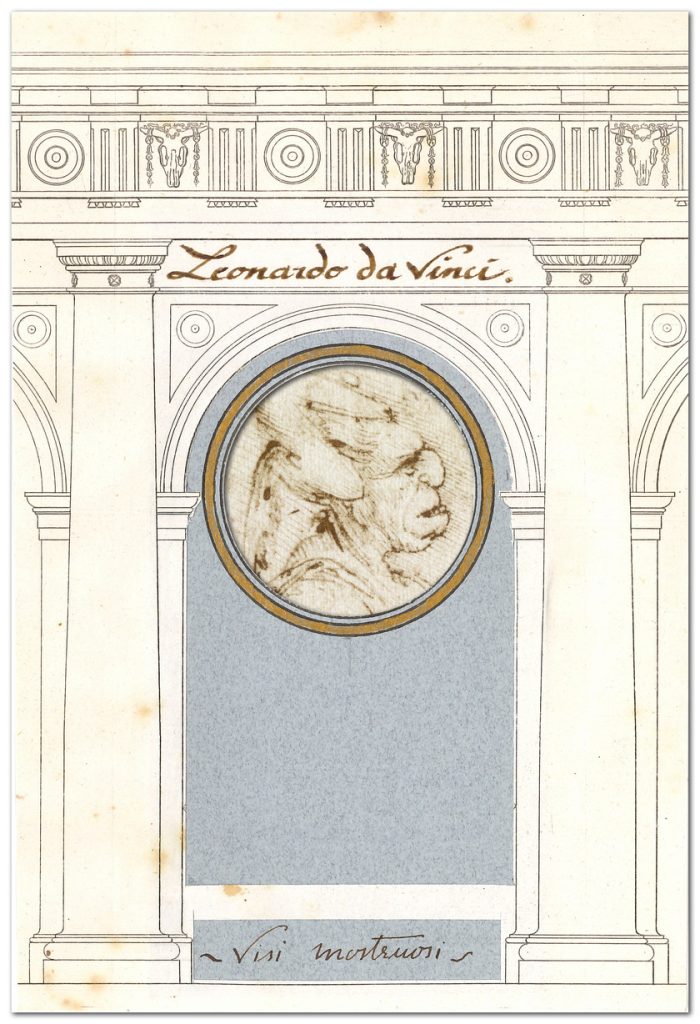
~ Visi mostruosi, volto di Megera ~
1490 / 1510 circa

Testa caricata e busto di profilo di megera verso destra, 1490 circa
Punta metallica, penna e inchiostro seppia su carta filigranata.
Frammento in carta di stracci (50 x 56 mm) ottagonale

incollato su carta giallastra quadrata
con retro azzurrato 72 × 72 mm,


This image has an empty alt attribute; its file name is 840-Spazio-WPbianco-Ghiriok.jpg

Leonardo da Vinci e i “Visi Mostruosi”: Un Ritrovamento Eccezionale in un’Edizione Rara del Trattato di Pittura

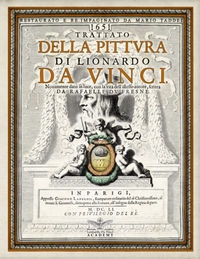
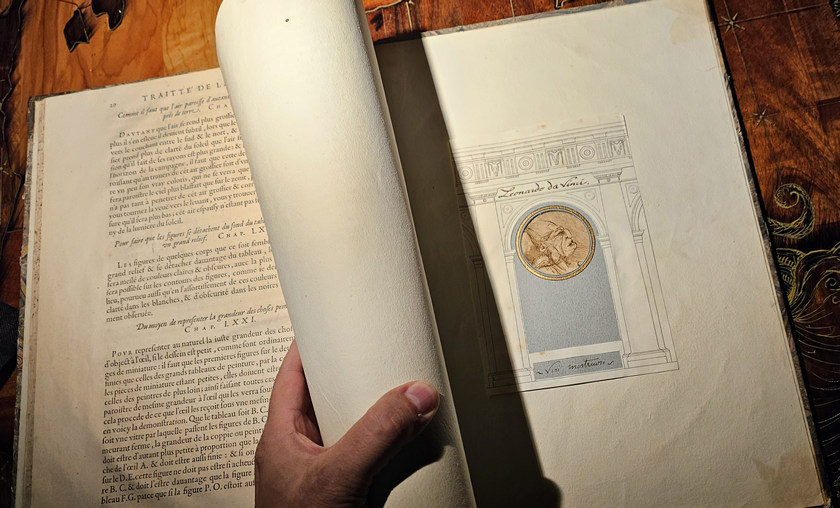
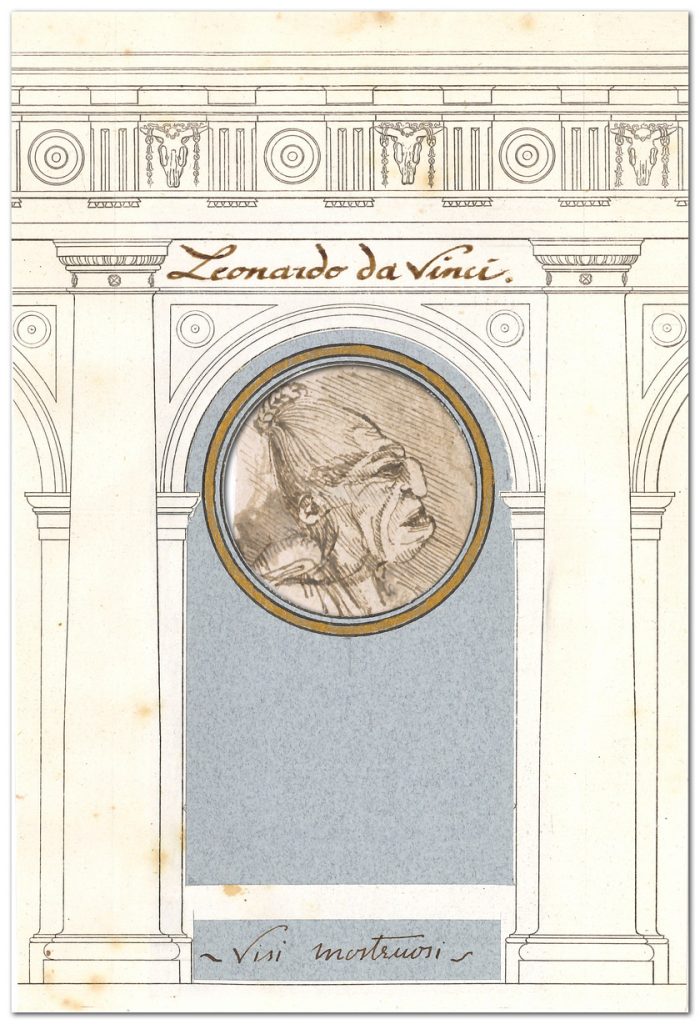
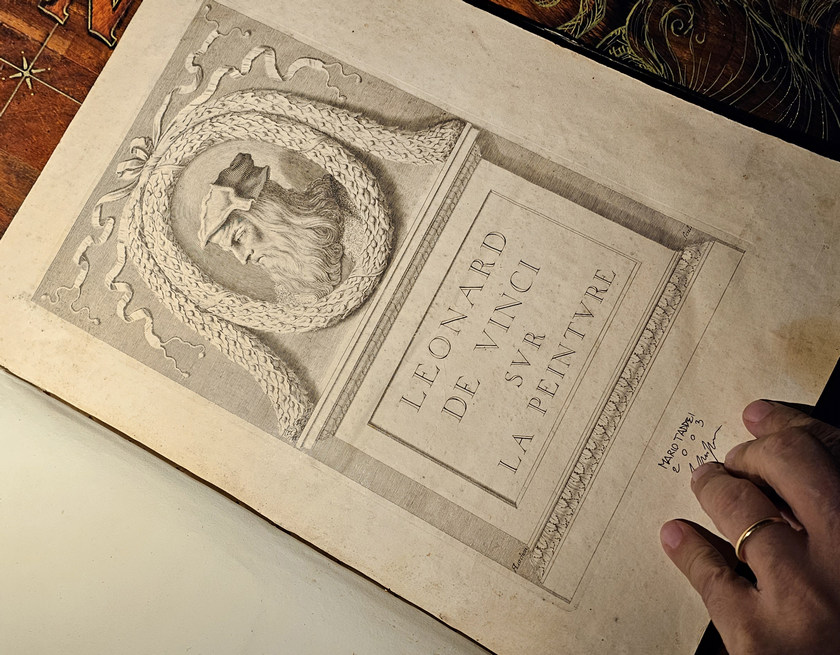
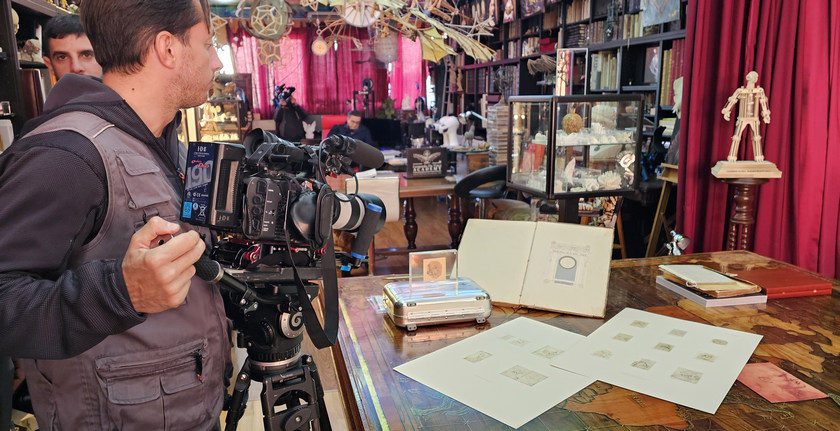
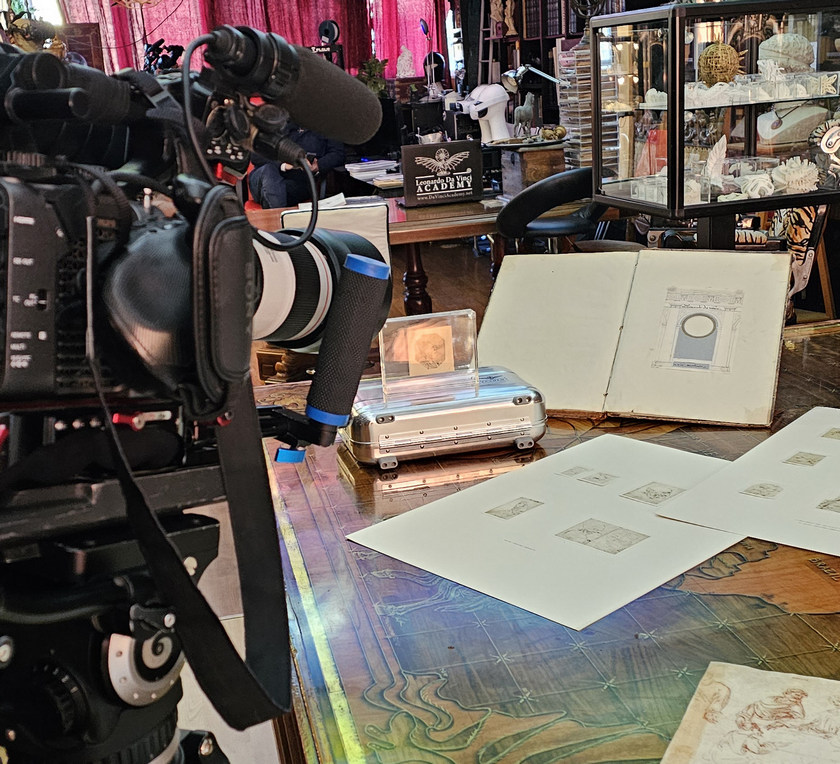
Recentemente, in un’edizione rara del Trattato della Pittura di Leonardo da Vinci, stampata nel 1651 in Francia, è emerso un ritrovamento straordinario che aggiunge un valore inestimabile a questa opera già di per sé preziosa. Nella penultima pagina del volume è stata scoperta una tasca, o passepartout, ricavata da un disegno intitolato “Visi Mostruosi”. Questo disegno è particolarmente significativo poiché all’interno della tasca è custodito un frammento di carta di dimensioni 50×56 mm, incollato su un fondo azzurrato di 72×72 mm. Questo pezzo di carta ottagonale è realizzato con la carta di stracci tipica del Rinascimento, lo stesso materiale utilizzato da Leonardo da Vinci per i suoi appunti e disegni.

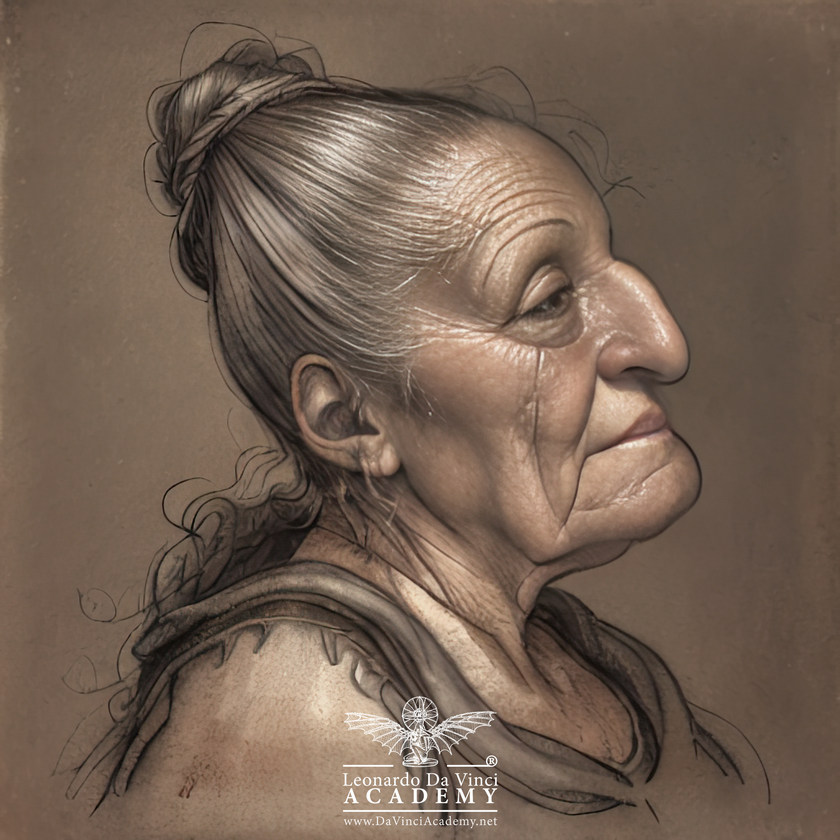
Viso mostruoso, il volto di Megera – Leonardo da Vinci ACADEMY

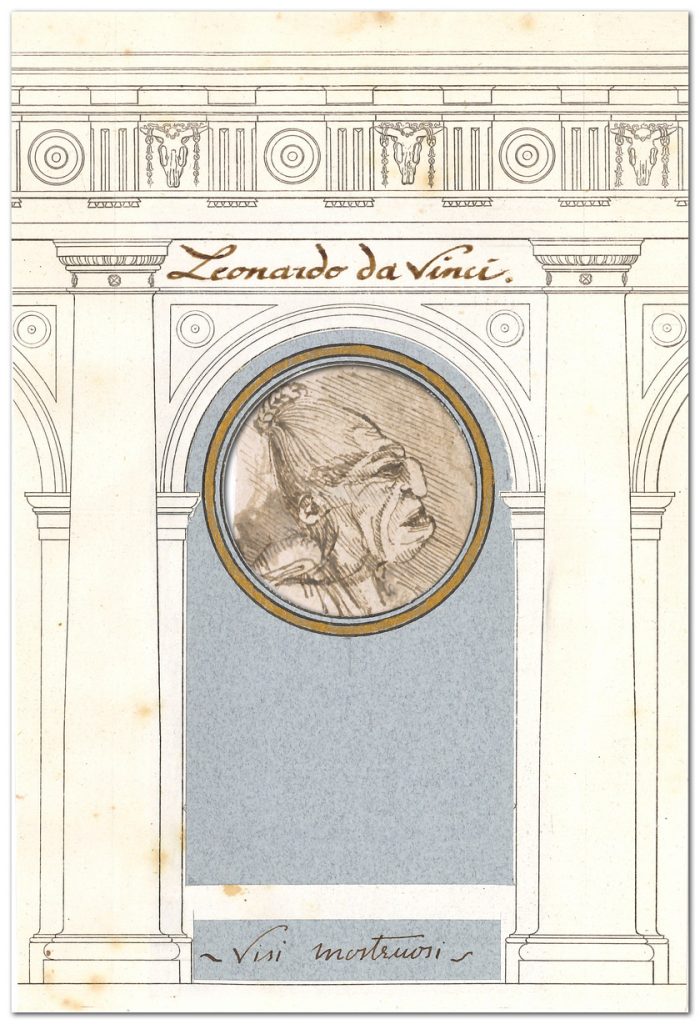
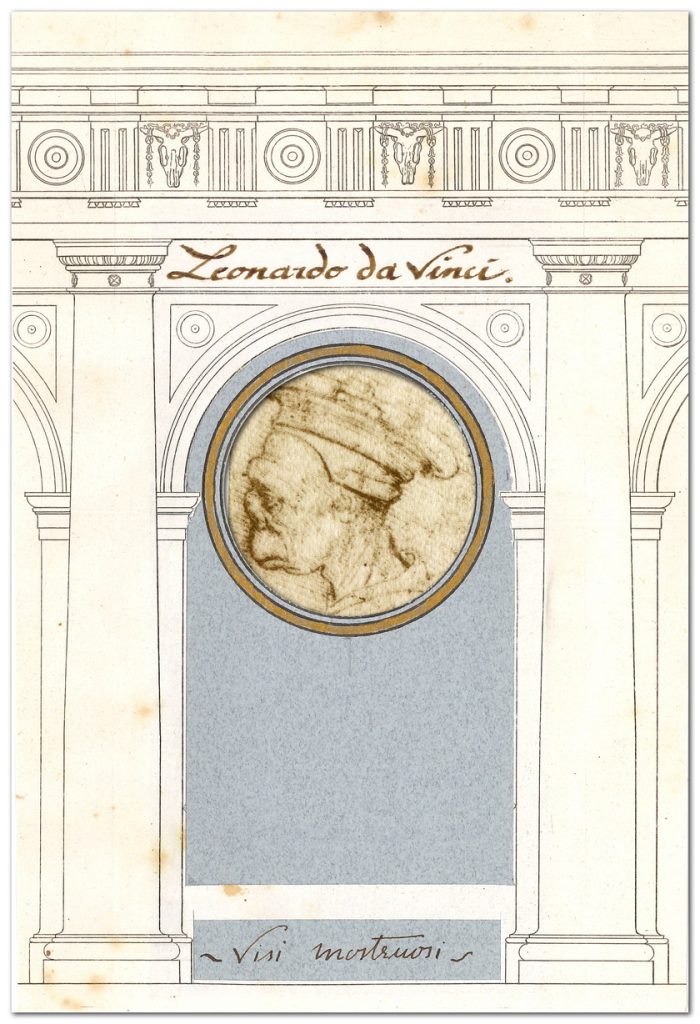
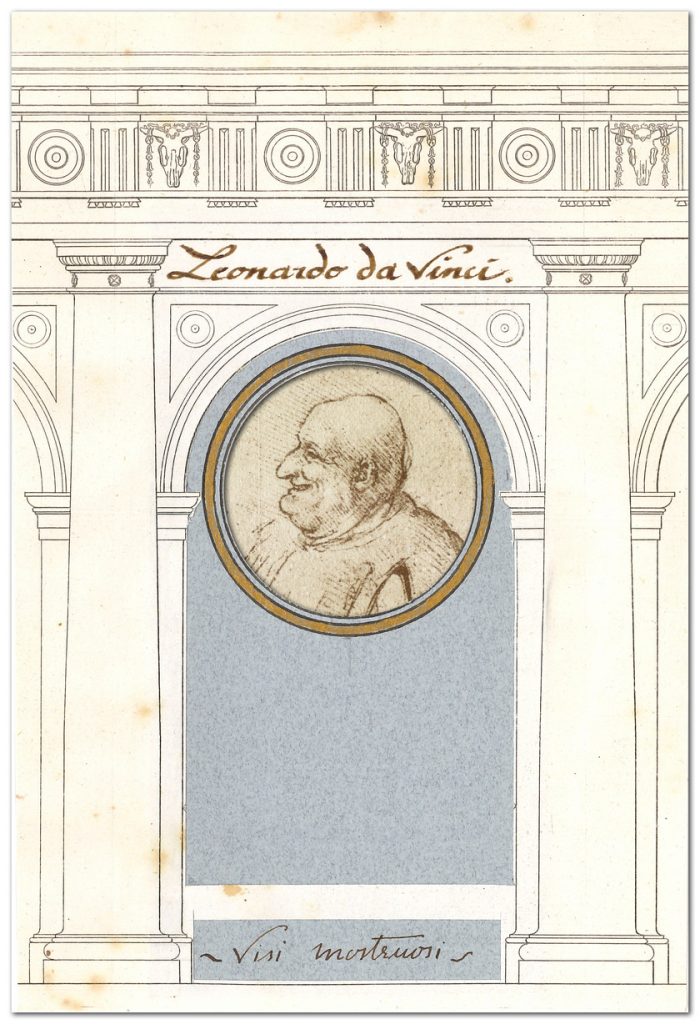
Il frammento in questione contiene un disegno realizzato con punta metallica, penna e inchiostro di seppia, che raffigura il profilo di una vecchia caricaturale, simile a una strega o Megera, rivolta verso destra. Questo tipo di rappresentazione rientra nel corpus di opere che Leonardo realizzò tra il 1490 e il 1510, un periodo in cui l’artista era particolarmente affascinato dalla rappresentazione di “visi mostruosi” e caricaturali.

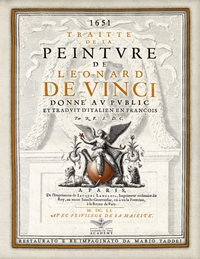
1651 TRAITÉ DE LA PEINTURE LÉONARD DE VINCI
DONNE AU PUBLIC ET TRADUIT D’ITALIEN EN FRANÇAIS
editio princeps – première édition

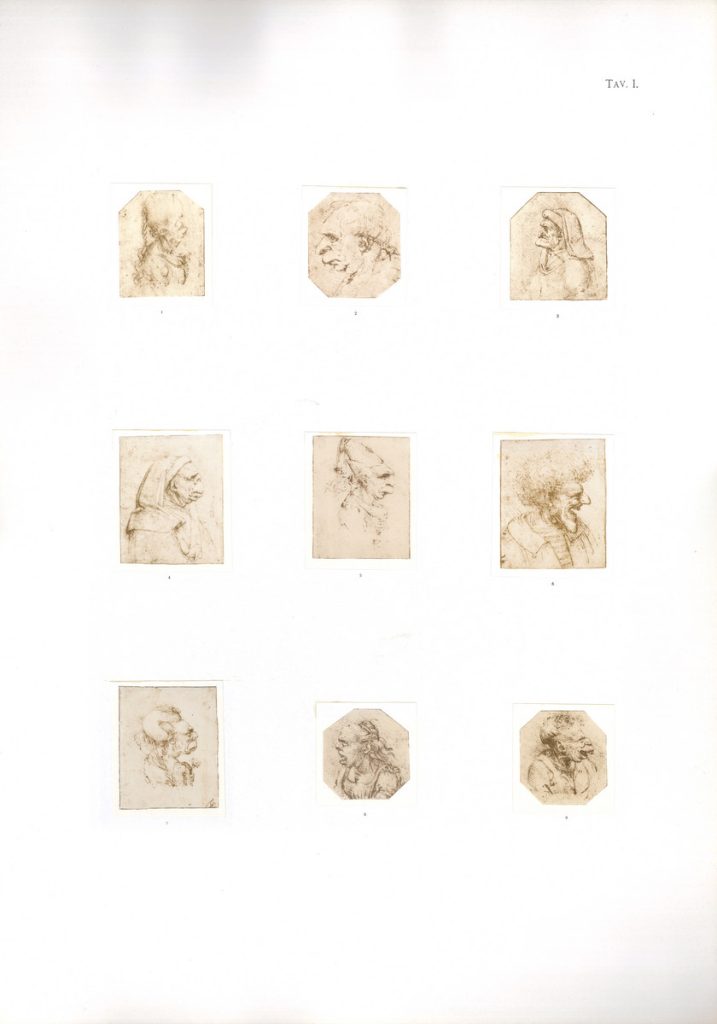
Questi disegni, conservati presso la Biblioteca Ambrosiana di Milano, comprendono una serie di ritratti di giullari di corte, anziani e figure grottesche, spesso con nasi esageratamente pronunciati e smorfie marcate. La loro particolarità non risiede solo nell’aspetto grottesco, ma anche nel profondo interesse di Leonardo per la fisiognomica e la sua ricerca di catturare l’essenza dell’anima umana attraverso il disegno. In effetti, Leonardo stesso scrive nel Codice Madrid II (72v) riguardo alla “varietà dei visi secondo gli accidenti dell’uomo, in fatica e riposo, in ira, in pianto, in riso, in gridare, il timore e simil cose.”

Viso mostruoso, il volto di Megera – Leonardo da Vinci ACADEMY

Questa affermazione sottolinea l’intento di Leonardo di esplorare e documentare la vasta gamma di emozioni e stati d’animo umani attraverso l’osservazione meticolosa dei volti. Non è solo l’estetica a interessare l’artista, ma anche la capacità del volto umano di raccontare una storia, di trasmettere emozioni intense e contrastanti.

Viso mostruoso, il volto di Megera – Leonardo da Vinci ACADEMY

Un altro riferimento significativo si trova nel Manoscritto A (106v), dove Leonardo menziona i “visi mostruosi”. Egli scrive: “De’ visi mostruosi non parlo, perché sanza fatica si tengano a mente.” Questo passaggio è particolarmente rivelatore, poiché suggerisce che i volti grotteschi e deformi ritratti da Leonardo erano talmente memorabili da non richiedere ulteriori descrizioni o spiegazioni. Erano immagini che, per la loro stranezza e forza espressiva, restavano impresse nella mente senza bisogno di parole. Leonardo sembra quasi voler custodire questi volti come segreti visivi, la cui potenza evocativa supera la necessità di essere narrata.

Leonardo – CVinciana Tav 201 p1- Windsor – Royal Library – Volti per il Cenacolo
Biblioteca Leonardo da Vinci ACADEMY

Durante il periodo in cui questi disegni furono realizzati, Leonardo era impegnato nella creazione di L’Ultima Cena nel refettorio del convento di Santa Maria delle Grazie a Milano. Nei suoi scritti, egli narra di come percorresse le strade di Milano alla ricerca di volti che potessero ispirare le figure degli apostoli e di Gesù. Una leggenda narra che Leonardo trovò il volto di Giuda in un uomo dal carattere crudele e che, per una sorta di scherzo, utilizzò il volto del priore del convento, con cui aveva un rapporto conflittuale, per rappresentare il traditore.

“teste caricate” o “grottesche”
Leonardo – CVinciana Tav 212 – Chatsworth – Biblioteca duca di Devonshire –
Biblioteca Leonardo da Vinci ACADEMY

Indipendentemente dalla veridicità di questa leggenda, ciò che è certo è che Leonardo osservava attentamente le persone comuni, ritraendole non solo nei loro tratti fisici, ma anche nella loro essenza interiore. Questa collezione di ritratti grotteschi non rappresenta semplicemente un esercizio di caricatura, ma una profonda esplorazione dell’umanità. Contrariamente ai ritratti idealizzati delle nobili dame, come La Gioconda, La Belle Ferronnière, e La Dama con l’Ermellino, queste rappresentazioni offrono uno sguardo più autentico e realistico sulle persone che popolavano Milano nel 1500.

Volto di Megera, Tasca cornice
Leonardo da Vinci ACADEMY

Il frammento ritrovato nell’edizione del 1651 del Trattato della Pittura raffigura uno di questi “visi mostruosi”: il profilo di una vecchia, con un grande naso adunco, capelli raccolti dietro la testa e un mento prominente. Questo disegno, unico nel suo genere, è stato mostrato per la prima volta in televisione in Italia e attualmente appartiene a una collezione privata.

1651 TRAITÉ DE LA PEINTURE LÉONARD DE VINCI
DONNE AU PUBLIC ET TRADUIT D’ITALIEN EN FRANÇAIS
editio princeps – première édition

Questo ritrovamento non solo aggiunge un valore storico e artistico all’edizione del Trattato della Pittura, ma ci offre anche uno spaccato della mente di Leonardo da Vinci, un uomo capace di trovare bellezza anche nei volti più grotteschi, e di vedere l’umanità in tutte le sue forme.

Viso mostruoso, il volto di Megera – Leonardo da Vinci ACADEMY
This image has an empty alt attribute; its file name is 840-Spazio-WPbianco-Ghiriok.jpg

Ricostruzione digitale del volto di Megera

Ricostruzione digitale del volto di Megera
This image has an empty alt attribute; its file name is 840-Spazio-WPbianco-Ghiriok.jpg

Riferimenti e documenti

“Delle varietà de visi, secondo li acidenti dell’omo, in fatica, in riposo, in ira, in
pianto, in riso, i’ gridare, in timore e ssimili cosse.”
Madrid II 72v

“Del modo di tenere a mente la forma d’un volto.

Se volli avere facilita in tenere a mente una aria d’uno volto, impara prima a mente di molte teste, occhi, nasi, bocche, menti e gole e colli e spalli. Poniamo caso, i nasi sono di 10 ragioni: diritto, gobbo, cavo, col rilievo più su o più giu che ‘l mezzo, aquilino, pari, simo e tondo e acuto: questi sono boni in quanto al proffilo. In faccia i nasi sono di 11 ragioni: equale, grosso in mezzo, sottile ‘n mezzo, e la punta grossa e sottile nell’appiccatura, sottile nella punta e grosso nell’appiccatura, di larghe anarise, distrette, d’alte e basse, di busi scoperti e di busi occupati dalla punta. E cosi troverai diversita nelle altre particule, delle quali cose tu de’ ritrarre di naturale e metterle a mente, ovvero, quando hai a fare uno volto a mente, porta con teco uno picciolo libretto, dove sieno notate simile fazione e quando hai dato una occhiata al volto della persona che voi ritrarre, guarderai poi in parte quale naso o bocca se le assomiglia, e favvi uno picciolo segno per riconoscerle poi a casa. De’ visi mostruosi non parlo, perché sanza fatica si tengano a mente.”

Manoscritto A 106v
Riportato poi nel Trattato di Pittura
Libro di Pittura (Codice Urbinate Lat. 1270) Capitolo 290

Madrid II 72v

Leonardo da Vinci ACADEMY
This image has an empty alt attribute; its file name is 840-Spazio-WPbianco-Ghiriok.jpg

ENGLISH

Leonardo da Vinci and his “Monstrous Faces”: An Extraordinary Find in a Rare Edition of the Treatise on Painting

ITALIAN


~ Monstrous faces, face of Megera ~
1490 / 1510 circa

Charged head and profile bust of hag towards right, c. 1490 Metal point, pen and sepia ink on watermarked paper. Rag paper fragment (50 × 56 mm) octagonal pasted on square yellowish paper with blued reverse 72 × 72 mm,


This image has an empty alt attribute; its file name is 840-Spazio-WPbianco-Ghiriok.jpg

Leonardo da Vinci and the “Monstrous Faces”: An Exceptional Find in a Rare Edition of the Treatise on Painting

Recently, in a rare edition of Leonardo da Vinci’s Treatise on Painting, printed in 1651 in France, an extraordinary find emerged that adds priceless value to this already valuable work. On the penultimate page of the volume, a pocket, or passepartout, was discovered from a drawing entitled “Monstrous Faces.” This drawing is particularly significant because inside the pocket is housed a 50×56 mm fragment of paper, glued to a 72×72 mm blued background. This octagonal piece of paper is made from the rag paper typical of the Renaissance, the same material used by Leonardo da Vinci for his notes and drawings.

Monstrous face, the face of Megera – Leonardo da Vinci ACADEMY

The fragment in question contains a drawing made with metal point, pen and sepia ink, depicting the profile of a caricatured old woman, resembling a witch or Megera, facing to the right. This type of depiction is part of the body of work that Leonardo produced between 1490 and 1510, a period when the artist was particularly fascinated by the depiction of “monstrous faces” and caricatures.

1651 TRAITÉ DE LA PEINTURE LÉONARD DE VINCI
DONNE AU PUBLIC ET TRADUIT D’ITALIEN EN FRANÇAIS
editio princeps – première édition

These drawings, preserved in the Biblioteca Ambrosiana in Milan, include a series of portraits of court jesters, old men and grotesque figures, often with exaggeratedly pronounced noses and marked grimaces. Their uniqueness lies not only in their grotesque appearance, but also in Leonardo’s deep interest in physiognomy and his quest to capture the essence of the human soul through drawing. Indeed, Leonardo himself writes in Codex Madrid II (72v) about the “variety of faces according to the accidents of man, in toil and rest, in wrath, in weeping, in laughter, in crying, fear and simil things.”

Monstrous face, the face of Megera – Leonardo da Vinci ACADEMY

This statement underscores Leonardo’s intent to explore and document the wide range of human emotions and moods through meticulous observation of faces. It is not only aesthetics that interested the artist, but also the ability of the human face to tell a story, to convey intense and conflicting emotions.

Monstrous face, the face of Megera – Leonardo da Vinci ACADEMY

Another significant reference is found in Manuscript A (106v), where Leonardo mentions “monstrous faces.” He writes, “De’ visi monruosi non parlo, perché sanza fatica si tengono a mente.” This passage is particularly revealing because it suggests that the grotesque and deformed faces portrayed by Leonardo were so memorable that they required no further description or explanation. They were images that, because of their strangeness and expressive force, stuck in the mind without the need for words. Leonardo seems almost to want to guard these faces as visual secrets whose evocative power surpasses the need to be told.

Leonardo – CVinciana Tav 201 p1- Windsor – Royal Library – Faces for the Upper Room
Leonardo da Vinci ACADEMY Library.

During the period when these drawings were made, Leonardo was busy creating The Last Supper in the refectory of the convent of Santa Maria delle Grazie in Milan. In his writings, he recounts how he walked the streets of Milan looking for faces that could inspire the figures of the apostles and Jesus. One legend has it that Leonardo found the face of Judas in a man with a cruel character and that, as a sort of joke, he used the face of the prior of the convent, with whom he had a contentious relationship, to represent the traitor.

“Loaded heads” or “grotesques”
Leonardo – CVinciana Tav 212 – Chatsworth – Duke of Devonshire Library – Leonardo da Vinci ACADEMY Library

Regardless of the veracity of this legend, what is certain is that Leonardo carefully observed ordinary people, portraying them not only in their physical features but also in their inner essence. This collection of grotesque portraits is not simply an exercise in caricature, but a profound exploration of humanity. In contrast to the idealized portraits of noble ladies, such as La Gioconda, La Belle Ferronnière, and The Lady with an Ermine, these depictions offer a more authentic and realistic look at the people who populated Milan in the 1500s.

Face of Megaera, Tasca frame – Leonardo da Vinci ACADEMY

The fragment found in the 1651 edition of the Treatise on Painting depicts one of these “monstrous faces”: the profile of an old woman, with a large hooked nose, hair pulled back behind her head, and a prominent chin. This unique drawing was first shown on television in Italy and currently belongs to a private collection.

1651 TRAITÉ DE LA PEINTURE LÉONARD DE VINCI
DONNE AU PUBLIC ET TRADUIT D’ITALIEN EN FRANÇAIS
editio princeps – première édition

This finding not only adds historical and artistic value to the edition of the Treatise on Painting, but also gives us a glimpse into the mind of Leonardo da Vinci, a man capable of finding beauty even in the most grotesque faces, and of seeing humanity in all its forms.

Monstrous face, the face of Megera – Leonardo da Vinci ACADEMY
This image has an empty alt attribute; its file name is 840-Spazio-WPbianco-Ghiriok.jpg

Digital reconstruction of the face of Megera

Ricostruzione digitale del volto di Megera
Digital reconstruction of the face of Megera
This image has an empty alt attribute; its file name is 840-Spazio-WPbianco-Ghiriok.jpg

References and documents

“Delle varietà de visi, secondo li acidenti dell’omo, in fatica, in riposo, in ira, in
pianto, in riso, i’ gridare, in timore e ssimili cosse.”

“Of the varieties of faces, according to the acidents of the man, in toil, in rest, in wrath, in weeping, in laughter, i’ shouting, in fear and same things”
Madrid II 72v

“Del modo di tenere a mente la forma d’un volto.

Se volli avere facilita in tenere a mente una aria d’uno volto, impara prima a mente di molte teste, occhi, nasi, bocche, menti e gole e colli e spalli.
Poniamo caso, i nasi sono di 10 ragioni: diritto, gobbo, cavo, col rilievo più su o più giu che ‘l mezzo, aquilino, pari, simo e tondo e acuto: questi sono boni in quanto al proffilo. In faccia i nasi sono di 11 ragioni: equale, grosso in mezzo, sottile ‘n mezzo, e la punta grossa e sottile nell’appiccatura, sottile nella punta e grosso nell’appiccatura, di larghe anarise, distrette, d’alte e basse, di busi scoperti e di busi occupati dalla punta. E cosi troverai diversita nelle altre particule, delle quali cose tu de’ ritrarre di naturale e metterle a mente, ovvero,
quando hai a fare uno volto a mente, porta con teco uno picciolo libretto, dove sieno notate simile fazione e quando hai dato una occhiata al volto della persona che voi ritrarre, guarderai poi in parte quale naso o bocca se le assomiglia, e favvi uno picciolo segno per riconoscerle poi a casa. De’ visi mostruosi non parlo, perché sanza fatica si tengano a mente.”


“Of the way of keeping in mind the form of a face.

If I wished to have facility in keeping in mind an air of a face, first learn in mind of many heads, eyes, noses, mouths, chins and throats and necks and shoulders. Let us say, the noses are of 10 reasons: straight, humped, hollow, with the relief more up or more down than ‘the middle, aquiline, even, simo and round and acute: these are good as to the proffile. In the face the noses are of 11 reasons: equal, coarse in the middle, thin in the middle, and the tip coarse and thin in the sticking, thin in the tip and coarse in the sticking, of broad anarise, distracted, of high and low, of uncovered busi and of busi occupied by the tip. And so you will find diversities in the other particulae, of which things you de’ portray naturally and put them in mind, or, when you have to make a face in mind, bring with you a little booklet, wherein similar factions are noted, and when you have taken a look at the face of the person whom you portray, you will then look in part what nose or mouth if it resembles them, and favvi a little mark to recognize them afterwards at home. Of monstrous faces I speak not, that without effort they may be kept in mind.”


Manuscript A 106v

Later reproduced in the Treatise on Painting Book of Painting
(Urbinate Codex Lat. 1270) Chapter 290

Madrid II 72v

Leonardo da Vinci ACADEMY
This image has an empty alt attribute; its file name is 840-Spazio-WPbianco-Ghiriok.jpg

Lecture – Creative Artificial Intelligence – Berlin 2024

ENGLISH

Ambasciata d’Italia Berlino
“Designing the Future: from 3D printing to AI”: evento in occasione dell’ VIIIª Giornata del Design Italiano nel mondo e della Iª Giornata del Made in Italy

In occasione dell’ VIII Giornata del Design Italiano nel mondo e della I Giornata del Made in Italy, l’Ambasciata ha ospitato l’evento “Designing the Future: from 3D printing to AI”, organizzato in collaborazione con la rivista H.O.M.E., la principale pubblicazione tedesca di architettura e design.

https://ambberlino.esteri.it/it/news/dall_ambasciata/2024/04/designing-the-future-from-3d-printing-to-ai-evento-in-occasione-dell-viiia-giornata-del-design-italiano-nel-mondo-e-della-ia-giornata-del-made-in-italy-11-04-2024/

AI Berlino IIC Ambasciata – VIII Giornata del Design Italiano nel mondo e della I Giornata del Made in Italy

È intervenuto in apertura l’Ambasciatore Armando Varricchio, che ha enfatizzato il ruolo dell’Italia come leader nell’innovazione del design. La serata è proseguita con una serie di presentazioni e una tavola rotonda, moderata da Angelika Müller, Direttrice Editoriale della rivista H.O.M.E., sui recenti sviluppi delle tecnologie italiane di manifattura additiva (3D Printing) nell’ambito dell’architettura e del design, nonché sulle promettenti applicazioni dell’intelligenza artificiale nella progettazione civile e industriale.

AI Berlino IIC Ambasciata – Prof Mario Taddei HD – Presentazione- AI Itelligenza Artificiale 2024

Nel corso del dibattito, i professori Mario Coppola e Mario Taddei, insieme all’architetto Martin Jasper, fondatore di Jasper Architects, e all’artista Vanessa Alessi, hanno esaminato le sinergie tra design, architettura, arte e intelligenza artificiale, delineando un futuro dove la tecnologia proporrà continue sfide ma anche soluzioni al mondo della creatività.

AI Berlino IIC Ambasciata – Prof Mario Taddei HD – Presentazione- AI Itelligenza Artificiale 2024

Ambasciata d’Italia Berlino
“Designing the Future: from 3D printing to AI”: evento in occasione dell’ VIIIª Giornata del Design Italiano nel mondo e della Iª Giornata del Made in Italy

AI Berlino IIC Ambasciata – Prof Mario Taddei HD – Presentazione- AI Itelligenza Artificiale 2024

In occasione dell’ VIII Giornata del Design Italiano nel mondo e della I Giornata del Made in Italy, l’Ambasciata ha ospitato l’evento “Designing the Future: from 3D printing to AI”, organizzato in collaborazione con la rivista H.O.M.E., la principale pubblicazione tedesca di architettura e design.

AI Berlino IIC Ambasciata – VIII Giornata del Design Italiano nel mondo e della I Giornata del Made in Italy

È intervenuto in apertura l’Ambasciatore Armando Varricchio, che ha enfatizzato il ruolo dell’Italia come leader nell’innovazione del design. La serata è proseguita con una serie di presentazioni e una tavola rotonda, moderata da Angelika Müller, Direttrice Editoriale della rivista H.O.M.E., sui recenti sviluppi delle tecnologie italiane di manifattura additiva (3D Printing) nell’ambito dell’architettura e del design, nonché sulle promettenti applicazioni dell’intelligenza artificiale nella progettazione civile e industriale.

AI Berlino IIC Ambasciata

Nel corso del dibattito, i professori Mario Coppola e Mario Taddei, insieme all’architetto Martin Jasper, fondatore di Jasper Architects, e all’artista Vanessa Alessi, hanno esaminato le sinergie tra design, architettura, arte e intelligenza artificiale, delineando un futuro dove la tecnologia proporrà continue sfide ma anche soluzioni al mondo della creatività.

AI Berlino IIC Ambasciata – Prof Mario Taddei HD – Presentazione- AI Itelligenza Artificiale 2024
La gioconda Cinese Exhibition
AI Berlino IIC Ambasciata – Prof Mario Taddei HD – Presentazione- AI Itelligenza Artificiale 2024
La gioconda Cinese Exhibition
AI Berlino IIC Ambasciata – Prof Mario Taddei HD – Presentazione- AI Itelligenza Artificiale 2024
What If?
AI Berlino IIC Ambasciata – Prof Mario Taddei HD – Presentazione- AI Itelligenza Artificiale 2024
What If?
AI Berlino IIC Ambasciata – Prof Mario Taddei HD – Presentazione- AI Itelligenza Artificiale 2024
What If?
AI Berlino IIC Ambasciata – Prof Mario Taddei HD – Presentazione- AI Itelligenza Artificiale 2024
Da Vinci By Lisa – Romantic Rock Musical Digital Scenography
AI Berlino IIC Ambasciata – Prof Mario Taddei HD – Presentazione- AI Itelligenza Artificiale 2024
Da Vinci By Lisa – Romantic Rock Musical Digital Scenography
AI Berlino IIC Ambasciata – Prof Mario Taddei HD – Presentazione- AI Itelligenza Artificiale 2024
Leonardo Cenacolo 3D
AI Berlino IIC Ambasciata – Prof Mario Taddei HD – Presentazione- AI Itelligenza Artificiale 2024
Leonardo Cenacolo 3D
AI Berlino IIC Ambasciata – Prof Mario Taddei HD – Presentazione- AI Itelligenza Artificiale 2024
Leonardo Cenacolo 3D
AI Berlino IIC Ambasciata – Prof Mario Taddei HD – Presentazione- AI Itelligenza Artificiale 2024
Leonardo Cenacolo 3D
AI Berlino IIC Ambasciata – Prof Mario Taddei HD – Presentazione- AI Itelligenza Artificiale 2024
Leonardo Cenacolo 3D
AI Berlino IIC Ambasciata – Prof Mario Taddei HD – Presentazione- AI Itelligenza Artificiale 2024
Leonardo Cenacolo 3D
AI Berlino IIC Ambasciata – Prof Mario Taddei HD – Presentazione- AI Itelligenza Artificiale 2024
Leonardo Cenacolo 3D


https://ambberlino.esteri.it/it/news/dall_ambasciata/2024/04/designing-the-future-from-3d-printing-to-ai-evento-in-occasione-dell-viiia-giornata-del-design-italiano-nel-mondo-e-della-ia-giornata-del-made-in-italy-11-04-2024/

Lecture “Leonardo da Vinci’s Manuscripts and the Influence of Ancient Arabic Science” – Abu Dhabi

This image has an empty alt attribute; its file name is 840-Spazio-WPbianco-Girighoro-1.jpg

April 5th, 2024 | 7:30pm
Italian Cultural Institute Abu Dhabi

Multimedia Presentation at the Virtual Museum of Leonardo da Vinci. Prof. Mario Taddei, Leonardo da Vinci Academy.

This image has an empty alt attribute; its file name is Leonardo-da-Vincis-Manuscripts-and-the-Influence-of-Ancient-Arabic-Science-Mario-taddei-Abu-Dhabi-Istituto-di-Cultura-poster.jpg

In this seminar, we will explore the manuscripts, art, and technology of Leonardo da Vinci, uncovering their deep connections to ancient Arabic science. With the support of the Italian Cultural Institute and the Embassy of Italy to the UAE, Prof. Mario Taddei will guide us through a multimedia presentation at the largest virtual museum of Leonardo da Vinci.

We will discover the reconstruction of incredible ancient machines designed by Leonardo, derived from the study of nature and ancient weaponry, such as flying spheres, the mechanical hawk, the robot car, and the first mechanical android. Art and technology intertwine, delving into the secrets of Leonardo’s masterpieces, including the Mona Lisa and The Last Supper.

We will explore one of Leonardo’s secrets, his study of the ancients, and particularly see the influence of ancient Arabic science on his work. Many machines and contraptions, erroneously attributed to Leonardo, are instead the result of Arab scientists from the year 1000 who influenced modern science and mathematics more than one might think.

This seminar underscores the importance of studying history, particularly the contributions of Arab scholars from the 10th century onwards, to understand the genius of Leonardo da Vinci and his creations. Participants will have the exclusive opportunity to experience a virtual reality station, allowing them to observe Leonardo da Vinci’s machines and masterpieces like never before, journeying into the largest virtual museum ever built: the Leonardo Da Vinci ACADEMY MUSEUM.

This image has an empty alt attribute; its file name is 1350x900-Leonardo-Da-Vinci-ACADEMY-Mario-Taddei-2022-Slide-01-840.jpg
This image has an empty alt attribute; its file name is 840-Spazio-WPbianco-Girighoro-1.jpg

Prof. Mario Taddei
Graduated with honors in Industrial Design from the Polytechnic University of Milan. He served as a professor at the Politecnico di Milano, teaching computer science courses. Taddei is a prominent Italian academic, best known for his contributions to Leonardo da Vinci studies. He is co-curator of some of the Leonardo Da Vinci’s exhibitions, showcasing groundbreaking discoveries in art and machine research on a global scale. With extensive experience in programming, 3D graphics, video games, virtual reality development, and multimedia applications, Taddei also teaches design, virtual scenography, and virtual architecture at various art academies in Milan, Italy.

He is an expert in artificial intelligence and has authored several books on the subject, delivering frequent lectures worldwide. As a curator, Taddei has organized numerous Leonardo exhibitions worldwide and authored several books on science, computer graphics, Renaissance masters, and Leonardo da Vinci. He is renowned for leading the study, software development, and reconstruction of hundreds of Renaissance machines, as well as pioneering virtual Codex technologies and interactive historical experiences. Taddei is also recognized as a digital artist, exhibiting under the pseudonyms Silver Mark and Neoart3 at prestigious contemporary art museums in Europe and China. Furthermore, he is an expert in NFT and metaverse technologies, contributing to the development of digital art and virtual environments. Currently, Taddei teaches at Milanese Academies, founded and directs the Leonardo da Vinci Academy (www.davinciacademy.net), and can also be found at www.Neoart3.net or by searching “Mario Taddei” on Google.

This image has an empty alt attribute; its file name is Leonardo-da-Vincis-Manuscripts-and-the-Influence-of-Ancient-Arabic-Science-Mario-taddei-Abu-Dhabi-Istituto-di-Cultura-Leonardo-anatomy-690x1024.jpg
Mario Taddei Manuscript Collection – Leonardo da Vinci ACADEMY
This image has an empty alt attribute; its file name is Leonardo-da-Vincis-Manuscripts-and-the-Influence-of-Ancient-Arabic-Science-Mario-taddei-Abu-Dhabi-Istituto-di-Cultura-Leonardo-anatomy-ARAB-738x1024.jpg
Mario Taddei Manuscript Collection – Leonardo da Vinci ACADEMY
This image has an empty alt attribute; its file name is Screenshot-2024-03-29-220946.png

The Italian Cultural Institute of Abu Dhabi is a body of the Ministry of Foreign Affairs and International Cooperation (MAECI), responsible for spreading and promoting the Italian language and culture. Its main objectives are the organization of cultural, artistic and scientific initiatives with Italy as their central theme.

This image has an empty alt attribute; its file name is Abu-Dhabi-Istituto-di-Cultura-map.jpg
https://maps.app.goo.gl/qK5zo9sQfs

E’ uscito ilLibro: Il Cenacolo 3D

E’ uscito!
In tutte le migliori librerie e nel circuito Giunti.
Due anni di dura fatica e migliaia di disegni fatti a mano, 3D, Virtuale e AI!
Il mio vecchio lavoro sul cenacolo del 2010, presente in libri, mostre, documentari e musei ha fatto il giro del mondo, ma era ormai ormai obsoleto e con qualche difetto… (lo ammetto e me ne vergogno!). Ho quindi deciso di riaffrontare l’argomento e ci ho dedicato giorni e notti. Un file enorme, milioni di pixel di meraviglia e un nuovo sistema VR all’avanguardia!
Ecco a voi il nuovo cenacolo 3D!
Mario Taddei

Scheda completa

Leonardo da Vinci. Il Cenacolo 3D
Ricostruzione virtuale di un capolavoro perduto e ritrovato
https://giunti.it/products/leonardo-da-vinci-il-cenacolo-3d-taddei-mario-9788809935853


Il Cenacolo di Santa Maria delle Grazie, a Milano, è uno dei luoghi leonardiani più visitati al mondo. Antico refettorio dei monaci, ospita, su una delle sue pareti, l’Ultima cena dipinta da Leonardo da Vinci nel 1494-1498, un capolavoro assoluto del Rinascimento. Questo libro presenta quest’opera, e questo luogo, come non si era mai fatto fino adesso. Anni di studio e un sapiente utilizzo di nuove tecnologie di restituzione in 3D ha consentito all’autore di riproporre questa opera facendo in modo da farci attraversare i secoli e le vicissitudini del dipinto fino a mostrarcelo “come era”, ricostruendone i colori, portandoci “dentro” la tecnica particolare della sua esecuzione, mostrandoci la tavola della Cena e i suoi protagonisti dalle angolazioni più diverse, ripristinando la decorazione originale degli ambienti reali e dipinti, in qualche modo a vederlo con gli occhi e la mente del suo creatore.

Leonardo da Vinci. Il Cenacolo 3DRicostruzione virtuale di un capolavoro perduto e ritrovato

Presentazione

Il Cenacolo di Leonardo, il capolavoro che ha cambiato per sempre il modo di dipingere e di immaginare un episodio di carattere religioso.
La storia ci ha lasciato, purtroppo, solo un debole ricordo di ciò che era. Con le moderne tecniche di ricostruzione tridimensionale, l’utilizzo dell’intelligenza artificiale e un nuovo lavoro di restauro digitale, è oggi possibile sperimentare nel refettorio di Santa Maria delle Grazie un’esperienza virtuale che può darci un idea del capolavoro com’era al tempo di Leonardo e che i milanesi ebbero la fortuna di vedere la prima volta nel 1498.
Leonardo è stato, con i suoi studi, il precursore delle moderne tecnologie di realtà virtuale. Il suo impianto prospettico e le sue pitture a 360° miravano a “ingannare” i visitatori che, per la prima volta, si ritrovavano immersi in un altro tempo e in un altro luogo: una realtà virtuale magnifica e gloriosa.

Leonardo da Vinci. Il Cenacolo 3DRicostruzione virtuale di un capolavoro perduto e ritrovato

Leonardo da Vinci. Il Cenacolo 3DRicostruzione virtuale di un capolavoro perduto e ritrovato

Introduzione

Estate 2022, mi trovo in Santa Maria delle Grazie a Milano, indosso il casco virtuale e avvio il programma con la nuova ricostruzione virtuale del Cenacolo in alta definizione. È emozionante essere nel posto dove Leonardo ha dipinto questa maestosa e importante opera. Dopo venti anni, realizzo un “sogno” tecnologico e viaggio nel tempo e nello spazio ritrovandomi all’epoca di Leonardo con l’opera così come era al suo tempo, in un’atmosfera
magica e sorprendente.
Una delle prime persone a cui ho fatto provare il software è stata la direttrice del Cenacolo stesso, la dottoressa Silvia Zanzani. La ringrazio per avermi dato la possibilità di “ascoltare” il Cenacolo dal vero, in silenzio. Lo conoscevo a memoria dopo averlo studiato per decenni e lì in Santa Maria delle Grazie addirittura ho provato a riviverlo, come in una macchina del tempo, come era nel 1498 grazie alla realtà virtuale immersiva. Un’esperienza che definisco “Realtà Virtuale Spazio Percettiva”. Lo spazio in cui si trovava il mio corpo era esattamente lo stesso simulato virtualmente. Questa emozionante esperienza, unica e difficilmente replicabile, è stata particolarmente impressionante perché ho potuto anche “sentire” per la prima volta, in silenzio, il Cenacolo.

Leonardo da Vinci. The Last Supper 3DVirtual reconstruction of a lost and rediscovered masterpiece


Quello che lascia spaesati ed emozionati nel trovarsi nel refettorio a Santa Maria delle Grazie è il fatto che si percepisce il grande spazio in cui è presente l’opera. Il dipinto in sé è quello che tutti conoscono, si può anche ammirare in libri e riproduzioni, ma quello che è impossibile da fare, se non nel luogo vero, è percepire lo spazio che ci circonda con l’udito. Le voci, i suoni e anche i passi hanno un’eco speciale che ci fa percepire lo spazio e la sua grandezza. Ho cercato di riprodurre la stessa sensazione nell’audio spaziale virtuale del software che ho realizzato con UNREAL Engine 5, lo stesso software con cui vengono realizzati tutti i videogiochi e i nuovi effetti speciali presenti nei film di Hollywood.
Anche se i suoni virtuali possono essere calcolati e riprodurre la stessa eco della stanza reale, mi sono accorto che mancavano i rumori dei miei passi e del mio respiro. Incredibile ma vero, nella sala del refettorio, da solo, ho potuto chiudere gli occhi camminando verso il capolavoro, percepivo la grandezza e la potenza dell’opera con l’aggiunta di un senso insolito e comunque fondamentale.

Leonardo da Vinci. Il Cenacolo 3DRicostruzione virtuale di un capolavoro perduto e ritrovato

La storia della ricerca sul Cenacolo VR parte dal 1999, anno della mia laurea in Disegno industriale al Politecnico di Milano, con una tesi multimediale e museale proprio su Leonardo da Vinci. Da allora mi sono sempre occupato di Leonardo e delle sue macchine fino a creare, nel 2021, la Da Vinci ACADEMY (www.davinciacademy.
net) che ha come scopo la divulgazione e l’utilizzo di tutti i mezzi tecnologici moderni per la comprensione della storia e per un nuovo Rinascimento Digitale. Ho presentato le nuove ricerche in conferenze a Milano e San Francisco. Per questo nuovo lavoro sul Cenacolo ho utilizzato anche l’Intelligenza Artificiale, creando per la prima volta dei modelli di diffusione con le “impronte” artistiche dello stesso Leonardo, la Davinci.A.I.©, per una ricostruzione che sia anche scientificamente corretta e non legata a un particolare stile personale. Leonardo, il mio riferimento, non smetterà mai di sorprenderci e, come ci ha insegnato, dobbiamo essere noi stessi sperimentatori di nuove tecnologie, anche rischiando di sbagliare ma senza mai arrendersi. Solo usando e dominando la tecnologia potremo migliorare il mondo con l’arte e con la storia, come guide di un’umanità che, in caso contrario, sarà dominata dalla tecnologia.
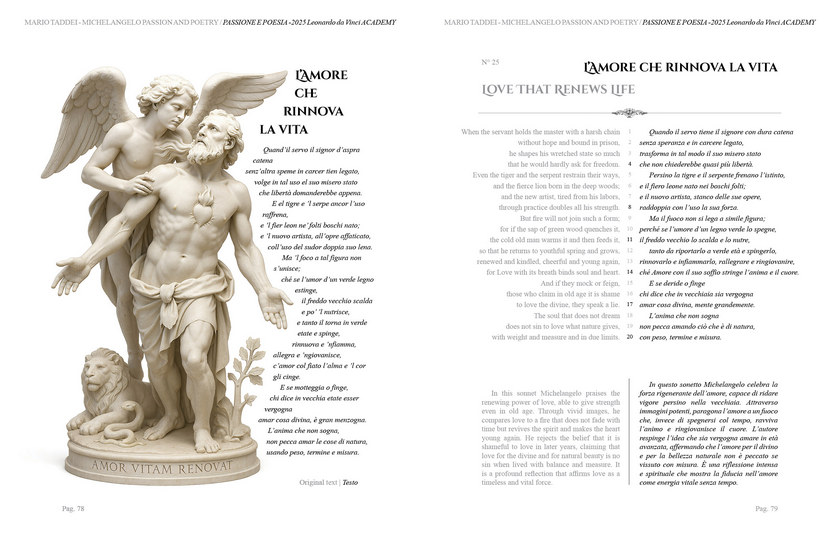
Mario Taddei

Leonardo da Vinci. Il Cenacolo 3DRicostruzione virtuale di un capolavoro perduto e ritrovato

Mario Taddei
Mario Taddei, laureato al Politecnico di Milano,  ha dedicato molti anni di lavoro, ricerca e studio a Leonardo da Vinci, analizzandone meticolosamente l’intera produzione artistica e scientifica. È docente di Computer grafica e Book informatico. Ha progettato e realizzato macchinari in 3D, video, ricostruzioni virtuali, ha tenuto lezioni e conferenze in vari paesi, ha curato pubblicazioni e mostre, iniziative didattiche, musei concreti e virtuali, multimediali e interattivi, tutti dedicati alla scienza medievale e rinascimentale e in particolare all’opera di Leonardo.

Corso Online – Intelligenza Artificiale Creativa

Intelligenza Artificiale Creativa
Una Rivoluzione, un Inganno o uno Strumento?

Contenuto del corso:

Introduzione alla computer grafica e ai sistemi di Intelligenza Artificiale applicata alle immagini e ai testi.
ChatGPT cosa è, come funziona e come si usa.
Come riconoscere un testo creato da ChatGPT?
Quali altre alternative si possono usare?
Come ottenere testi utilizzabili da ChatGPT e utilizzo dei testi creati per altre creazioni.

Introduzione all’arte digitale e alla computer grafica.
Concetti base di immagini digitali, formati e applicazioni pratiche.
Come funzionano i programmi di Intelligenza Artificiale grafica?
ChatGPT, Dall-E2, Midjourney,  Stable Diffusion.
I più diffusi sistemi di creazione di immagini con AI.
Come si utilizzano e come funzionano.
Pericoli, limiti e utilizzo di queste immagini.
Come riconoscere le immagini create utilizzando questi strumenti?
Programmi di IA offline, opensource e liberi da copyright, watermark e censura.
Pericoli e opportunità.
Utilizzo produttivo dei software di AI
Tutorial, consigli, e spiegazioni.
Samplig steps, CFG, seed, algoritmi, denoising, pixel e proporzioni. Cosa sono e come usarli al meglio.
Esempi e suggerimenti sulla realizzazione di composizioni complesse e creative fino a quelle enormi e impossibili.
Cosa è la singolarità e il concetto di espansione geometrica.
La IA creativa come strumento al servizio della creatività.
Accenno alla video AI e alla generazione di audio AI.
Conclusioni ed esempi di utilizzo di sistemi AI per la creazione di Musei Virtuali, videogiochi, video e opere d’arte di nuova generazione.

Mario Taddei


#intelligenzaartificiale #STEAM #leonardodavinciacademy

Libro di riferimento:

Libro di riferimento: su AMAZON https://www.amazon.it/dp/B0BYM4BCY5
AI – Intelligenza Artificiale Creativa – Rivoluzione – Inganno – Strumento

AI – Intelligenza Artificiale Creativa – Rivoluzione – Inganno – Strumento
ChatGPT, Dall-E2, Midjourney, Stable Diffusion. Tutorial, consigli, spiegazioni, segreti, arte, design e storie, in attesa della Singolarità

ISBN-13 ‏ : ‎ 979-8387206276
Normale https://www.amazon.it/dp/B0BYM4BCY5
Hard cover: https://www.amazon.it/dp/B0BYR7YJSH
Versione kindle: https://www.amazon.it/dp/B0C187GSDY

Polizia di Stato – Intelligenza Artificiale – Convegno 2023

Martedì 16 Maggio 2023 – Conferenza

“ INTELLIGENZA ARTIFICIALE – COSA CI RISERVA IL “PRESENTE” ?

Polizia di Stato – Sala convegni III reparto mobile – Milano via U. Cagni 21. milano

Apre la conferenza il Questore di Milano Dott. Fabrizio Cipriani

interventi:
dott. Paolo Barone, dott. Alessandro Ciprani, dott. Giuseppe Gagliano, ing. Carletto Calcia, prof. Andrea Gaggioli, dott. Roberto Carlo Rossi, dott. Giuseppe Deleo, prof. Edoardo Fleischner, dott. Concetto Stracuzzi, dott. Alessandro Carriglio, dott. Antonio Palmieri, avv. Stefano Salvetti, prof. Mario Taddei e dott. Rocco Nardulli

Convegno Polizia di Stato – Milano – Intelligenza Artificiale – AI – 2023

Convegno Polizia di Stato – Milano – Intelligenza Artificiale – AI – 2023

IA generativa e creativa, rivoluzione / inganno / strumento: dimostrazione dal vivo

La IA può essere creativa? Come funziona una Intelligenza Artificiale Generativa? Lo vedremo con esempi pratici ed immagini sorprendenti. Una delle cose più affascinanti, utili e pericolose è quella dell’addestramento delle IA Grafiche. Con queste tecnologie non solo è possibile generare nuove opere d’arte a partire proprio dal nostro lavoro e dalla nostra arte, ma è anche possibile generare immagini e fotografie di qualsiasi persona in qualsiasi situazione. E’ possibile “rubare” l’anima alle persone in formato digitale? Questa Tecnologia è un Inganno come dicono alcuni? Come funziona Chat GPT e perché alcuni dicono che sbaglia?

Vedremo in diretta l’utilizzo e il funzionamento di una IA addestrata, potente e senza censura o limitazioni, che genererà immagini e fotografie a nostro piacimento. Questi strumenti informatici sono un opportunità, una risorsa incredibile e utile ma possono essere anche usati per creare danni e possono essere un pericolo se usate in modo scorretto.
Ho deciso di usarli per creare arte e conoscenza, ma come ogni strumento può essere anche usato per fare del male. Meglio saperlo ed essere preparati, che ignorare o denigrare queste nuove tecnologie. Infine un accenno alla singolarità, cosa è e perché è pericolosa.

Mario Taddei
Leonardo da Vinci ACADEMY

Convegno Polizia di Stato – Milano – Intelligenza Artificiale – AI – 2023

In occasione del Convegno sull’Intelligenza Artificiale organizzato dalla polizia di Stato a Milano del 16 Maggio, il prof Mario Taddei mostrerà in anteprima mondiale la ricostruzione con Intelligenza Artificiale di Leonardo da Vinci che risponderà a voce ad alcune domande sui suoi lavori. I video, la voce ed il contenuti sono stati generati attraverso modelli di Intelligenza artificiale addestrati su misura con opere, testi e storia dello stesso Leonardo.
Mario Taddei, che insegna Intelligenza Artificiale, Design e scenografia Virtuale all’accademia ACME e Istituto Pantheon ha addestrato e creato dei modelli matematici per le AI che “contengono” lo stile, i testi e la storia di Leonardo Da Vinci. Attraverso questi modelli matematici ed un generatore di testo, vocale e di immagini IA è possibile far “rivivere” un Leonardo Artificiale.

“Dopo aver creato un modello matematico di me stesso ho provato a realizzare quello di Leonardo da Vinci. E’ come possedere sul proprio computer una memoria matematica, un impronta di conoscenza di Leonardo. Grazie a questi modelli è possibile generare dei testi e delle risposte alle nostre domande come se ci trovassimo di fronte a Leonardo. La cosa più incredibile è che è possibile anche generare alcuni nuovi dipinti utilizzando il suo stile. Un sogno, un inganno? Sembra una cosa fantascientifica, molti rabbrividiscono e sono spaventati da queste tecnologie e altri, addirittura, le rifiutano a priori. La realtà è che la Tecnologia delle Intelligenze Artificiali sta evolvendo esponenzialmente e il vero problema è che non ha limiti di potenza né limiti di memoria. Siamo entrati in una nuova epoca e una delle ultime domande che ho fatto al mio Leonardo digitale è stata:: Come ci possiamo salvare?

Mario Taddei
AI – Intelligenza Artificiale Creativa
Rivoluzione Inganno – Strumento
ChatGPT, Dalle-E, Midjourney, Stable Diffusion Tutorial, consigli, spiegazioni, segreti, arte, design e storie, in attesa della Singolarità

su AMAZON

AI – Intelligenza Artificiale Creativa – Rivoluzione – Inganno – AMAZON

Come funzionano i programmi di Intelligenza Artificiale?
Cosa avrebbe pensato Nietzsche o Leonardo da Vinci della IA?
Come si realizzano immagini incredibili e pericolose?
Lo sapevi che nel π si nasconde l’infinito?

ENGLISH

AI – Creative Artificial Intelligence – Revolution – Deception – Tool – BOOK AMAZON

AI – Creative Artificial Intelligence
Revolution – Deception – Tool
ChatGPT, Dalle-E, Midjourney, Stable Diffusion Tutorials, tips, explanations, secrets, art, design and stories, waiting for the Singularity

GET IT HERE : https://www.amazon.com/dp/B0C126RWJT

212 Pages in full color.
Diagrams and details.
Prompts visible

Mario Taddei e la sua “Gioconda cinese” …che spopola Galleria Cortina – MILANO

IlGiorno 8 Maggio 2023 Articolo Gioconda Cinese – Mario Taddei – Galleria Cortina

Il Giorno – 8 Maggio 2023

Mario Taddei e la sua “Gioconda cinese” …che spopola Galleria Cortina – MILANO

Tutti, a corteggiare i cinesi potenti e furbacchioni, capaci, si presume; di negoziare la pace tra i bellicosi russi e ucraini. E alla Galleria Cortina di Milano, via Mac Mahon 14, zona Cenisio-Monumentale, nel suggestivo Cortile degli Scultori che sembra appartenere a un mondo lontano, fino al 30 maggio si vedrà “LaGioconda Cinese”.

Perché, Mario Taddei, l’ha dipinta?
«Per smontare il mito della superiore bellezza occidentale. Tanto idealizzata da favorire il razzismo E da anni, studiando Leonardo, combatto pure l’omologazione del genio assoluto: sarebbe potuto nascere altrove, non esclusivamente in Italia, né “italiano” ancora poteva esserlo ».

Ma lui che rapporti aveva con la Cina?
«Prestiti in ambito in scientifico deve averli ricevuti: il suo ponte militare a incastro, da realizzare rapidamente e, una volta passati, altrettanto rapidamente smontare, si trova già disegnato su un papiro cinese dell’anno Mille».

Lusingati i cinesi?
«Hanno apprezzato re mie ricerche trasmesse “a distanza”, durante il Covid, quando ho fatto lezione a classi di bambini. E hanno ospitato una mia mostra, pure spedita via Internet, dedicandomi un intero piano di un museo di Quingdao».

La milanese Galleria Cortina ha voluto opere realizzate con la segreta tecnica NFT. Che ci
può dire?

«Attingo al mondo dei bit digitali. Elaborazione tramite computer, impressione su supporto di legno. Risultato: ritratti rinascimentali di moderni sei principi e 28 dame, pezzi unici, non ripetibili, indistinguibili da opere realizzate a pennello».

Viene in mente Bridgerton, il serial più visto di sempre, cast multietnico, membri di colore nella famiglia reale, che però fa a pugni storicamente con la Londra dell’Ottocento in cui è ambientato. Davvero irresistibili le utopie?
«Con la Gioconda cinese dico che Leonardo può tornare sulla terra a regalarvi un sogno: in NFT il ritratto della fidanzata, o moglie, mamma, figlio/a, amico/a, collega; la loro anima, età preferita e bellezza eternizzate.
La versione digitale in movimento dà l’effetto dei dipinti appesi nella scuola di Hogwarts, nei film della saga di Harry Potter. .Un gioco, una favola».

Anna Mangiarotti